GoDaddy Small Business Research Lab | 2025 Year-End Report
NORTHAMPTON, MA / ACCESS Newswire / December 22, 2025 / Originally published by GoDaddy's Small Business Research Lab
From Resiliency to Resolve: The State of Small Businesses
Small businesses have always been resilient. This year we are seeing something else too. Entrepreneurs are moving forward with intention and conviction. They are not just adapting, but they are committed, and staying present.
Over 70% of small business owners are confident they will achieve their definition of success in their lifetime. With AI reshaping how they grow, the outsized local economic impact is scaling faster than ever. Below is a 2025 wrap-up report on their outlook, plans to hire, and where you can find them online and nationally.
Introduction
For over six years, the GoDaddy Small Business Research Lab (formerly Venture Forward) has reported annually on digital businesses with typically fewer than 10 employees. Our research has captured the growth in number of jobs they create, their aspirations as well as challenges, and how patterns have shifted across the country and where they are taking root and thriving. We invite you to explore the key findings, customize the interactive map, download the charts, and share this with anyone supporting or owning a small business.
Report Sections
Microbusinesses Are Growing
Resilience has been a defining trait of small businesses, and in 2025, resolve stands out just as strongly.
In Canada, small and microbusinesses continue to expand in number and influence all over the country. Last year's report highlighted the steady rise of entrepreneurs even in more remote areas - and this year, that momentum persists. Many of the entrepreneurs represented here are running relatively young businesses, often less than a decade old, and their ability to operate without a physical storefront has given them the flexibility to adapt quickly and seize new opportunities. These patterns align with survey insights from over 1,800 small business owners this year, and their steadfast focus, navigation of financial challenges, and positive business impact from using AI.
The chart below is a ranking of provinces by the highest microbusiness counts.
While strong activity is led by more populated areas, entrepreneurship is also accelerating fast in some smaller areas like Yukon. While Ontario is the largest community of small businesses, British Columbia is the densest. Density shows how many microbusinesses exist per 100 people. It gives us a clearer way to compare large and small provinces.
Provinces Ranked By Microbusiness Count
Province | Active Microbusinesses Q3 '25 | 1 year Microbusiness Count % Growth | Microbusiness Density Q3 '25 |
Ontario | 428,608 | 17% | 2.7 |
British Columbia | 170,943 | 16% | 3.1 |
Quebec | 155,601 | 14% | 1.7 |
Alberta | 111,929 | 19% | 2.4 |
Manitoba | 19,285 | 15% | 1.3 |
Saskatchewan | 16,240 | 13% | 1.3 |
Nova Scotia | 14,925 | 16% | 1.4 |
New Brunswick | 9,470 | 4% | 1.1 |
Newfoundland and Labrador | 4,453 | 15% | 0.8 |
Prince Edward Island | 2,715 | 9% | 1.5 |
Yukon | 817 | 23% | 1.8 |
Northwest Territories and Nunavut | 613 | 16% | 1.4 |
Source: GoDaddy Small Business Research lab 2025
Each year, the GoDaddy Small Business Research Lab reports on changes in e-commerce activity, including revenue, order volume, or number of sellers, based on data self-reported by website owners. The findings surface notable shifts in demand and participation, highlighting which products and services are drawing more suppliers, such as Writing and Business as well as Entertainment in 2025. These rankings show which industries saw the biggest year-over-year growth in entrepreneurs selling online.
Top 5 Ecommerce Industries in 2025
Ranked by growth in entrepreneurs
Customer Stories
Myriam Provost
Atelier Renouveau par Myriam, ATELIERRENOUVWAU.CA
Myriam Provost started Atelier Renouveau par Myriam with a simple belief that old furniture deserves a second life. What began as a passion project during the pandemic quickly grew as customers fell in love with her restored vintage pieces. When she launched her bilingual website, she felt her business shift from hobby to real company. The site helped her reach new buyers who valued her eye for design and her careful craftsmanship. Today Myriam manages every step of the process herself and continues to build a loyal community. Her story shows how digital tools can turn one person's creativity into a growing microbusiness.
Sadaf Rahimi
Charcuterie Vancouver, CHARCUTERIEVANCOUVER.com
Sadaf Rahimi built Charcuterie Vancouver from her love of bringing people together through food. She started with events and custom grazing tables, growing a small following that appreciated her care and artistry. When the pandemic halted gatherings, she refused to let the business fade. She shifted to individual charcuterie boxes and built a simple website so customers could order directly. The change kept her business alive and introduced her work to a wider community. Sadaf's journey from newcomer to Canada to successful microbusiness owner shows how resilience, creativity, and digital tools can help an idea grow even in the toughest moments.
Key Entrepreneur Insights
Since 2019, GoDaddy's Small Business Research Lab has surveyed over 60,000 global microbusiness owners with a GoDaddy domain and active website and just under 10,000 in Canada. Their answers give us a real view of how people are navigating changing conditions, and often offer an early signal of what's ahead. Their responses cut through broader noise and provide a clearer, bottom-up read on the grassroots economy. The below chart captures their outlook for their business revenue compared to the national economy over the second half of 2025.
Positive outlook for my business vs. the economy.
| Business | Economy |
Nov '23 | 69% | 27% |
Jul ‘24 | 68% | 38% |
Jul '25 | 60% | 26% |
Source: GoDaddy Venture Forward Canada National Survey. July 2025 (N-= 3,101)
Microbusinesses in Canada are, by design, small. 92% have fewer than ten employees, and over a quarter are run by solo entrepreneurs. Many owners are still building toward full-time operations, with 28% saying their business is their main source of income, 38% using it as supplemental income, and 34% reporting that it currently generates no income, which may be due to the recent start of the business.
Half are first-time founders, and about 1 in 4 currently own more than one business. 37% previously sold a business at a profit or broke-even. This shows how strongly entrepreneurial ambition is continuing in Canada, with people experimenting, launching, and growing multiple ideas even in a shifting economic landscape. This is a community that is both resilient and resolute.
Microbusinesses are small
Microbusinesses generate income
28%: Main
38%: Supplemental
34%: No Income
About 1 in 4 currently own more than one business
50% are first-time small business owners.
Source: GoDaddy Small Business Research Lab National CA Survey, July 2025; n=~1,800+
While broader economic conversations leaned toward caution in 2025, micro-and small business owners delivered a quieter, more telling signal: they believe in their path and they're planning for growth. Canadian microbusiness owners continue to show a grounded and moderate outlook for their financial turnover in the second half of 2025. After two-thirds had a steady or profitable first half of the year. 40% anticipate an increase, and 29% expect no change.
Expectations for financial turnover increase in 2025 have been neutral to positive
29%: No Change
40%: Positive
First half of 2025 was steady or profitable for most small businesses in Canada
Monthly revenue change Jan-July
29%: Lower
40%: No Change
24%: Higher
Their ambition, hard work and independence has made them successful, but recent economic concerns have made them more self-aware, cost-sensitive and income-driven having started their ventures using their personal savings. 45% of entrepreneurs cited having enough money to pay rent, wages, advertising, etc. as the primary cause of stress from their business, and that is on top of the fact that 64% of entrepreneurs fund their small business from personal savings when first starting out. Just over half (54%) of microbusiness owners would say they have a work-life balance.
Under these financial pressures and with the goal of optimizing time and stress, they are turning more to AI to do more content creation and summaries as well as strategy for marketing or operations.
Overall, AI adoption has accelerated. Over one-third (38%) now use AI for their business, and small business owners say AI delivers value in several key areas:
And when it comes to what brings these entrepreneurs the most joy, it's predominantly creating their own source of income (25%), followed by connecting with customers (17%). They also have strong conviction in the return on investment of having a venture, with 1 in 4 believing their small business is the best way to fund their future and retirement, above stocks and retirement funds.
Al use has a positive impact on small businesses
Financial and time pressures top the list as causes of stress for entrepreneurs
45%: Financial stress/limited cash
38%: Work-Life balance (not enough time)
29%: Competition from other businesses
20%: Customer issues
16%: Technology/Equipment
11%: Vendors/Partnerships stress
3%: Employee issues
25%: 1 in 4 believe income from their small business is the most lucrative way to fund their future and retirement.
Source: GoDaddy Small Business Research Lab National CA Survey, July 2025; n=~1,800+
The main source of capital when starting a small business in Canada
64% | Personal savings |
9% | No capital needed |
9% | Loan from friends and/or family |
5% | Loan from bank/credit union |
2% | Equity investors |
1% | Online startup campaign or crowdfunding |
Source: GoDaddy Small Business Research Lab National CA Survey, July 2025; n=~1,800+
As far as connecting with customers, their approach to online presence reflects another interesting trend. 40% point to their website as the main place where customers can buy from them, followed by 27% on social media and 21% in a storefront or office.
For those who don't sell on their website, an online presence still plays a central role: 69% view it as critical for marketing and credibility, and 42% rely on it for customer communications. And despite the reach a website can provide, many operate with a strong local focus. Most say their customers are based within their province or even city, offering meaningful proximity to the people they serve and, in some cases, insulating them from certain global or cross-border market pressures.
Online presence leads as far as where small businesses conduct business and Services
What entrepreneurs use their website for the most
Source: GoDaddy Small Business Research Lab National CA Survey, July 2025; n=~1,800+
Microbusinesses are focused locally
About GoDaddy Small Business Research Lab
A research initiative launched in 2018 that quantifies the growth and economic impact of over 25 million global online microbusinesses, and provides a unique view into the attitudes, demographics, and needs of these entrepreneurs.
To explore our research further, specifically all the reports since 2020, we've also introduced a CustomGPT experience through ChatGPT at research.godaddy/gpt that allows for deeper analysis and discovery.
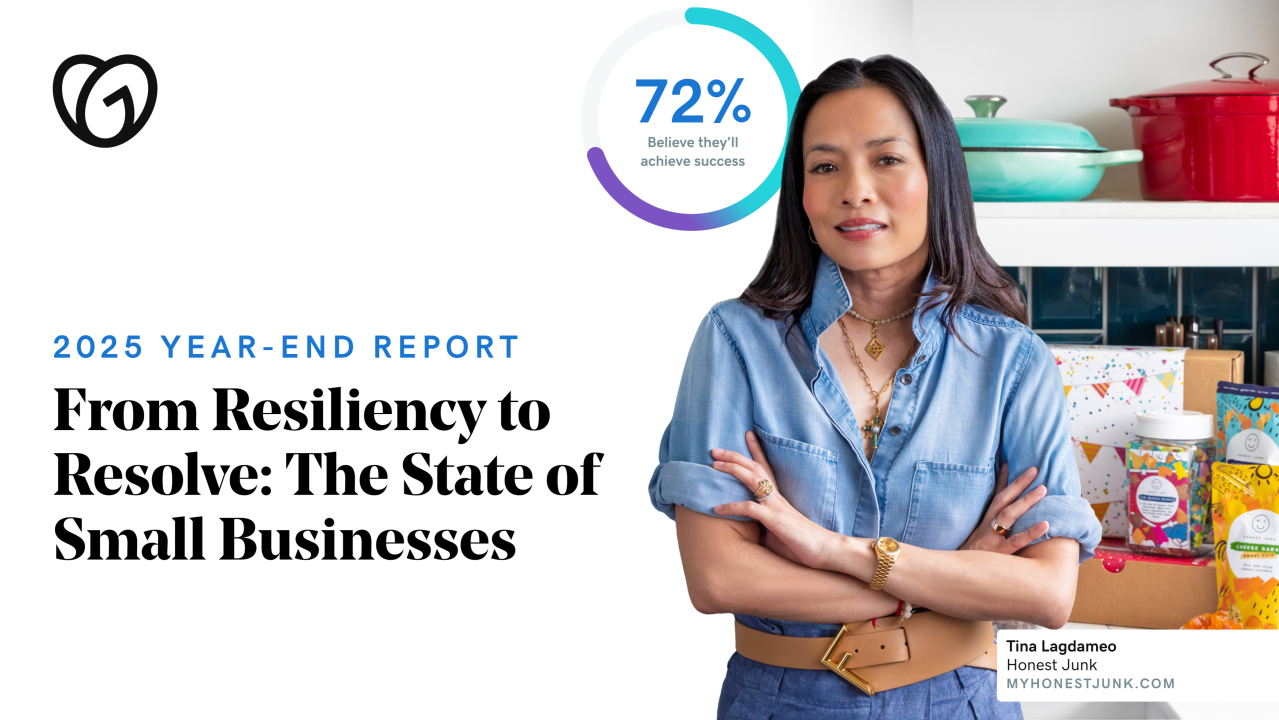
Photo: Tina Lagdameo, Honest Junk, MyHonestJunk.com
View additional multimedia and more ESG storytelling from GoDaddy on 3blmedia.com.
Contact Info:
Spokesperson: GoDaddy
Website: https://www.3blmedia.com/profiles/godaddy
Email: info@3blmedia.com
SOURCE: GoDaddy
View the original press release on ACCESS Newswire

© 2026 Canjex Publishing Ltd. All rights reserved.