(via TheNewswire)
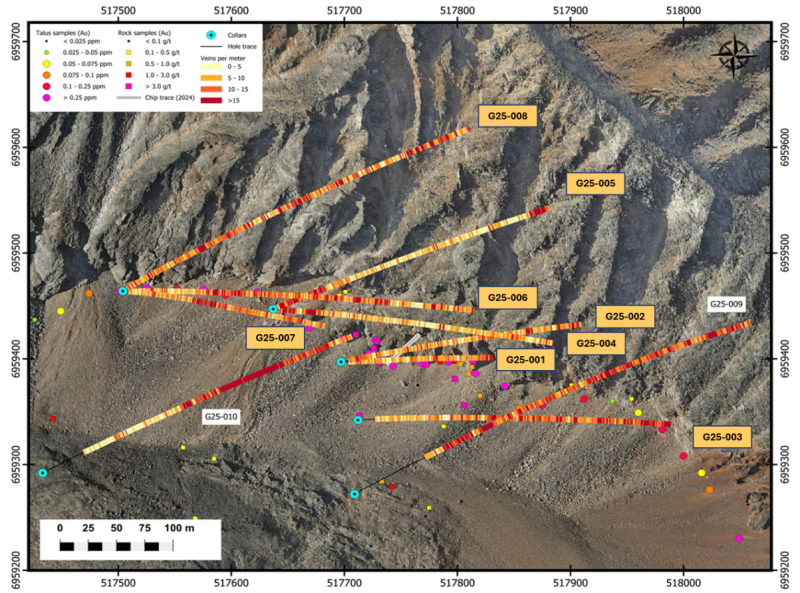
Vancouver, British Columbia – December 10 th , 2025 – TheNewswire - Rackla Metals Inc. (TSX-V: RAK) (the “Company”) reports analytical results from drill holes G25-009 and G25-010 from the 2025 campaign at the Grad property. These holes tested the Intrusive-sediment contact south of the BiTe showing and continued well into the intrusive south of previously announced holes G25-004 to G25-008 (see news release dated November 27, 2025, Figure 1).
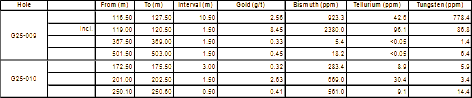
Rackla Metals reports a significant intercept of 10.5 meters grading 2.56 g/t gold in hole G25-009, which included an intercept of 8.45 g/t gold over 1.5 m, the strongest result from the 2025 campaign (Table 1). The gold intercepts show good correlation with bismuth and a moderate correlation with tellurium and tungsten. However, overall, the bismuth concentration in these holes is much less than was visually estimated during core logging.
Table 1 – Summary of drill hole results from holes G25-009 and G25-010 (intercepts are core intervals and may not represent true widths).
The BiTe Zone is located at the base of the steep cliff in Figure 1 in the center of the area drill tested. It has been mapped as an intensely altered quartz-sericite zone in quartz-monzonite with bismuth sulphide and/or tellurides. Surface sampling in 2024 and 2025 returned high-grade gold results in chip-channel and grab samples. Talus-fine sampling along the base of the cliff returned 500m averaging over one gram per tonne of gold with coincident, anomalous bismuth and tellurium. Drilling to date has failed to return any continuity to the gold mineralization at depth nor has it returned any of the high-grade gold results returned from the surface samples.
A characteristic of RIRGS deposits in the Tombstone Gold Belt is that vein density is typically an indication of grade. However, the results observed to date from the drilling at the Grad Property indicate that vein density is not the determining factor as hole G25-010 is intensely veined yet returned only weak, sporadic gold intercepts.
Figure 1 – Plan map of the BiTe Showing drill hole traces with vein density counts (G25-009 and G25-010 highlighted)
Click Image To View Full Size
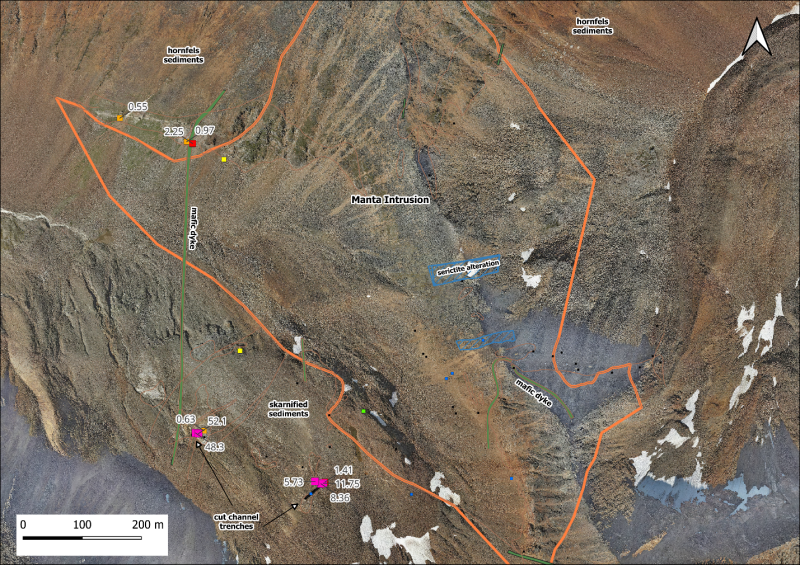
Trenching at the Manta showing yielded low-grade results despite high-grade grab samples. The Manta showing is located in altered sedimentary rocks at the contact with the Manta intrusive body, 1.5km south of the BiTe showing. Initial grab and 1m chip samples from quartz-bismuthinite veins in metasomatically altered skarn zone at two locations returned a 5 multi-gram gold results (5.73, 8.36, 11.75, 48.3 and 52.1 g/t gold, Figure 2). However, channel sampled trenches cut across each of these areas returned disappointing results with the best being 0.63 g/t gold over 1 m in the northern trench and 1.41 g/t gold over 1 m in the southern trench.
Given the number of high-grade gold results obtained from the sampling at Grad and adjacent prospects, further work needs to be done in the region. The Company is working with the data collected in the 2025 campaign to refine its model for the region and is planning a methodical approach for 2026 with the goal to unlocking the key to these gold discoveries in this very prospective region of the Tombstone Gold Belt.
Figure 2 – Surface Grab and Trench Sampling Results for Gold at the Manta Showing
Click Image To View Full Size
Rackla has a Cooperation and Benefits Agreement with the Sahtu Dene First Nation and remains committed to maintaining the respectful, collaborative relationship. As we advance exploration at our properties, we will continue working closely with local stakeholders and regulatory agencies to ensure our activities create long-term value and reflect community priorities.
Sampling Methodology
For the 2025 program drilling was NTW-sized core. Once the core was received at the core logging facility it was systematically logged for geological attributes, photographed and marked for sampling by the geological staff. Sample lengths were generally 1.5 meter or less depending on the need to isolate features of interest. Core sampling was accomplished by cutting in half lengthwise along a pre-determined line, with one half to be sent to the lab and one half stored as a record. Field duplicates were collected at regular intervals as ¼ core samples by splitting the ½ core to be sent to the lab, leaving a consistent record of half core material from duplicate and non-duplicate samples alike. Standard reference materials were inserted by Rackla personnel at regular intervals into the sample stream. The samples were delivered by expeditor to ALS Canada Ltd preparatory facility in Whitehorse, Yukon. Sample preparation was completed at either the Whitehorse facility or re-directed by ALS to their Langley, BC facility, depending on workloads, with final analyses completed at the ALS laboratory in North Vancouver.
ALS Canada Ltd is accredited to ISO/IEC 17025:2017 and ISO9001:2015 for quality management. Core and rock samples were prepared according to the ALS Prep-31A procedure, which involved crushing to >70% passing below 2 mm and split using a riffle splitter. 250 g splits were pulverized to >85% passing below 75 microns. A four-acid digest with an inductively coupled plasma mass spectroscopy (ICP-MS) finish was used for 48-element analysis on 0.25 g sample pulps (ALS code: ME-MS61). All samples were analysed for gold content by fire assay with an atomic absorption spectroscopy (AAS) finish on 50 g samples (ALS code: Au-GRA22). In addition, samples that returned over limits for bismuth, tellurium, arsenic, base metals and silver we assayed by Ore Grade analytical methods.
For the purposes of this release, contiguous mineralized intervals at are defined as runs of mineralization >0.3 g/t Au.
Qualified Person
Scott Casselman, B.Sc., P.Geo., Vice-President Exploration of the Company, is a member of the Association of Professional Engineers and Geoscientists of British Columbia and is the Company’s Qualified Person as defined by National Instrument 43-101. Mr. Casselman has reviewed and approved the technical information contained in this news release.
About Rackla
Rackla Metals Inc. (TSX-V: RAK) is a Vancouver, Canada based junior gold exploration company. The Company is targeting Reduced Intrusion-Related Gold Systems (RIRGS) mineralization on the southeastern part of the Tombstone Gold Belt in eastern Yukon and western Northwest Territories. Management believes that this area, which is underexplored for RIRGS deposit types, has the potential to be the next frontier for the discovery of these large gold systems.
ON BEHALF OF THE BOARD
Simon Ridgway,
CEO and Director
Tel: (604) 801-5432; Fax: (604) 662-8829
Email: info@racklametals.com
Website: www.racklametals.com
Neither the TSX Venture Exchange nor its Regulation Services Provider (as that term is defined in the policies of the TSX Venture Exchange) accept responsibility for the adequacy or accuracy of this news release.
Forward-Looking Information
Certain statements contained in this news release constitute forward-looking statements within the meaning of Canadian securities legislation. All statements included herein, other than statements of historical fact, are forward- looking statements and include, without limitation, the Company’s exploration plans for 2026; and general business and economic conditions. Often, but not always, these forward looking statements can be identified by the use of words such as “estimate”, “estimates”, “estimated”, “potential”, “open”, “future”, “assumed”, “projected”, “used”, “detailed”, “has been”, “gain”, “upgraded”, “offset”, “limited”, “contained”, “reflecting”, “containing”, “remaining”, “to be”, “periodically”, or statements that events, “could” or “should” occur or be achieved and similar expressions, including negative variations.
Forward-looking statements involve known and unknown risks, uncertainties and other factors which may cause the actual results, performance or achievements of the Company to be materially different from any results, performance or achievements expressed or implied by forward-looking statements. Such uncertainties and factors include, among others, whether exploration plans will proceed as anticipated; changes in general economic conditions and financial markets; the Company or any joint venture partner not having the financial ability to meet its exploration and development goals; risks associated with the results of exploration and development activities, estimation of mineral resources and the geology, grade and continuity of mineral deposits; unanticipated costs and expenses; and such other risks detailed from time to time in the Company’s quarterly and annual filings with securities regulators and available under the Company’s profile on SEDAR + at www.sedarplus.ca . Although the Company has attempted to identify important factors that could cause actual actions, events or results to differ materially from those described in forward-looking statements, there may be other factors that cause actions, events or results to differ from those anticipated, estimated or intended.
Forward-looking statements contained herein are based on the assumptions, beliefs, expectations and opinions of management, including but not limited to: that the Company’s stated goals and planned exploration activities at its properties will be achieved; that there will be no material adverse change affecting the Company, its properties or its securities; and such other assumptions as set out herein. Forward-looking statements are made as of the date hereof and the Company disclaims any obligation to update any forward-looking statements, whether as a result of new information, future events or results or otherwise, except as required by law. There can be no assurance that forward-looking statements will prove to be accurate, as actual results and future events could differ materially from those anticipated in such statements. Accordingly, investors should not place undue reliance on forward-looking statements.
Copyright (c) 2025 TheNewswire - All rights reserved.
© 2026 Canjex Publishing Ltd. All rights reserved.