(via TheNewswire)
Vancouver, British Columbia – TheNewswire - August 31, 2026 – Au Gold Corp (TSXV: AUGC) (the “Company ” or “AUGC ”) is pleased to provide details of the recent research and subsequent historical long section reconstruction along the Shaw-McFarlane Trend (“SMT” or “Trend”) at its Havelock Gold-Antimony project in Victoria, Australia.
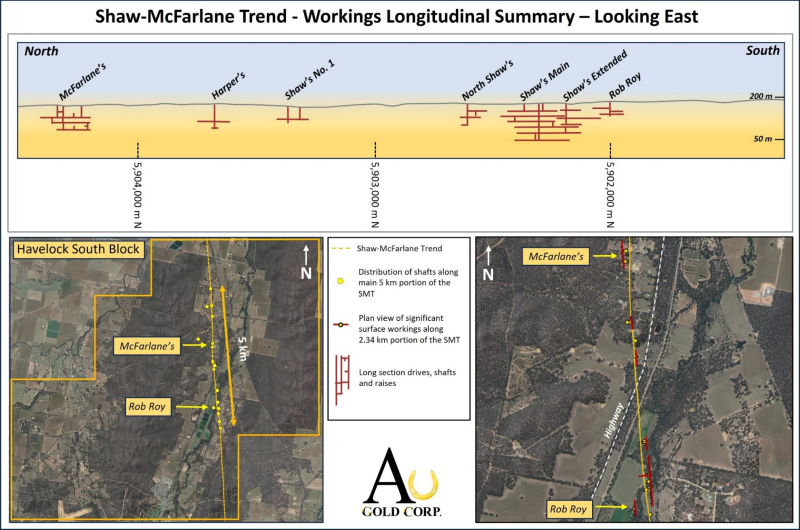
The Company has completed its research and compiled the findings from a series of documented historical shafts (approximately seventeen) and significant workings along the central portion of the Havelock property spanning a strike length of 5 kilometers (“km”) of the 9 km Shaw-McFarlane Trend. The bulk of the historical gold production is reported from a series of mines within a 2.34 km central portion of the Trend. Figure 1 shows the Havelock southern exploration license with plan view maps of the northerly trending SMT and the distribution of the main workings in long section.
Between 1864 and 1891, the total recorded hard rock gold production from the mines along the SMT was approximately 17,097 ounces at an average grade of 28.7 grams per tonne (“g/t”) gold. The majority of this reported production is from the mines between McFarlane’s and Rob Roy illustrated on Figure 1. The most extensive series of workings are situated at Shaw’s Main where approximately 11,400 ounces of gold was extracted with the lowest level of the mine recorded at 500 feet (152 m). All other mines along the trend were worked to levels shallower than 350 feet (107 m).
Marc Blythe, Founder and CEO of Au Gold, comments, “The extensive reconstruction of these historical production records is a critical step in our understanding of the reef systems developed at Havelock. Past shallow high-grade gold production at multiple sites along the trend reinforces our belief in the potential for significant discoveries beneath the historical workings”.
Each of the past-producing mines was owned and operated by separate, publicly traded companies all now inoperative. Production reports were filed by mine managers on a quarterly basis and contained highlights, interesting developments and generalizations often only amounting to several short paragraphs. At several of the mines, documentation of parallel gold bearing reefs is reported, some of which appear to have never received follow up. One example of this is described at McFarlane’s where the mine manager reported an exploration crosscut in favourable geological conditions on the 250 foot (76 m) level. The crosscut encountered “a strong body of laminated quartz 2 feet thick, highly mineralized and throwing out a strong body of water ”. There are no records of additional work on this parallel reef.
During the Havelock mining boom (1864 and 1891), much if not all of the ground was staked for mining licenses along the SMT as was much of the ground peripheral to the trend. This is visually apparent from the vast amount of shallow surface workings across large areas of the Havelock exploration license. Groups and syndicates were established forming companies which in turn sought financing to develop mines through the public markets of the day. Historical records suggest only twelve companies managed to gather sufficient funds to develop mines on their respective licenses. It is considered likely that the gaps between the reconstructed mines on the SMT long section are a function of the license holder’s inability to secure financing for development.
In addition to the reconstructed long section, records collated for each mine contain a wealth of information about the conditions, mineralization and thickness of quartz veins. AUGC is using this information to identify key sections where it believes the highest grade/thicknesses exist and to target exploration programs below these zones. During this era, grades were not assayed from samples at the mine. Gold content was obtained from actual crushing of mined material and gravity separation using stamp battery mills. The historic records provide subjective commentary about the gold content of the quartz veins, based on visual observation by mine workers.
AUGC cautions the reader that the information collated pre-dates the introduction of NI 43-101. Despite recorded historic production, no mineral resources exist on the project and there is no certainty that further exploration will result in the definition of mineral resources.
Next Steps
AUGC is currently collating and assessing all historical mine production and report data to direct the phase 1 diamond drill testing of the highest priority targets. Detailed long section target data and drill rationale will be released shortly.
The Company continues to engage with the community, in particular private landowners within areas of interest on the project.
Click Image To View Full Size
Figure 1 : shows the Havelock southern exploration license with plan view maps of the northerly trending SMT and the distribution of the main workings in long section with the majority of this reported production from the mines between McFarlane’s and Rob Roy.
Qualified Person
Technical information in this press release was prepared under the supervision of Mr. William Wengzynowski, P.Eng., a Qualified Person as defined by NI 43-101. Mr. Wengzynowski is AUGC’s Exploration Manager.
For further information, please contact:
Au Gold Corp
Marc G. Blythe, MBA, P.Eng., Founder, President & Chief Executive Officer
David Jan, Investor Relations
1-888-807-4566
info@augoldcorp.com
www.augoldcorp.com
About Au Gold
Au Gold Corp (TSXV: AUGC) is a gold exploration company focused on advancing its flagship Havelock gold-antimony project in the Victorian Gold Fields in Australia and the Ponderosa gold project in the Spences Bridge Gold Belt in British Columbia, Canada. More information at www.AuGoldCorp.com
Cautionary Note
This release includes certain statements and information that may constitute forward-looking information within the meaning of applicable Canadian securities laws. Forward-looking statements relate to future events or future performance and reflect the expectations or beliefs of management of the Company regarding future events. Generally, forward-looking statements and information can be identified by the use of forward-looking terminology such as “intends ” or “anticipates” , or variations of such words and phrases or statements that certain actions, events or results “may”, “could ”, “should ”, “would ” or “occur ” . This information and these statements, referred to herein as "forward-looking statements", are not historical facts, are made as of the date of this news release and include without limitation, statements regarding discussions of future plans, estimates and forecasts and statements as to management’s expectations and intentions with respect to, among other things, future exploration activities including drilling on the Project.
These forward-looking statements involve numerous risks and uncertainties and actual results might differ materially from results suggested in any forward-looking statements. Such risks and uncertainties include, among other things, the ability of the Company to obtain sufficient financing to fund its business activities and plans, delays in obtaining governmental and regulatory approvals (including of the TSX Venture Exchange), changes in laws, regulations and policies affecting mining operations, currency fluctuations, market uncertainty, as well as those factors discussed in the Company's most recently filed management's discussion and analysis and other filings of the Company with Canadian securities authorities, copies of which can be found under the Company's profile on the SEDAR+ website at www.sedarplus.ca.
In making the forward looking statements in this news release, the Company has applied several material assumptions, including without limitation, that the Company will be able to obtain sufficient financing to carry out its planned exploration activities.
Although management of the Company has attempted to identify important factors that could cause actual results to differ materially from those contained in forward-looking statements or forward-looking information, there may be other factors that cause results not to be as anticipated, estimated or intended. There can be no assurance that such statements will prove to be accurate, as actual results and future events could differ materially from those anticipated in such statements. Accordingly, readers should not place undue reliance on forward-looking statements and forward-looking information. Readers are cautioned that reliance on such information may not be appropriate for other purposes. The Company does not undertake to update any forward-looking statement, forward-looking information or financial outlook that are incorporated by reference herein, except in accordance with applicable securities laws. We seek safe harbour.
Copyright (c) 2026 TheNewswire - All rights reserved.
© 2026 Canjex Publishing Ltd. All rights reserved.