Dieppe, New Brunswick--(Newsfile Corp. - November 23, 2026) - Canadian Gold Resources Ltd. (TSXV: CAN) ("Canadian Gold" or the "Company") is pleased to announce assay results from its 2025/2026 diamond drilling program at the Lac Arsenault Gold Project, located on the Gaspé Peninsula in Québec. The drilling program intersected several high-grade gold-bearing intervals, including 6.01 grams per tonne ("g/t") gold ("Au") over 1.35 metres, including 11.75 g/t Au over 0.60 metre. A previously reported intercept of 19.50 g/t Au over 1.00 metre (March 3, 2026) is also included for context.
Highlights of the 2025/2026 Drilling Program
Selected gold assay results from the 2025/2026 drilling program include the following (the previously reported intercept is marked with an asterisk):
- 19.50 g/t Au over 1.00 metre in drill hole LAC-25-BM-001, from 30.35 to 31.35 metres (Previously reported on March 3, 2026).
- 7.01 g/t Au over 1.20 metres in drill hole LAC-25-BM-002, from 42.25 to 43.45 metres.
- 15.00 g/t Au over 0.40 metre in drill hole LAC-25-BM-010, within a broader interval of 1.97 g/t Au over 5.30 metres.
- 6.01 g/t Au over 1.35 metres, including 11.75 g/t Au over 0.60 metre, in drill hole LAC-25-BM-046.
- 13.25 g/t Au over 0.40 metre in drill hole LAC-25-BM-077.
- 6.11 g/t Au over 0.85 metre, within a broader interval of 3.16 g/t Au over 2.40 metres, in drill hole LAC-25-BM-035.
Intervals and distances are reported downhole; true widths have not been established. See Table 1 for selected intercepts.
Management Commentary
Ron Goguen, Interim Chairman and Interim President and CEO of Canadian Gold, commented:
"We are pleased with the results of our first diamond drilling program at the Baker and Mersereau targets at Lac Arsenault. The results provide a clear direction for the next phase of exploration, with the ultimate objective of defining a significant gold deposit.
"Our Gaspé Project encompasses a substantial land position with several promising gold exploration opportunities. In addition to Lac Arsenault, the Robidoux property represents an advanced exploration target supported by historical high-grade gold drill intercepts and the recovery of a high-grade gold bulk sample. Through regional geological and geophysical compilations and additional claim acquisitions, we have also identified and secured additional exploration targets associated with the Grand Pabos-Garin River fault structural corridor."
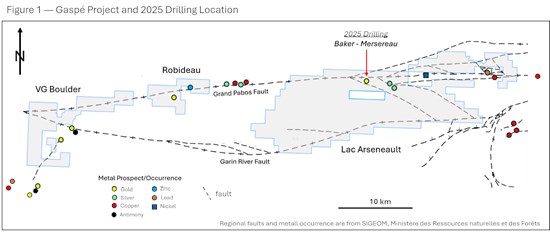
Figure 1. Regional map of the Gaspé Project showing the Lac Arsenault, oux and VG Boulder properties, the Grand Pabos and Garin River faults, and the Baker-Mersereau drilling area.
To view an enhanced version of this graphic, please visit:
https://images.newsfilecorp.com/files/11663/325084_0f13ec0034841909_001full.jpg
Lac Arsenault and the 2025/2026 Diamond Drilling Program
Canadian Gold's Gaspé Project is located on the southern part of the Gaspé Peninsula, Québec, within a region characterized by a major structural corridor that includes the Grand Pabos Fault, part of a regionally significant Appalachian fault system. The Gaspé Project comprises three exploration properties: the Lac Arsenault property, the Robidoux property and the VG Boulder property. Collectively, these properties comprise 514 mineral claims covering approximately 29,225 hectares (72,185 acres).
The 2025/2026 diamond drilling program focused on the Baker and Mersereau targets, two historically identified high-grade gold-bearing quartz vein systems located on the Lac Arsenault property.
Historical and recent surface channel sampling of exposed segments of the Baker and Mersereau quartz veins has returned reported length-weighted average gold grades of 19.98 g/t Au and 9.12 g/t Au, respectively. The Baker average is calculated from five channel samples with a combined sampled length of 3.58 m; the Mersereau average is based on five channel samples.
The Baker and Mersereau veins are quartz-dominant structures containing ubiquitous but highly variable concentrations of sulphide minerals, including pyrite, galena, sphalerite, arsenopyrite and lesser chalcopyrite.
The 2025/2026 diamond drilling program comprised 81 drill holes that have been logged and sampled. An additional 10 drill holes has been drilled and remain to be logged. A total of 2,712 samples have been assayed.
Table 1 - Selected Gold Drill Intercepts
| Drill Hole | From (m) | To (m) | Length (m) | Au (g/t) |
| LAC-25-BM-001 | 30.35 | 31.35 | 1.00 | 19.50 |
| LAC-25-BM-002 | 42.25 | 43.45 | 1.20 | 7.01 |
| LAC-25-BM-003 | 47.75 | 50.60 | 2.85 | 2.11 |
| Including | 49.15 | 50.60 | 1.45 | 4.00 |
| LAC-25-BM-008 | 50.15 | 50.40 | 0.25 | 8.63 |
| LAC-25-BM-009 | 53.20 | 54.45 | 1.25 | 1.56 |
| Including | 53.20 | 53.50 | 0.30 | 5.32 |
| LAC-25-BM-010 | 46.00 | 51.30 | 5.30 | 1.97 |
| Including | 47.25 | 47.75 | 0.50 | 5.31 |
| Including | 50.90 | 51.30 | 0.40 | 15.00 |
| LAC-25-BM-035 | 62.30 | 64.70 | 2.40 | 3.16 |
| Including | 63.85 | 64.70 | 0.85 | 6.11 |
| LAC-25-BM-046 | 38.25 | 39.60 | 1.35 | 6.01 |
| Including | 38.25 | 38.85 | 0.60 | 11.75 |
| LAC-25-BM-053 | 60.20 | 62.50 | 2.30 | 0.94 |
| Including | 60.20 | 60.50 | 0.30 | 5.32 |
| LAC-25-BM-065 | 18.25 | 18.55 | 0.30 | 6.70 |
| LAC-25-BM-077 | 58.55 | 58.95 | 0.40 | 13.25 |
| LAC-25-BM-078 | 64.40 | 64.75 | 0.35 | 5.28 |
| LAC-25-BM-082 | 41.25 | 41.90 | 0.65 | 5.12 |
| LAC-25-BM-083 | 111.90 | 112.30 | 0.40 | 6.37 |
| LAC-25-BM-084 | 19.25 | 19.65 | 0.40 | 6.05 |
| LAC-25-BM-088 | 77.05 | 78.45 | 1.40 | 0.97 |
| Including | 78.20 | 78.45 | 0.25 | 4.68 |
| LAC-25-BM-088 | 80.20 | 80.80 | 0.60 | 5.07 |
| LAC-25-BM-089 | 83.55 | 83.90 | 0.35 | 5.86 |
Intervals are reported as downhole lengths; true widths have not been established. The selected intercept for LAC-25-BM-001 (19.50 g/t Au over 1.00 metre) was previously reported on March 3, 2026
Exploration Model
The exploration concept for the 2025/2026 drill program was based on a significant induced polarization (IP) chargeability anomaly identified by a geophysical survey completed in 2020, encompassing the Baker and Mersereau vein systems. Given the sulphide-rich character of the gold-bearing quartz veins, the Company interpreted the anomaly as potentially reflecting a broader zone of disseminated and stockwork-style quartz-sulphide mineralization associated with the higher-grade quartz-sulphide veins.
The principal objective of the drilling program was to determine whether the higher-grade vein systems, together with potentially associated lower-grade stockwork mineralization, could define a mineralized zone of sufficient width, grade and continuity to support the delineation of a gold resource potentially amenable to open-pit mining.
Drilling Results and Geological Interpretation
The results of the 2025/2026 drilling program demonstrate a strong spatial association between gold mineralization and the geophysical chargeability anomaly encompassing the Mersereau and Baker vein systems. As illustrated in Figure 2, all reported gold assay intervals exceeding 0.3 g/t Au occur within the limits of the interpreted chargeability anomaly. The 0.3 g/t Au threshold was selected as an appropriate screening grade for evaluating the potential for bulk-tonnage mineralization amenable to open-pit mining.
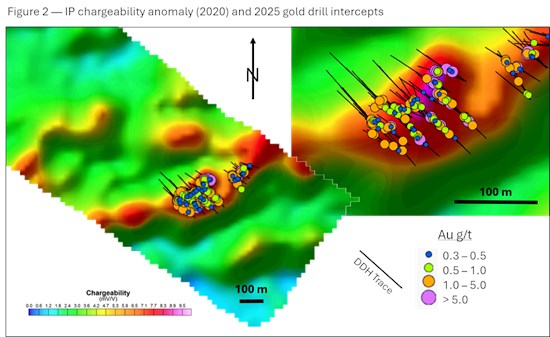
Figure 2. Gold assay intervals exceeding 0.3 g/t Au plotted against the IP chargeability anomaly at the Baker-Mersereau targets, with a detailed view of the drilling area.
To view an enhanced version of this graphic, please visit:
https://images.newsfilecorp.com/files/11663/325084_0f13ec0034841909_002full.jpg
The distribution of gold mineralization is illustrated in two geological sections (Figures 3 and 4), which display drill hole assay intervals exceeding 0.3 g/t Au. Figure 3 presents an approximately vertical oblique section looking northeast, while Figure 4 presents an oblique section looking southeast and down along the interpreted trend of mineralization. The sections illustrate the apparent development of two distinct gold-mineralized domains, designated the Upper and Lower Domains, within the broader IP chargeability anomaly.
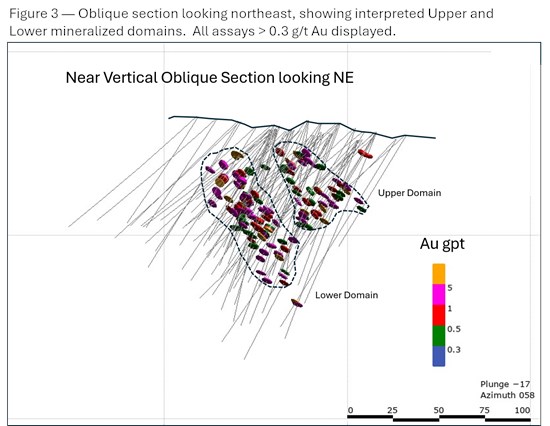
Figure 3. Near-vertical oblique geological section looking northeast, showing assay intervals exceeding 0.3 g/t Au and the interpreted Upper and Lower Domains.
To view an enhanced version of this graphic, please visit:
https://images.newsfilecorp.com/files/11663/325084_0f13ec0034841909_003full.jpg
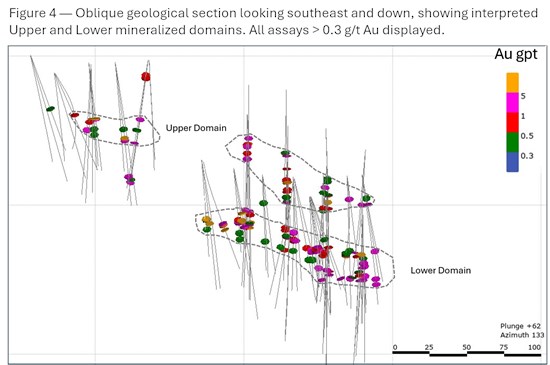
Figure 4. Oblique geological section looking southeast and down along the interpreted trend of mineralization, showing assay intervals exceeding 0.3 g/t Au in relation to the Upper and Lower Domains.
To view an enhanced version of this graphic, please visit:
https://images.newsfilecorp.com/files/11663/325084_0f13ec0034841909_004full.jpg
Next Steps
The 2025 /2026 diamond drilling program was conducted primarily with holes inclined toward the northwest. Subsequent geological mapping and exposures in recent excavations have identified quartz veins with moderate to steep westerly to southwesterly dips. Given the similarity in orientation between the drilling and these vein structures, the 2025/2026 drilling program may not have optimally tested their distribution, density and continuity. Drilling from alternative orientations, particularly toward the east, presents an opportunity to more effectively evaluate the density and continuity of gold-bearing quartz veins within the interpreted mineralized domains.
The Company sees an opportunity to make greater use of the available induced polarization (IP) data for exploration targeting. Geological interpretations to date have relied primarily on the 2020 IP survey; an additional survey completed in 2025/2026 has yet to be fully integrated. Combined three-dimensional modelling of the two surveys could help identify zones of elevated chargeability potentially associated with increased concentrations of quartz-sulphide veins. This could provide focus in the continued evaluation of the Baker-Mersereau target as well as a basis for evaluating the survey area for a broader gold-mineralized system.
The next phase of exploration will focus on further evaluation of the 2025/2026 drilling results, integration and three-dimensional interpretation of the available IP datasets, and selected additional drilling. Future drilling will test variable drill hole orientations to better evaluate the density and continuity of gold-bearing quartz veins and will target zones of elevated chargeability identified through the enhanced geophysical interpretation. The objective is to establish whether sufficient mineralized vein density, grade and continuity exist to support the delineation of a potentially open-pit-able gold resource.
Drilling and Sampling Procedures and QA/QC
The 2025/2026 diamond drilling program at the Lac Arsenault Gold Project was conducted in accordance with generally accepted mineral exploration industry practices, with reference to the Canadian Institute of Mining, Metallurgy and Petroleum (CIM) Mineral Exploration Best Practice Guidelines.
Downhole orientation surveys were conducted at selected intervals of approximately 50 metres using a Reflex single-shot downhole survey instrument. Upon completion of the drilling program, the collar locations of all drill holes were surveyed using differential GPS equipment by a registered professional land surveyor based in the project area.
Diamond drill core was transported from the property to the Company's core logging and sampling facility in Caplan, Québec. At the facility, the drill core was geologically logged, photographed and sampled. Core samples were cut using a conventional diamond-blade core saw, with the resulting samples prepared for shipment to commercial analytical laboratories. All core is stored in the Company's secure logging and processing facility in Caplan.
Samples from the initial portion of the drilling program were dispatched to Activation Laboratories Ltd. (Actlabs) in Ancaster, Ontario. Samples from the subsequent portion of the program were submitted to ALS Global through its Moncton, New Brunswick, facility for laboratory preparation and analysis.
Drill core samples from the initial portion of the program were submitted to Activation Laboratories Ltd. (Actlabs) in Ancaster, Ontario, for preparation and analysis. Samples were prepared by crushing, riffle splitting and pulverization. Gold was determined using a 30-gram fire assay with an atomic absorption finish (Method 1A2B-30), with higher-grade samples subject to fire assay with a gravimetric finish (Method 1A3). Additional analyses for silver, lead and zinc were conducted using inductively coupled plasma optical emission spectrometry (ICP-OES).
Samples from the latter portion of the program were submitted to ALS Global through its Moncton, New Brunswick, facility. Samples were prepared by crushing, riffle splitting and pulverization. Gold analyses were conducted using a 30-gram fire assay with an atomic absorption finish (Method Au-AA23), with a gravimetric finish (Method Au-GRA21) employed for higher-grade samples. Multi-element analyses were conducted using aqua regia digestion followed by ICP-AES (Method ME-ICP41), with additional ore-grade analyses performed where applicable.
The Company's quality assurance and quality control (QA/QC) program incorporated the systematic insertion of certified reference materials, analytical blanks and duplicate samples into the drill core sample stream. A total of 271 control samples were included with the core samples submitted to the laboratories, representing a frequency of approximately one control sample in every 10 samples.
Technical References
Dube, J. (2020). Technical report. Resistivity and Induced Polarization Survey. Lac Arsenault Project, Bonaventure Area. Prepared for: 1844 Resources Inc. Suite 602 - 224 4th Avenue S. Saskatoon, SK, Canada S7K 5M5
Duplessis, C. LAC ARSENAULT PROJECT NI 43-101 TECHNICAL REPORT, QUÉBEC, CANADA. Prepared for Amseco Exploration Ltd and Canadian Gold Resources Ltd., Moncton, NB, E1H 2P7
Qualified Person
The scientific and technical information contained in this news release has been reviewed and approved by Claude Duplessis, P.Geo., a Qualified Person as defined by National Instrument 43-101.
About Canadian Gold Resources Ltd.
The Company is a junior exploration issuer advancing three high-grade gold properties totaling approximately 29,225 hectares in Québec's Gaspé Peninsula. The Company's strategy is to unlock the potential of historically explored assets through modern exploration and development, supported by a management team with a proven track record in discovery and project advancement.
Neither TSX Venture Exchange nor its Regulation Services Provider (as that term is defined in policies of the TSX Venture Exchange) accepts responsibility for the adequacy or accuracy of this release.
Canadian Gold trades on the TSX Venture Exchange under the ticker "CAN" and has 58,937,025 common shares currently outstanding.
Forward-Looking Statements Disclaimer
This news release contains "forward-looking statements," including but not limited to statements regarding the Company's strategic objectives and anticipated growth. Forward-looking statements are based on current expectations and assumptions that are subject to risks and uncertainties that may cause actual results to differ materially. Readers are cautioned not to place undue reliance on these statements. The Company disclaims any obligation to update or revise any forward-looking information, except as required by applicable securities laws..

To view the source version of this press release, please visit https://www.newsfilecorp.com/release/325084

© 2026 Canjex Publishing Ltd. All rights reserved.