Two New Zones of Elevated Radioactivity Discovered in Basement Rocks
120 Metres Down Dip of Pike Zone High-Grade Uranium
Grid 1 Area Along the Epp Lake Corridor
Both Zones are Open in All Directions
Elevated Radioactivity at Pike Zone Continues Along the Unconformity for Approximately 1.2 Kilometres Southwest; Remains Open
Parallel Faulted Graphitic Conductor with Extensive Hydrothermal Alteration Adds Discovery Space for Pike Zone Drill Targeting
Saskatoon, Saskatchewan--(Newsfile Corp. - November 24, 2026) - CanAlaska Uranium Ltd. (TSXV: CVV) (OTCQX: CVVUF) (FSE: DH7) ("CanAlaska" or the "Company") is pleased to report that it has completed the summer drill program on the West McArthur Joint Venture Project (the "Project") in the eastern Athabasca Basin (Figure 1). The summer program was multi-purposed to; 1) continue step out drilling along the unconformity to the southwest and northeast of the high-grade uranium Pike Zone, 2) test for uranium mineralization potential along a sub-parallel hanging wall conductor to the Pike Zone conductor (Figure 2), and 3) confirm the newly modeled conductors in the southwest of the Grid 1 area (Figure 5). The Company successfully completed 12,652 metres in 16 drill holes, including 4 abandoned drill holes, within 2 main targets areas; Pike Zone and Grid 1.
CanAlaska CEO, Cory Belyk, comments, "The summer drill program has continued to expand CanAlaska's knowledge of the Pike Zone mineralizing system. The mineralizing system is now over 1,000 metres in length along the unconformity target and remains open in both directions. Importantly and significantly, a deep test 120 metres below Pike Zone high-grade mineralization yielded an intercept of strong radioactivity within an area that has no drilling for at least 100 metres in any direction. A faulted hanging wall conductor is just starting to be evaluated, and early results are very encouraging. I look forward to the next phase of fully-funded exploration in 2027."
James Sykes, CanAlaska's Vice President, Exploration, adds, "The results from the summer drill program, especially drill hole WMA115, support the idea that the unconformity-hosted, high-grade uranium of the Pike Zone is part of a larger structural system that penetrates at least 120 m beneath the unconformity and remains open in all directions. The basement rocks are an important consideration at Pike because there's potential for more space available for high-grade uranium expansion. Also, the evidence of a structurally-controlled hydrothermal fluid system along a sub-parallel conductor to the main C10S conductor suggests the basement rocks to the northeast and southwest of the Pike Zone could also be fertile for high-grade uranium mineralization. I am excited to be part of the planning stages for CanAlaska's fully-funded, follow-up winter drill program on the West McArthur JV Project."
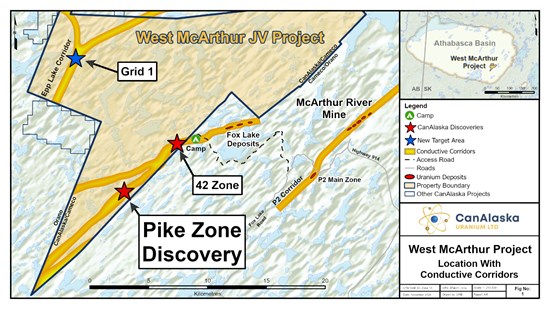
Figure 1 – Project Location Map
To view an enhanced version of this graphic, please visit:
https://images.newsfilecorp.com/files/2864/325412_c7e9bd8c6413dbd9_002full.jpg
2026 West McArthur Summer Drill Program Summary
The 2026 summer drill program on the West McArthur project is now complete. In total, 12,652 metres in 16 drill holes were completed, including 4 abandoned drill holes. The program consisted of five exploration target strategies that included;
- 1) Two (2) completed drill holes for 1,149 metres to systematically test the unconformity along the northeast extension of the C10S conductor from the Pike Zone (Figure 2, blue),
- 2) One (1) completed and one (1) abandoned drill holes for 1,561 metres to test the down dip extension of the Pike Zone to the southeast (Figure 2, red),
- 3) Six (6) completed and two (2) abandoned drill holes for 4,619 metres to test the mineralization potential of a hanging wall, sub-parallel conductor to the southeast of the C10S conductor hosting the Pike Zone (Figure 2, orange),
- 4) Five (5) completed and one (1) abandoned drill holes for 3,420 metres to systematically test the unconformity along the southwest extension of the C10S conductor from the Pike Zone (Figure 2, green), and
- 5) Two (2) completed drill holes for 1,903 metres to test newly interpreted conductors in the south of the Grid 1 area (Figure 5, black).
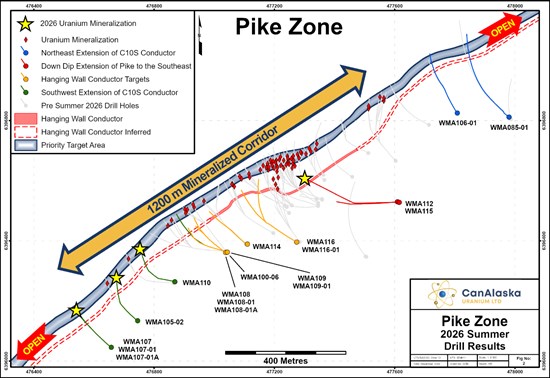
Figure 2 – Summer 2026 Pike Zone Drill Collar Locations and Drill Hole Traces
To view an enhanced version of this graphic, please visit:
https://images.newsfilecorp.com/files/2864/325412_c7e9bd8c6413dbd9_003full.jpg
Drill Program Details - Down Dip Extension of Pike to the Southeast
Drill hole WMA112 was abandoned in the sandstone before reaching the unconformity and was re-started as WMA115. WMA115 successfully intersected elevated radioactivity (9,494 cps over 1.0 m) approximately 120 metres down dip of unconformity-hosted, high-grade uranium of the Pike Zone, and at least 100 m from some of the nearest drill hole pierce points, representing a new basement target area for future uranium mineralization expansion (long section Figure 3, Table 1). The structurally-controlled uranium veins and hydrothermal alteration system intersected in WMA115 are similar to the high-grade uranium basement-hosted veins at the Pike Zone that have all been 10 to 50 metres from larger uranium intersections. For example, WMA074-01 intersected 1 m at 0.29% U3O8, and an offcut from the same pilot hole, WMA074-04, intersected 9.59% U3O8 over 17.4 m only 30 m away from the lower grade intercept (see news releases dated August 15, 2023, and July 17, 2025, respectively). An ongoing structural reinterpretation of Pike Zone will hopefully identify basement targets for high-grade uranium potential as this area has become an immediate priority for follow-up drill programs.
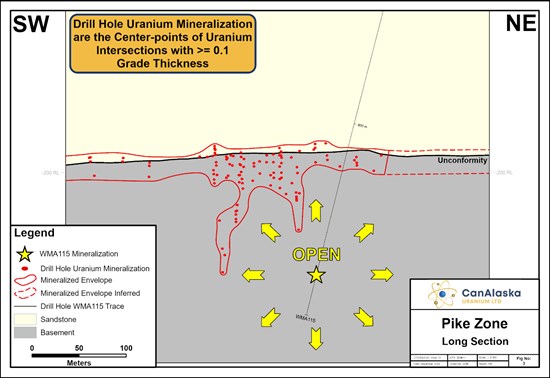
Figure 3 – Long Section with High-Grade Uranium Mineralization Centre-Points and Outline Within the Graphitic Rocks of the C10S Conductor
To view an enhanced version of this graphic, please visit:
https://images.newsfilecorp.com/files/2864/325412_c7e9bd8c6413dbd9_005full.jpg
Drill Program Details - Southwest Extension of C10S Conductor
Drill holes WMA105-02, WMA107, WMA107-01, WMA107-01A, WMA109-01 and WMA110 were all collared to test for uranium mineralization at the unconformity along the southwest extension of the C10S conductor. Both WMA105-02 and WMA110 intersected intervals of elevated radioactivity in the sandstone at least 1 to 5 m above the unconformity, suggesting these drill holes may have overshot their intended target. WMA107-01 intersected elevated radioactivity in the basement rocks approximately 7 m beneath the unconformity, also suggesting this drill hole has undershot it's intended target at the unconformity (Table 1). In addition, WMA107-01 demonstrated similar structure, alteration and clay speciation observed in the sandstone to that over the main Pike Zone, suggesting this drill hole could be close to a new mineralized zone. The southwest extension of the C10S conductor beyond WMA107-01 remains a priority target area for unconformity and basement-hosted uranium mineralization potential.
Drill Program Details - Hanging Wall Conductor Targets
Drill holes WMA100-06, WMA108, WMA108-01, WMA109, WMA114, WMA116 and WMA116-01 were all collared to test a sub-parallel, hanging wall conductor southeast of the C10S conductor that hosts the Pike Zone. All drill holes intersected brittle-reactivated structures and significant hydrothermal alteration, including clay alteration, silicification, and dravite in the lower sandstone and highly altered basement rocks. Although elevated radioactivity was not intersected in any of these drill holes, the degree of alteration and structures intersected along this trend suggest a significant volume of hydrothermal fluids have moved along this corridor. Additional work is required to better understand the importance of this sub-parallel trend; to understand if the alteration is directly related to the Pike Zone or possibly, another nearby undiscovered uranium occurrence.
Drill Program Details - Northeast Extension of C10S Conductor
Drill holes WMA085-01 and WMA106-01 were designed to further test the unconformity along the northeast extension of the C10S conductor from the Pike Zone. Although both drill holes successfully intersected their targets, neither drill hole intersected elevated radioactivity. The Company believes both drill holes overshot parallel targets as the structures and alteration encountered in the sandstone suggest that a favourable structural system for uranium deposition may exist to the southeast of these drill holes (Figure 4). This interpretation suggests the sub-parallel, hanging wall conductor noted in the section above continues this far to the northeast of the Pike Zone, adding ~1.0 km of untested structures and hydrothermal alteration prospective for new possible uranium occurrences.
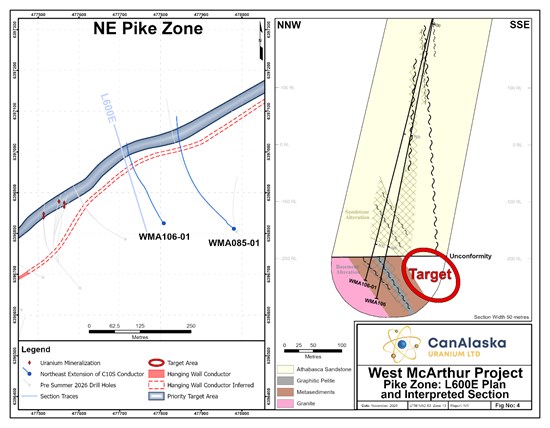
Figure 4 – Cross Section of Drill Holes WMA106 and WMA106-01 with Follow-Up Drill Target
To view an enhanced version of this graphic, please visit:
https://images.newsfilecorp.com/files/2864/325412_c7e9bd8c6413dbd9_008full.jpg
Drill Program Details - Grid 1 Area
The Company completed two exploration drill holes, WMA111 and WMA113, in the Grid 1 area of the West McArthur Project to test newly defined conductors (Figure 5, see news release dated May 26, 2026). Both drill holes were collared at least 1.0 km south of historic drill holes in the area. WMA111 successfully intersected elevated radioactivity in the basement rocks approximately 25 m beneath the unconformity (Table 1). WMA111 is on trend with four historic drill holes that have anomalous uranium geochemistry mostly within 5 to 20 m of the unconformity, including WMA010 that intersected basement-hosted uranium mineralization (0.28% U3O8 over 0.5 m) associated with strong white clay hydrothermal alteration also enriched with anomalous boron, arsenic, molybdenum, nickel and zinc, and WMA024 which intersected 0.02% U3O8 over 0.5 m in the sandstone approximately 200 m above the unconformity. These results suggest the Conductor B trend of the Grid 1 area is fertile for unconformity-hosted and basement-hosted uranium mineralization. Grid 1 will continue to be an area of interest for future drill programs.
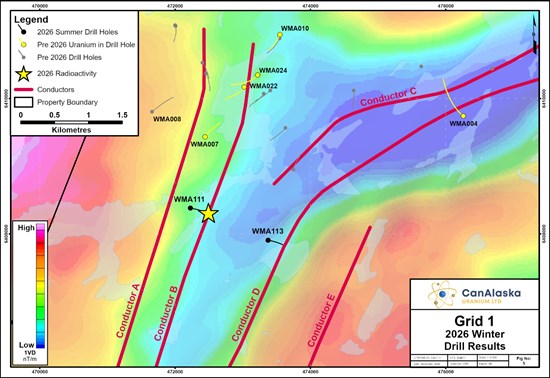
Figure 5 – Plan View of the Grid 1 Area Drill Holes; WMA111 and WMA113
To view an enhanced version of this graphic, please visit:
https://images.newsfilecorp.com/files/2864/325412_c7e9bd8c6413dbd9_009full.jpg
Geochemical samples from the 2026 summer exploration program have been submitted to the lab and assay results are pending.
The West McArthur project, a Joint Venture with Cameco Corporation, is operated by CanAlaska, which holds an 88.89% ownership in the Project. The 2026 exploration program is being co-funded by Cameco and CanAlaska under the Joint Venture.
Table 1 - Radioactivity Results Summer 2026 Drill Program
| DDH | From
(m)7 | To
(m)7 | Length
(m)7 | SST/BSMT | Composite Radioactivity
(cps)6 |
| WMA105-021,6 | 827.6 | 827.8 | 0.2 | SST | 1,175 |
|
|
|
|
|
|
| WMA107-012,6 | 842.6 | 842.9 | 0.3 | BSMT | 8,067 |
|
|
|
|
|
|
| WMA1103,6 | 821.2 | 822.6 | 1.4 | SST | 354 |
| 823.4 | 823.5 | 0.1 | SST | 340 |
| 823.7 | 823.9 | 0.2 | SST | 335 |
| 826.8 | 826.9 | 0.1 | SST | 330 |
|
|
|
|
|
|
| WMA1114,6 | 895.2 | 895.4 | 0.2 | BSMT | 385 |
|
|
|
|
|
|
| WMA1155,6 | 928.3 | 928.4 | 0.1 | BSMT | 630 |
| 961.3 | 961.5 | 0.2 | BSMT | 613 |
| 967.4 | 968.4 | 1.0 | BSMT | 9,494 |
| 982.4 | 982.5 | 0.1 | BSMT | 1,550 |
| 984.6 | 984.8 | 0.2 | BSMT | 1,500 |
- WMA105-02 was drilled at an azimuth of 300 with an inclination of -79.0˚, collared at 476,745 m E / 6,396,134 m N, 614 m A.S.L. (UTM NAD83 Z13N) as a daughter hole from WMA105. WMA105-02 intersected the unconformity at 829.9 metres.
- WMA107-01 was drilled at an azimuth of 300˚ with an inclination of -80.0˚, collared at 476,658 m E / 6,396,045 m N, 612 m A.S.L. (UTM NAD83 Z13N) as a daughter hole from WMA107. WMA107-01 intersected the unconformity at 835.6 metres.
- WMA110 was drilled at an azimuth of 290˚ with an inclination of -78.0˚, collared at 476,869 m E / 6,396,263 m N, 614 m A.S.L. (UTM NAD83 Z13N) as a pilot hole. WMA110 intersected the unconformity at 827.2 metres.
- WMA111 was drilled at an azimuth of 100˚ with an inclination of -75.0˚, collared at 472,226 m E / 6,408,381 m N, 545 m A.S.L. (UTM NAD83 Z13N) as a pilot hole. WMA111 intersected the unconformity at 870.0 metres.
- WMA115 was drilled at an azimuth of 275˚ with an inclination of -70.0˚, collared at 477,615 m E / 6,396,528 m N, 601 m A.S.L. (UTM NAD83 Z13N) as a daughter hole from WMA112. WMA115 intersected the unconformity at 824.7 metres.
- Minimum thickness of 0.1 m above a cut-off of 300 cps with a maximum of 2.0 m of consecutive internal dilution.
- All reported depths and intervals in this table are drill hole depths and intervals, and do not represent true thicknesses or vertical depths, which have yet to be determined.
|
Technical Disclosure - Scintillometer Readings, Geochemical Assay Sampling Procedures, and Reported Depths
The Company defines "radioactivity" as a measurement of total gamma radiation from drill core measured in counts per second (cps) and detected with a CT007-M gamma-ray spectrometer/scintillometer. The Company cautions that drill core radioactivity is an indication of the presence of radioactive materials (uranium, thorium, and/or potassium) but may not directly correlate with uranium chemical assays. Total gamma cps readings are preliminary and may not be used directly to quantify or qualify uranium concentrations of the rock samples measured. The Company considers all CT007-M readings greater than 300 cps to be "elevated radioactivity".
All assay drill core samples from the program, completed as NQ-sized core, were shipped to the Saskatchewan Research Council Geoanalytical Laboratories (SRC) in Saskatoon, Saskatchewan in secure containment for preparation, processing, and multi-element analysis by ICP-MS and ICP-OES using total (HF:NHO3:HClO4) and partial digestion (HNO3:HCl), boron by fusion, and U3O8 wt% assay by ICP-OES using higher grade standards. Assay samples are chosen based on downhole probing radiometric equivalent uranium grades and scintillometer (CT007-M) peaks. Assay sample intervals comprise 0.3 - 0.8 metre continuous half-core split samples over the mineralized intervals. With all assay samples, one half of the split sample is retained and the other sent to the SRC for analysis. The SRC is an ISO/IEC 17025/2005 and Standards Council of Canada certified analytical laboratory. Blanks, standard reference materials, and repeats are inserted into the sample stream at regular intervals by CanAlaska and the SRC in accordance with CanAlaska's quality assurance/quality control (QA/QC) procedures. Geochemical assay data are subject to verification procedures by qualified persons employed by CanAlaska prior to disclosure.
All depths and distances reported in the text are true depths and distances.
About CanAlaska Uranium
CanAlaska is a leading explorer of uranium in the Athabasca Basin of Saskatchewan, Canada. With a project generator model, the Company has built a large portfolio of uranium projects in the Athabasca Basin. CanAlaska owns numerous uranium properties, totaling approximately 400,000 hectares, with clearly defined targets in the Athabasca Basin covering both unconformity and basement uranium deposit potential. The Company has recently concentrated on the West McArthur high-grade uranium expansion with targets in 2024, 2025 and 2026 leading to significant success at Pike Zone. Fully financed for 2027, CanAlaska is focused on uranium deposit discovery and delineation in a safe and secure jurisdiction. The Company has the right team in place with a track record of discovery and projects that are located next to critical mine and mill infrastructure.
The Company's head office is in Saskatoon, Saskatchewan, Canada with a satellite office in Vancouver, BC, Canada.
The Qualified Person under National Instrument 43-101 Standards of Disclosure for Mineral Projects for this news release is Andrew Smith, P.Geo., Senior Project Geologist for CanAlaska Uranium Ltd., who has reviewed and approved its contents.
On behalf of the Board of Directors
"Cory Belyk"
Cory Belyk, P.Geo., FGC
CEO, President and Director
CanAlaska Uranium Ltd.
Neither TSX Venture Exchange nor its Regulation Services Provider (as that term is defined in the policies of the TSX Venture Exchange) accepts responsibility for the adequacy or accuracy of this release.
Forward-looking information
All statements included in this press release that address activities, events or developments that the Company expects, believes or anticipates will or may occur in the future are forward-looking statements. Forward-looking statements are frequently identified by such words as "may", "will", "plan", "expect", "anticipate", "estimate", "intend" and similar words referring to future events and results. Forward-looking statements are based on the current opinions and expectations of management. These forward-looking statements involve numerous assumptions made by the Company based on its experience, perception of historical trends, current conditions, expected future developments and other factors it believes are appropriate in the circumstances. In addition, these statements involve substantial known and unknown risks and uncertainties that contribute to the possibility that the predictions, forecasts, projections and other forward-looking statements will prove inaccurate, certain of which are beyond the Company's control. Actual events or results may differ materially from those projected in the forward-looking statements and the Company cautions against placing undue reliance thereon.
The Company believes that the expectations reflected in forward-looking statements included herein are reasonable, but no assurance can be given that these expectations will prove to be correct and such forward-looking statements included herein should not be unduly relied upon. These statements speak only as of the date hereof. The Company does not intend, and does not assume any obligation, to revise or update these forward-looking statements, except as required by applicable law.

To view the source version of this press release, please visit https://www.newsfilecorp.com/release/325412

© 2026 Canjex Publishing Ltd. All rights reserved.