Toronto, Ontario--(Newsfile Corp. - July 15, 2026) - Magna Terra Minerals Inc. (TSXV: MTT) (the "Company" or "Magna Terra") is pleased to announce that partner Lunex Metals Corp. ("Lunex") has released assay results from a recently completed diamond drilling program at the Company's Luna Roja Project ("Luna Roja" or the "Project") in Santa Cruz Province, Argentina (Figure 1). The drill program, comprising sixteen diamond drill holes (LR_DDH09 to LR_DDH19 and LR_DDH23 to LR_DDH27) totaling 2,517.5 metres, was designed to test multiple targets, including the Cruz del Sur, Orion, and Estrella del Norte targets, along the Vía Láctea structural corridor, a major northwest-trending structure approximately 2.8 kilometres in length (Figure 2; Table 1). These results were originally reported in Lunex news releases dated July 2 and July 8, 2026, and are summarized below, in Table 2 and Figure 3.
"We are very pleased with the work to date undertaken by the Lunex team at Luna Roja. This successful initial drill program follows up on and significantly enhances the drill success we had on the Project in 2019. The Lunex drilling campaign focused on the 2.8 km-long Vía Láctea mineralized corridor and continues to demonstrate the presence of a potentially significant epithermal system. What is most encouraging is the presence of significant widths of near surface precious metals (Au / Ag) mineralization reported in almost every hole, confirming potential strike length and identifying new zones of mineralization. While still early days, this preliminary drill program confirms that there is a potentially significant epithermal gold system present at Luna Roja, and we look very forward to Lunex's continued work 'unlocking' this potential."
~ Lew Lawrick, President and CEO, Magna Terra Minerals Inc.
"We are very encouraged by the initial results from Luna Roja. The reported drill holes intersected broad zones of hydrothermal alteration, silicification, brecciation, sulphide mineralization and quartz stockwork veining along the Vía Láctea structural corridor, confirming the presence of a large-scale epithermal system.
Importantly, the results obtained to date suggest that gold and silver mineralization at Cruz del Sur remains open both toward the north and at depth. This supports our interpretation that the Vía Láctea corridor is not an isolated occurrence, but a broader mineralized system with significant expansion potential.
The Estrella del Norte results are particularly encouraging as they confirm the presence of a new mineralized center located more than two kilometres north of Cruz del Sur. Drilling identified mineralized intervals associated with silicification, hydrothermal alteration and structures related to the Vía Láctea corridor, demonstrating that the system extends beyond the area initially defined.
In addition, drilling at Orion has helped define the geometry of the Vía Láctea structural corridor with greater precision, particularly through the intersection of the structural and lithological contact between volcaniclastics and domes associated with the main fault. This information will be critical in guiding future drilling along one of the principal structural controls of the system.
The new drilling also confirms and expands mineralization previously identified by historical drilling, validating our geological model for the corridor and supporting the interpretation that Cruz del Sur may represent the upper portion of a much larger hydrothermal system. Several priority sectors remain either undrilled or sparsely drilled."
~ Joaquin Mignaquy, CEO, Lunex Metals Corp.
Luna Roja Project Highlights
~10,000 hectares in 3 exploration licenses;
Accessible year-round via road access from Fitz Roy located 80 km to the northeast;
Centered along a 2.8 km section of the northwest striking Via Láctea Fault lying just 75 km northwest of Cerrado Gold's Minera Don Nicolás Mine infrastructure and 30 km north-northwest of the Las Calandrias mining and exploration tenements;
2019 discovery hole drilled by Magna Terra - LR DDH002 intersected 75.0 m of 0.62 g/t gold and 5.50 g/t silver (from 37.0 m to 112.0 m). The deepest part of the zone, which is oxidized, included 42.0 m of 1.01 g/t gold and 4.6 g/t silver (from 68.0 m to 110.0 m), suggesting increased grade with depth;
A 3 km x 800 m striking gold trend underlain by anomalous soil geochemistry and Induced Polarization ("IP") geophysical signature; and
Multiple drill ready targets in three distinct surface mineralized horizons including the Estrella del Norte, Orion, Cruz del Sur, and Signos target areas.
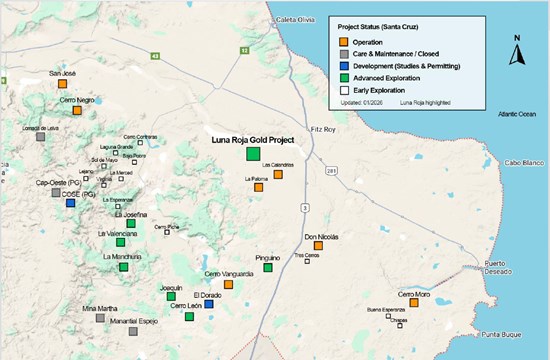
Figure 1: Location of key mining and exploration projects in Santa Cruz Province, Argentina including the Luna Roja Project.
To view an enhanced version of this graphic, please visit:
https://images.newsfilecorp.com/files/11586/305215_f015bef6c49658b4_002full.jpg
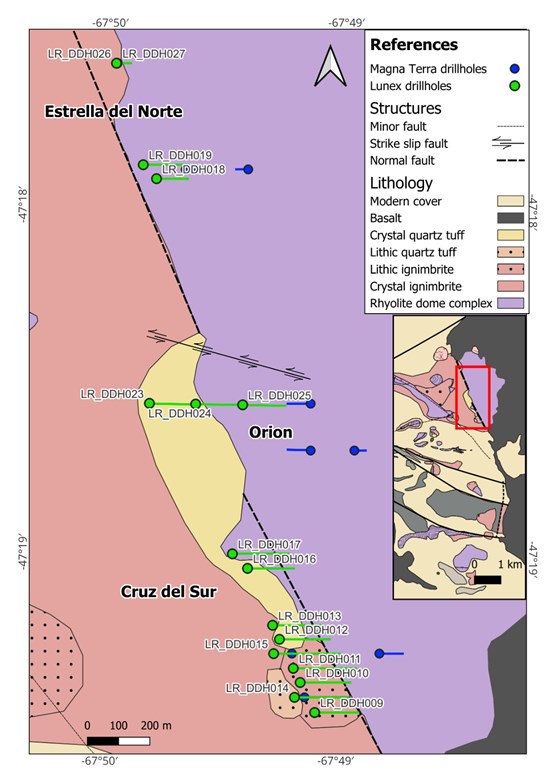
Figure 2: Geological Map of the Vía Láctea Structural Corridor Showing the Location of Reported Drill Holes and Principal Targets at the Luna Roja Project.
To view an enhanced version of this graphic, please visit:
https://images.newsfilecorp.com/files/11586/305215_f015bef6c49658b4_003full.jpg
Table 1. Collar Locations of the 2026 Drill Program at the Luna Roja Project.
| Hole ID# | Target | Easting | Northing | Altitude (m) | Azimuth | Dip | Depth (m) |
| LR_DDH09 | Cruz del Sur | 589.113 | 4.759.211 | 245 | 85° | -45 | 127.0 |
| LR_DDH10 | Cruz del Sur | 589.066 | 4.759.308 | 250 | 95° | -45 | 160.0 |
| LR_DDH11 | Cruz del Sur | 589.044 | 4.759.353 | 252 | 83° | -45 | 188.0 |
| LR_DDH12 | Cruz del Sur | 589.000 | 4.759.446 | 248 | 85° | -42 | 160.0 |
| LR_DDH13 | Cruz del Sur | 588.978 | 4.759.491 | 253 | 87° | -45 | 161.0 |
| LR_DDH14 | Cruz del Sur | 589.048 | 4.759.260 | 244 | 90° | -45 | 170.0 |
| LR_DDH15 | Cruz del Sur | 588.981 | 4.759.400 | 248 | 91° | -45 | 212.0 |
| LR_DDH16 | Cruz del Sur | 588.898 | 4.759.673 | 255 | 85° | -45 | 180.0 |
| LR_DDH17 | Cruz del Sur | 588.849 | 4.759.719 | 251 | 90° | -42 | 155.0 |
| LR_DDH18 | Estrella del Norte | 588.607 | 4.760.920 | 265 | 91° | -44 | 140.0 |
| LR_DDH19 | Estrella del Norte | 588.564 | 4.760.965 | 261 | 90° | -44 | 200.0 |
| LR_DDH23 | Orión | 588.580 | 4.760.200 | 248 | 92° | -46 | 194.0 |
| LR_DDH24 | Orión | 588.730 | 4.760.200 | 273 | 91° | -42 | 146.0 |
| LR_DDH25 | Orión | 588.880 | 4.760.200 | 262 | 89° | -43 | 185.0 |
| LR_DDH26 | Estrella del Norte | 588.480 | 4.761.290 | 255 | 90° | -45 | 38.5 |
| LR_DDH27 | Estrella del Norte | 588.478 | 4.761.290 | 250 | 90° | -60 | 101.0 |
Table 2. Highlight Results from the 2026 Drill Program at the Cruz del Sur and Estrella del Norte Targets.
| Hole ID# | From (m) | To (m) | Intercept (m)* | Au (g/t) | Ag (g/t) |
| LR_DDH09 | 31.6 | 41.0 | 9.4 | 0.25 | 11.45 |
| And | 82.0 | 94.0 | 12.0 | 0.39 | 1.14 |
| Including | 84.0 | 85.0 | 1.0 | 2.42 | 4.70 |
| LR_DDH10 | 46.0 | 62.0 | 16.0 | 0.36 | 3.96 |
| LR_DDH11 | 58.0 | 82.0 | 24.0 | 0.64 | 2.73 |
| Including | 66.0 | 70.0 | 4.0 | 1.56 | 3.20 |
| LR_DDH12 | 69.0 | 126.0 | 57.0 | 0.26 | 2.03 |
| Including | 89.0 | 116.0 | 27.0 | 0.39 | 1.29 |
| LR_DDH13 | 104.0 | 128.6 | 24.6 | 0.96 | 1.51 |
| Including | 104.9 | 114.0 | 9.1 | 2.16 | 2.53 |
| LR_DDH14 | 79.0 | 102.1 | 23.1 | 0.36 | 61.76 |
| Including | 95.0 | 97.0 | 2.0 | 1.15 | 465.00 |
| LR_DDH15 | 103.0 | 122.0 | 19.0 | 0.70 | 9.38 |
| Including | 112.0 | 116.0 | 4.0 | 1.79 | 33.15 |
| LR_DDH16 | 83.0 | 113.0 | 30.0 | 0.10 | 0.43 |
| LR_DDH17 | 120.0 | 130.0 | 10.0 | 0.63 | 1.83 |
| Including | 126.0 | 128.0 | 2.0 | 2.04 | 3.30 |
| LR_DDH18 | 12.0 | 18.0 | 6.0 | 0.30 | 0.87 |
| LR_DDH19 | 137.3 | 145.0 | 7.7 | 0.17 | 0.88 |
| LR_DDH26 | 20.0 | 28.0 | 8.0 | 0.23 | 44.05 |
| LR_DDH27 | 29.0 | 37.0 | 8.0 | 0.07 | 30.15 |
| And | 43.0 | 49.0 | 6.0 | 0.39 | 16.40 |
| And | 76.0 | 83.0 | 7.0 | 0.21 | 3.34 |
| *Reported drill intercepts represent downhole lengths. True widths are not yet estimated due to the current limited understanding of the geometry of the mineralized zones. |
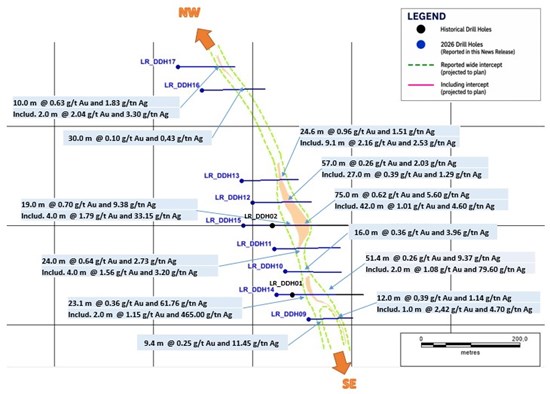
Figure 3. Plan View of the Cruz Del Sur Sector Showing Highlighted Drill Intercepts and Interpreted Mineralized Trends Along the Vía Láctea NW-Trending Au-Ag Structural Corridor
To view an enhanced version of this graphic, please visit:
https://images.newsfilecorp.com/files/11586/305215_f015bef6c49658b4_005full.jpg
Drill Program Details
Estrella Del Norte Drill Results
A total of four diamond drill holes were completed at Estrella del Norte. Holes LR_DDH26 and LR_DDH27 were designed to test the structural and lithological contact between the hanging wall volcaniclastics and the footwall dome complex along the Vía Láctea Fault.
Hole LR_DDH26 was abandoned prematurely at 38.5 metres due to tool loss within a fault zone, while LR_DDH27, drilled from the same platform at a steeper inclination, successfully intersected the full width of the mineralized system.
Holes LR_DDH18 and LR_DDH19 were designed to test hydrothermal breccia structures developed entirely within the dome complex and confirm a mineralized hydrothermal breccia corridor developed within the footwall of the Vía Láctea system.
Results from this sector confirm the presence of gold and silver mineralization associated with hydrothermal breccias, stockworks and veinlets. Highlight intercepts include 8.0 m grading 0.23 g/t gold and 44.05 g/t silver in LR_DDH26; multiple mineralized intervals in LR_DDH27, including 8.0 m grading 0.07 g/t gold and 30.15 g/t silver, 6.0 m grading 0.39 g/t gold and 16.40 g/t silver, and 7.0 m grading 0.21 g/t gold and 3.34 g/t silver; as well as 6.0 m grading 0.30 g/t gold and 0.87 g/t silver in LR_DDH18, and 7.7 m grading 0.17 g/t gold and 0.88 g/t silver in LR_DDH19.
The presence of relatively elevated silver values compared to much of the drilling completed at Cruz del Sur suggests geochemical variations within the hydrothermal system and supports the interpretation that Estrella del Norte represents a second mineralized center within the Vía Láctea corridor.
As part of the ongoing geological review of the 2026 drill program, Lunex identified several unsampled core intervals within broader mineralized zones associated with some of the reported intercepts. Given the significant widths and continuity of mineralization encountered, these intervening intervals are being systematically cut, sampled, and submitted for assay in order to complete the evaluation of the mineralized system. Results from this additional sampling will be reported by Lunex once received, validated, and interpreted.
Cruz del Sur Drill Results
The 2026 drill program was designed to systematically evaluate the continuity of mineralization at the Cruz del Sur target both along strike and at depth.
All nine (9) drill holes completed at Cruz del Sur intersected intense silicification, hydrothermal brecciation, grey silica, abundant quartz-sulphide stockwork veining, disseminated sulphides and strong hydrothermal alteration.
The Vía Láctea Fault constitutes the principal feeder structure of the hydrothermal system. Gold and silver mineralization occurs within both Jurassic volcaniclastic rocks in the hanging wall and the rhyolitic dome complex exposed in the footwall, highlighting the role of the structure in controlling hydrothermal fluid flow and metal deposition.
Higher-grade gold and silver intervals are primarily associated with silicified hydrothermal breccias hosted within broader mineralized zones characterized by abundant quartz-sulphide stockwork veining, supporting the interpretation of a structurally controlled epithermal gold-silver system.
Historical drill holes LR_DDH001 and LR_DDH002 previously intersected broad gold and silver mineralized zones, including 51.4 m grading 0.26 g/t gold and 9.37 g/t silver, and 75.0 m grading 0.62 g/t gold and 5.50 g/t silver, respectively (see Magna Terra news release dated June 19, 2019).
Results obtained to date include mineralized intervals such as 10.0 m grading 0.63 g/t gold in hole LR_DDH17, including 2.0 m grading 2.04 g/t gold, indicating that the system remains open to the north.
Particularly encouraging are the results from holes LR_DDH14 and LR_DDH15, which were drilled as step-back holes relative to the historical intercepts.
Hole LR_DDH14 returned 23.1 m grading 0.36 g/t gold and 61.76 g/t silver, including 2.0 m grading 1.15 g/t gold and 465.0 g/t silver, while hole LR_DDH15 returned 19.0 m grading 0.70 g/t gold and 9.38 g/t silver, including 4.0 m grading 1.79 g/t gold and 33.15 g/t silver.
Elevated arsenic and mercury values identified in surface sampling, together with exceptionally high arsenic concentrations encountered in several drill holes, are consistent with the shallow levels of a preserved epithermal system and suggest that significant portions of the hydrothermal system may remain intact at depth beneath the levels evaluated to date.
Orion Drill Results
Holes LR_DDH23, LR_DDH24, and LR_DDH25 tested the central segment of the Vía Láctea structural corridor located between Cruz del Sur and Estrella del Norte. While drilling did not intersect significant gold or silver intervals, hole LR_DDH23 successfully intersected the Vía Láctea Fault, precisely identifying the structural and lithological contact between Jurassic volcaniclastics and the rhyolitic-dacitic dome complex.
This intersection represents a key element for refining the geometry of the corridor and improving the positioning of future drill holes designed to test this contact, which is interpreted as one of the principal controls on mineralization within the system.
Taken together, these results confirm the continuity of the hydrothermal system, indicate that the Cruz del Sur system remains open to the north, and suggest the potential for increasing metal enrichment at depth.
As part of the ongoing geological review of the 2026 drill program, Lunex identified several unsampled core intervals within broader mineralized zones associated with some of the reported intercepts. Given the significant widths and continuity of mineralization encountered, these intervening intervals are being systematically cut, sampled, and submitted for assay in order to complete the evaluation of the mineralized system. Results from this additional sampling will be reported by Lunex once received, validated, and interpreted.
Geological Interpretation
Results from Estrella del Norte confirm the presence of a second mineralized center within the Vía Láctea structural corridor, located approximately 2.0 km north of Cruz del Sur, consolidating the continuity of a mineralized hydrothermal system extending for at least 2.8 kilometres. Mineralization is associated with silicification, quartz stockworks, hydrothermal breccias and veinlets developed within both Jurassic volcaniclastics and the rhyolitic-dacitic dome complex.
Drill results obtained along the Vía Láctea corridor confirm not only lateral continuity, but also the development of broad zones of hydrothermal alteration, stockworks, breccias and mineralized veinlets. At Cruz del Sur, mineralization is associated with a moderately west-dipping structure, while at Estrella del Norte the system evolves into steeper to subvertical geometries, suggesting structural variations within the same hydrothermal architecture.
The significantly higher silver values obtained at Estrella del Norte relative to Cruz del Sur suggest possible vertical and/or lateral variations within the epithermal system, potentially reflecting differences in preservation level or structural-fluid controls along the Vía Láctea corridor.
Elevated arsenic values identified at Estrella del Norte, combined with mercury anomalies previously recognized at surface and the nature of hydrothermal alteration, remain consistent with relatively shallow levels of a preserved low-sulphidation epithermal system, maintaining open potential to identify higher-grade zones at depth along the Vía Láctea corridor.
Ground Magnetic Survey And Target Generation
In addition to drilling, Lunex completed a detailed ground magnetic survey covering approximately 6,500 hectares across the Luna Roja Project. The survey comprised 49 ground magnetic survey lines totalling approximately 330 line-kilometres (Figure 4).
The survey significantly enhanced the geological understanding of the district and contributed to the identification and refinement of multiple exploration targets beyond the areas drilled to date.
Processed magnetic products highlighted major structural corridors, magnetic highs, interpreted dome complexes, lithological contacts and zones of structural complexity throughout the property. As a result, several satellite targets have been identified or upgraded, including Omega, Signos, Alfa, Lambda and a southeastern magnetic lineament target area.
The magnetic interpretation suggests the presence of multiple structural intersections, dilation zones and hydrothermal pathways considered favourable for epithermal mineralization. These targets remain largely untested and substantially expand the exploration potential of the Luna Roja district beyond the Cruz del Sur area.
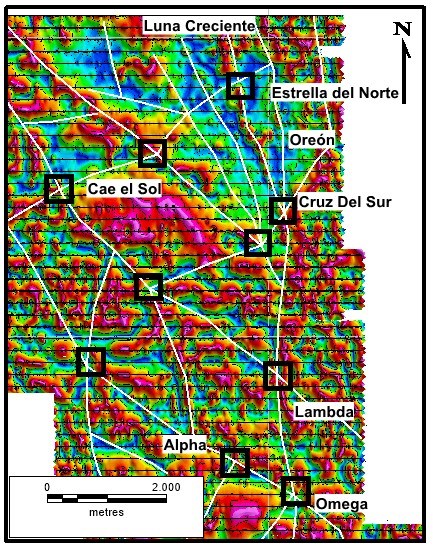
Figure 4. Ground Magnetic Survey Highlighting Priority Exploration Targets and Interpreted Structural Corridors Across the Luna Roja District.
To view an enhanced version of this graphic, please visit:
https://images.newsfilecorp.com/files/11586/305215_f015bef6c49658b4_006full.jpg
Next Steps
Future exploration will focus on follow-up drilling to expand mineralization at Cruz del Sur, testing the depth potential of the system, integrating results from Orion and Estrella del Norte, and advancing additional targets identified through ground magnetics, geological mapping, and surface geochemistry.
Previous Work
Since optioning the Luna Roja Project from Magna Terra in October 2025, Lunex has carried out prospecting, geological mapping, and ground geophysical surveys that have identified priority targets, several of which were tested during the completed 2026 drill program. Exploration to date has included the collection of 31 rock chip and 23 channel samples, as well as 330.04-line kilometres of ground magnetic surveying in advance of the drill program.
Rock chip and channel sampling resulted in the discovery of high-grade gold and silver mineralization with assays up to 13.26 g/t gold and 1,155 g/t silver. Rock samples ranged from <0.01 g/t gold to 13.26 g/t gold with 7 of the 54 samples assaying over 1 g/t gold; and ranged from <0.01 g/t silver to 1,155 g/t silver with 40 of the 54 samples assaying greater than 1 g/t silver. Notably two of the highest-grade samples (samples 1004 and 1005) assayed for elevated mercury (Hg) with values of 5,896 ppb and 4,686 ppb, a key pathfinder for gold mineralization within low-sulphidation epithermal systems.
At the south end of Estrella del Norte, 3 channel samples were collected that assayed 1.97 g/t gold and 7.2 g/t silver over 1.0 metre, 4.02 g/t gold and 4.03 g/t silver over 1.0 metre; and 13.26 g/t gold and 8.2 g/t silver over 1.0 metre from an outcrop of altered rhyolitic dome rocks with fine disseminated sulphides and stockwork-style mineralization.
At Cruz del Sur, at the south end of the Via Láctea Fault, chip samples were collected that assayed 1.65 g/t gold and 1,155 g/t silver over 1.0 metre and 1.48 g/t gold and 241 g/t silver over 1.0 metre from hydrothermal breccia with quartz-adularia- sericite alteration.
About the Luna Roja Project
The Luna Roja Project is located in the prolific Deseado Massif region of Santa Cruz Province approximately 75 km to the northwest of the new Minera Don Nicolás mine and 30 km to the north-northwest of the Las Calandrias project. The Project is accessible year-round, and benefits from access to infrastructure including roads, power, and water.
Luna Roja's geology includes rhyolitic volcanic rocks with intense silicification and hydrothermal alteration, typical of productive low-sulphidation gold systems in the region. The Project is centred along a 3 km section of the northwest striking Via Láctea Fault with coincident IP resistivity and chargeability anomalies and intermittently exposed low-sulphidation epithermal Au-Ag veins and breccias.
Previous exploration work at Luna Roja includes 360 rock chip and float samples, 741 trench samples, 715 soil samples, and 17.6 line-km of IP surveying. In 2019, Magna Terra completed eight diamond drill holes, totalling 1,184 metres, in a first phase drill program that led to the discovery of a significant gold-silver mineralized zone at Cruz del Sur (see Magna Terra news release dated April 16, 2019).
Highlight assays from the historic drilling program include:
75.0 m of 0.62 g/t gold and 5.50 g/t silver (from 37.0 m to 112.0 m), including 42.0 m of 1.01 g/t gold and 4.6 g/t silver (from 68.0 m to 110.0 m) in drill hole LR_DDH002; and
51.4 m of 0.26 g/t gold and 9.37 g/t silver (from 44.6 m to 96.0 m), including, 2.0 m of 1.08 g/t gold and 79.60 g/t silver (from 62.0 m to 64.0 m) in drill hole LR-DDH001.
Exploration work to date has identified gold intercepts at shallow depths, with the potential for future exploration to identify geologic controls to the mineralization, and to expand the mineralized footprint and establish continuity. Luna Roja is well positioned for additional near-term discovery, potential resource delineation and possible future development, supported by a strong regional geological framework and positive early-stage results.
Option Agreement Details
Under the terms of the Agreement, Lunex can earn a 100% interest in the Project for total consideration of C$2,375,000 payable in cash and Lunex common shares (see news release dated October 6, 2025) as detailed below:
| Term | Cash (C$) | Cash / Shares (C$) | Total (C$) |
| 60-day exclusivity period (paid) | $75,000 | - | $75,000 |
| On Signing Definitive Agreement (paid) | $100,000 | - | $100,000 |
| 1st Anniversary | $125,000 | $275,000 | $400,000 |
| 2nd Anniversary | $125,000 | $375,000 | $500,000 |
| 3rd Anniversary | $125,000 | $475,000 | $600,000 |
| 4th Anniversary | $125,000 | $575,000 | $700,000 |
| TOTAL | $675,000 | $1,700,000 | $2,375,000 |
The Luna Roja Project is subject to a one percent (1%) NSR, payable to Orogen Royalties Inc.
Qualified Person and Technical Disclosure
The historical technical information relating to Magna Terra Minerals Inc., the Luna Roja Project property, the Option Agreement, and exploration results prior to Lunex Metals Corp.'s involvement has been reviewed and approved by David A. Copeland, P.Geo., a non-independent consultant to the Company and a "Qualified Person" as defined under National Instrument 43-101 - Standard for Disclosure for Mineral Projects.
The scientific and technical information contained in this press release has been reviewed and approved by Fernando Ganem, P.Geo., Vice President Exploration of Lunex Metals Corp., who acts as a "Qualified Person" as defined under National Instrument 43-101 - Standards of Disclosure for Mineral Projects. Mr. Ganem has reviewed and approved the scientific and technical information relating to Lunex's 2026 exploration program, including drilling, sampling, analytical procedures and QA/QC results disclosed in this news release.
Drill core samples were obtained by longitudinally sawing the diamond drill core, with one-half retained as a reference sample. Samples were submitted to Alex Stewart International Argentina S.A. in San Julián, Santa Cruz Province, for sample preparation and analysis.
Gold analyses were completed by fire assay with AA finish, while silver and multi-element analyses were determined by acid digestion and ICP methods.
The QA/QC program included the systematic insertion of blanks, certified reference materials and duplicates within the analytical sequence in accordance with the Company's internal quality control procedures.
About Magna Terra
Magna Terra Minerals Inc. is a precious and critical metals focused exploration company, headquartered in Toronto, Canada. Magna Terra is focused on acquiring and advancing its high-potential mineral projects in Atlantic Canada and Argentina while generating value for shareholders and minimizing shareholder dilution through option and joint venture partnerships where appropriate; leveraging our ability to explore, grow, and transact projects. The Company is focused on exploring our 100%-owned Humber Copper-Cobalt and Shellbird Gold Projects in Newfoundland and Labrador; our 100% owned Rocky Brook Gold and Critical Metals Project in the historic Bathurst Mining Camp of New Brunswick; the recently acquired Prospect Or's Dream Gold Project, and our 100%-owned Cape Spencer Gold Project in New Brunswick. In addition, the Company has optioned the Great Northern Project in Newfoundland to Gold Hunter Resources Inc. ("Gold Hunter") for total cash and share consideration of $10.075 million over a 4-year period, and currently holds an approximate 19% equity interest in Gold Hunter. The Company has also optioned the Luna Roja Project in Argentina to Lunex Metals Corp. (formerly Andean Metals Corp.) for total cash and share consideration of $2.375 million over a 4-year period. Further, the Company maintains a significant exploration portfolio in the province of Santa Cruz, Argentina which includes its large 100% owned Boleadora Project, as well as several additional district scale drill ready projects available for purchase or option/joint venture.
About Lunex Metals
Lunex Metals Corp. is a Canadian mineral exploration company focused on advancing the Luna Roja Project in the prolific Deseado Massif region of Santa Cruz Province, Argentina. The Company is committed to the discovery and development of high-grade precious metal deposits through systematic exploration and technical excellence. Lunex is a British Columbia, Canada corporation and a reporting issuer in the Provinces of British Columbia and Alberta, and is progressing toward listing its common shares on the TSX Venture Exchange.
Forward-Looking Statements
Neither the TSX Venture Exchange nor its Regulation Services Provider (as that term is defined in the policies of the TSX Venture Exchange) accepts responsibility for the adequacy or accuracy of this release.
Cautionary Statements Regarding Forward Looking Information
This news release contains forward-looking statements and forward-looking information (collectively, "forward-looking statements") within the meaning of applicable Canadian legislation. All statements in this news release that are not purely historical are forward-looking statements and include statements regarding beliefs, plans, expectations and orientations regarding the future including, without limitation, the ability of the Company to file a report that complies with National Instrument 43-101. Although the Company believes that such statements are reasonable and reflect expectations of future developments and other factors which management believes to be reasonable and relevant, the Company can give no assurance that such expectations will prove to be correct. Forward-looking statements are typically identified by words such as: "believes", "expects", "anticipates", "intends", "estimates", "plans", "may", "should", "would", "will", "potential", "scheduled" or variations of such words and phrases and similar expressions, which, by their nature, refer to future events or results that may, could, would, might or will occur or be taken or achieved. In making the forward-looking statements in this news release, the Company has applied several material assumptions, including without limitation, and the ability of the author of the Technical Reports to finalize same.
Forward-looking statements involve known and unknown risks, uncertainties and other factors which may cause the actual results, performance or achievements of the Company to differ materially from any future results, performance or achievements expressed or implied by the forward-looking information. Such risks and other factors include the inability of the Company to execute its proposed business plans and carry out planned future activities. Other factors may also adversely affect the future results or performance of the Company, including general economic, market or business conditions, future prices of gold, changes in the financial markets and in the demand for precious metals, changes in laws, regulations and policies affecting the mineral exploration industry, and the Company's investment and operation in the mineral exploration sector, as well as the risks and uncertainties which are more fully described in the Company's annual and quarterly management's discussion and analysis and in other filings made by the Company with Canadian securities regulatory authorities under the Company's SEDAR+ profile at www.sedarplus.ca. Readers are cautioned that forward-looking statements are not guarantees of future performance or events and, accordingly, are cautioned not to put undue reliance on forward-looking statements due to the inherent uncertainty of such statements.
These forward-looking statements are made as of the date of this news release and, unless required by applicable law, the Company assumes no obligation to update the forward-looking statements or to update the reasons why actual results could differ from those projected in these forward-looking statements.

To view the source version of this press release, please visit https://www.newsfilecorp.com/release/305215

© 2026 Canjex Publishing Ltd. All rights reserved.