VANCOUVER, BC / ACCESS Newswire / February 18, 2026 / Nevada Lithium Resources Inc. (TSXV:NVLH)(OTCQB:NVLHF)(FSE:87K) ("Nevada Lithium" or the "Company") is pleased to announce results from the first of a suite of samples being analysed by the Department of Earth Sciences ("DiSTAR") at the University of Naples Federico II, of Naples, Italy. These samples are being analysed as part of a research agreement between the Company and DiSTAR, to further define the lithium distribution in clay minerals within existing drill core on its 100% owned Bonnie Claire lithium project (the "Project" or "Bonnie Claire"), located in Nye County, Nevada. This work is designed to identify mineralogical controls on lithium grade and is expected to provide valuable guidance for high-impact exploration, targeted drilling, and resource grade maximization.
Nevada Lithium's CEO, Stephen Rentschler, comments:
We are pleased to announce that an initial drill core analysis by our research partners at the University of Naples Department of Earth Sciences has returned a lithium grade of 19,815 ppm for the first clay fraction sample from hole BC 2402C. This sample was chosen to gain additional understanding of the high-grade lithium Lower Zone, from which Bonnie Claire's lithium/boron resource, and mine plan, are derived.
The dominance of Illite, which can display a lithium grade comparable to many spodumene deposits, explains the very high grades observed within Bonnie Claire's lithium resource. As earlier analyses were undertaken prior to the identification of lithium residence within the clay fraction, this work provides important context for the interpretation of existing lithium grades. This context is also expected to be of use in targeting higher-grade mineralization in areas of clay-rich rocks, which could further increase the grade of the Project's lithium resource.
The research program at the University of Naples is continuing, and it is expected to provide further insight into the multiple zones of lithium mineralization at Bonnie Claire. Conclusions from the work-to-date are currently being integrated into Nevada Lithium's technical work programs, which are designed to advance the Project, and deliver additional shareholder value.
Join Stephen Rentschler, CEO & Jeff Wilson, VP Exploration, of Nevada Lithium for a LIVE virtual event
to learn more about the details of this news release
Date and time: Thursday, February 19, 2026 at 2:00 PM EST
Click here to register for the event >
Highlights
First positive determination of lithium residence at Bonnie Claire
Clay fraction sample from Lower Zone identifies dominant illite mineralogy
Drill core displays illite trend in high-grade samples and potential smectite trend in low-grade samples
19,815 ppm Li concentration in clay fraction sample
Potential to intercept higher grade mineralization at Bonnie Claire within clay-rich rocks in Lower Zone
Lithium Residence
The Company announced a research agreement with the Department of Earth Sciences ("DiSTAR") at the University of Naples Federico II, of Naples, Italy in its December 11, 2025 news release. The research project seeks to develop a greater understanding of the lithium distribution in clay minerals in the Bonnie Claire deposit. The project involves the analysis of a suite of core samples from drillhole BC 2402C. The Company initially disclosed drillhole BC 2402C in the Company's October 1, 2024 news release.
This release discloses the results from the first of these analyses, from sample N21, which was taken from a depth of 2353.3-2354ft. This sample is located within the high-grade Lower Zone at Bonnie Claire, and was collected from an intercept having a bulk-rock lithium assay of 6020 ppm.
Sample N21 underwent a series of analyses, including
Bulk-rock X-ray diffraction ("XRD") to assess variations in mineralogy across the sample
XRD & Short-Wave Infrared ("SWIR") on clay fraction to determine dominant clay mineralogy
Inductively Coupled Plasma Optical Emission Spectroscopy ("ICP-OES") on clay fraction to determine the lithium concentration
Bulk-Rock XRD
XRD analyses were carried out on a number of micro-samples within sample N21, to assess mineralogical variations within different textural components. Results indicate that the fine-grained and clay-rich parts of the sample are dominated by searlesite and a 10 Å (illite and/or mica) phyllosilicate. The more granular parts of the sample also contain plagioclase and analcime, suggesting the occurrence of partially altered tuffaceous sediments, bearing relict igneous phases (plagioclase) and zeolite formed after glassy material (analcime).
XRD on clay fraction
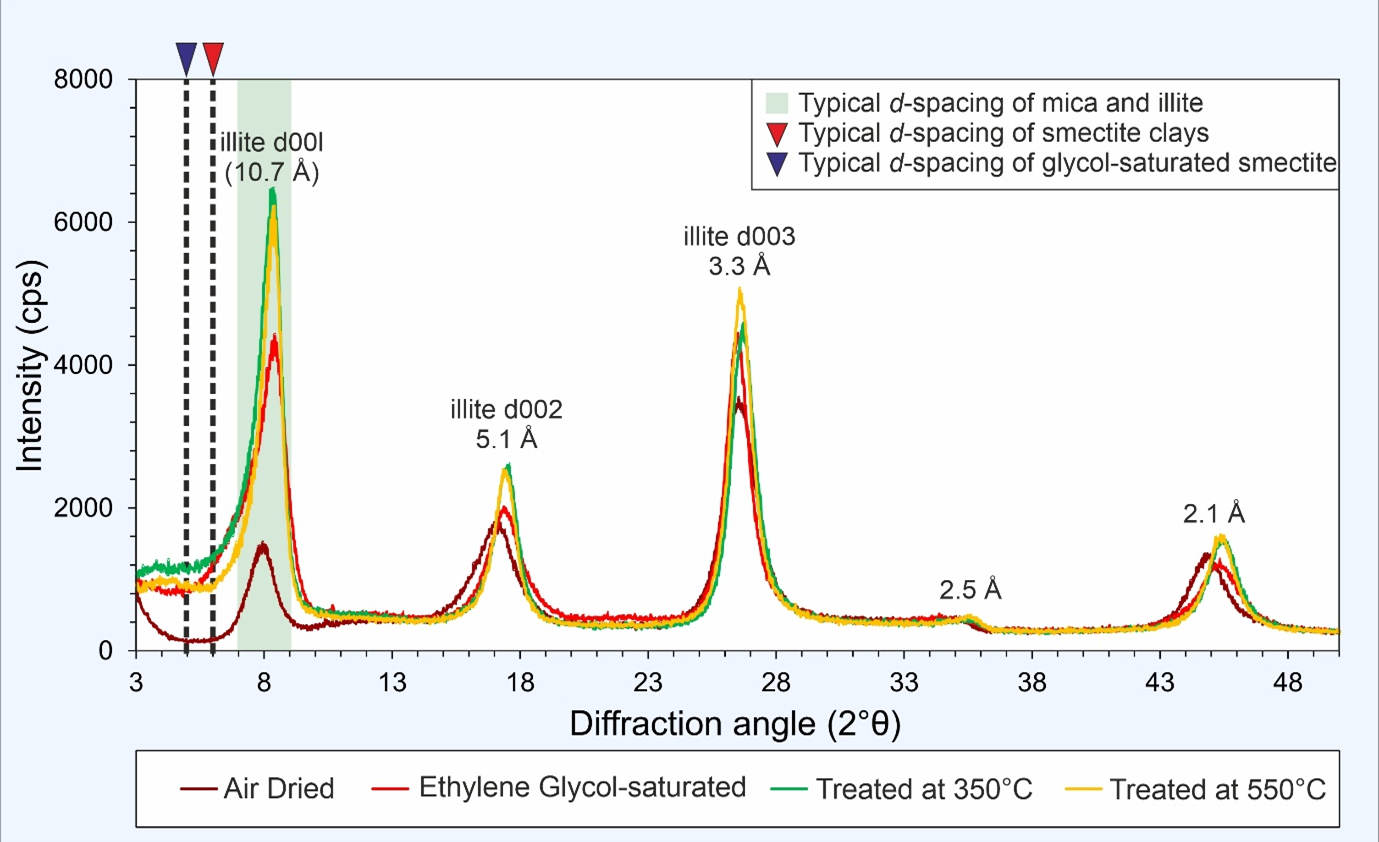
XRD analyses were conducted on the clay fraction from sample N21 and the results are illustrated in Figure 1. The measured XRD patterns demonstrate that the clay fraction is dominated by a basal reflection of 10 Å, reflecting a phyllosilicate (mica or illite). After glycol saturation, to allow for the expansion of any swelling (smectite) clays, analysis of the clay fraction did not show any significant shift of the basal reflection to 15-17 Å. The absence of any 15-17 Å shift rules out the presence of significant smectite and/or smectite-illite mixed layers components. The broad nature of the reflection peaks indicates that the 10 Å phyllosilicate is microcrystalline, and hence can be classified as illite, rather than mica (further evidence are given by SWIR).
Figure 1: XRD on clay fraction in Air-Dried, Ethylene Glycol saturated mode,
and after heat treatments at 350°C and 550°C.
SWIR on clay fraction
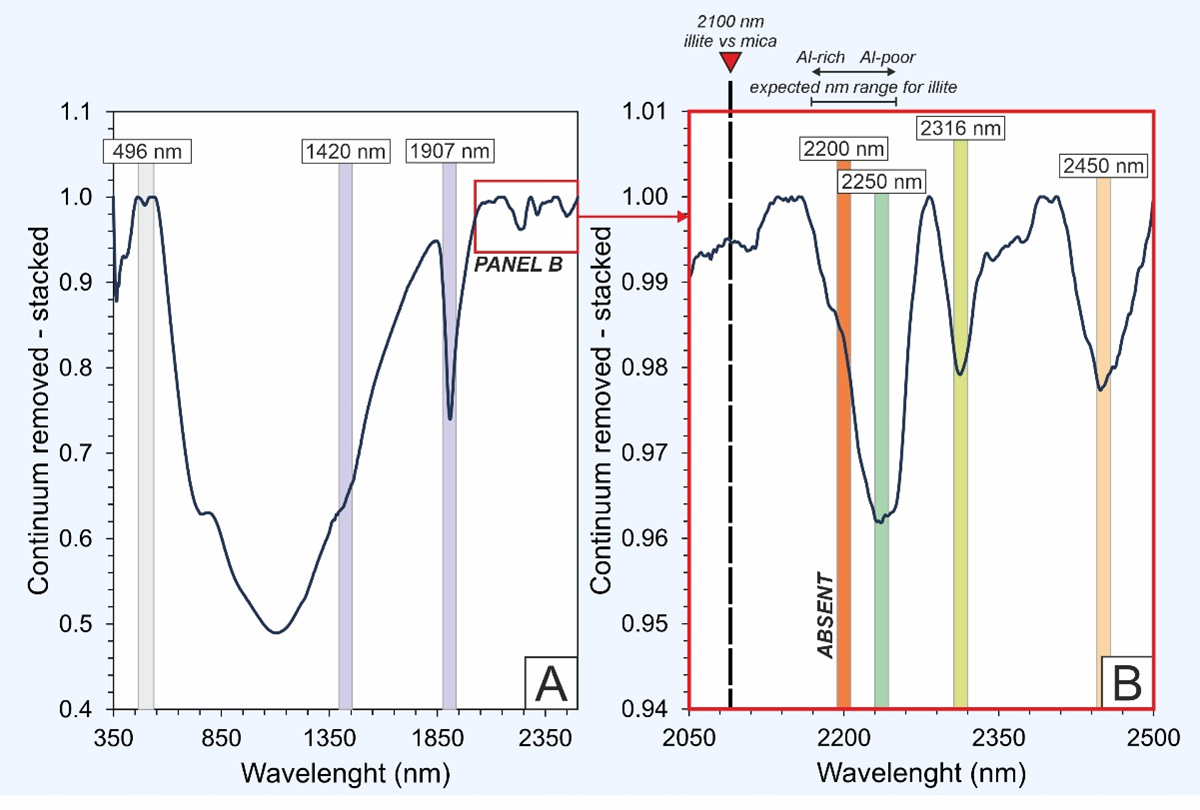
High-resolution VNIR-SWIR reflectance point spectroscopy was conducted on the clay fraction from sample N21, and results are illustrated in Figure 2. The analysis displays the typical OH group-related features of sheet silicates in the SWIR range at around 1400 and 1900 nm (Fig. 2A). These are common to most clays, and hence are not conclusive for classification purposes. Typical SWIR absorption bands of illite are found in the 2000-2500 nm range, and include the 2250 nm, 2359 nm and the 2450 nm features (Fig. 2B). The absence of a feature at 2100 nm points out that illite is prevailing over micas (Fig. 2B). These findings confirm the XRD results. The feature at 2316 nm suggests an illite with Mg-bearing composition, while that at 2250 nm is a proxy of low-Al contents (Fig. 2B).
Figure 2 (A&B): SWIR spectral signature of clay fraction after continuum removal.
ICP-OES on clay fraction
ICP-OES analysis was carried out on clay fraction from sample N21, and a list of the analyzed elements is presented in Table 2. Of particular note, the geochemical analysis of the clay fraction has yielded an overall lithium concentration of 19,815 ppm. A grade of this magnitude supports the identification of dominant illite in the XRD & SWIR analysis.
Table 2: ICP-OES results in ppm of clay fraction from sample N21.

Lithium Clay classification
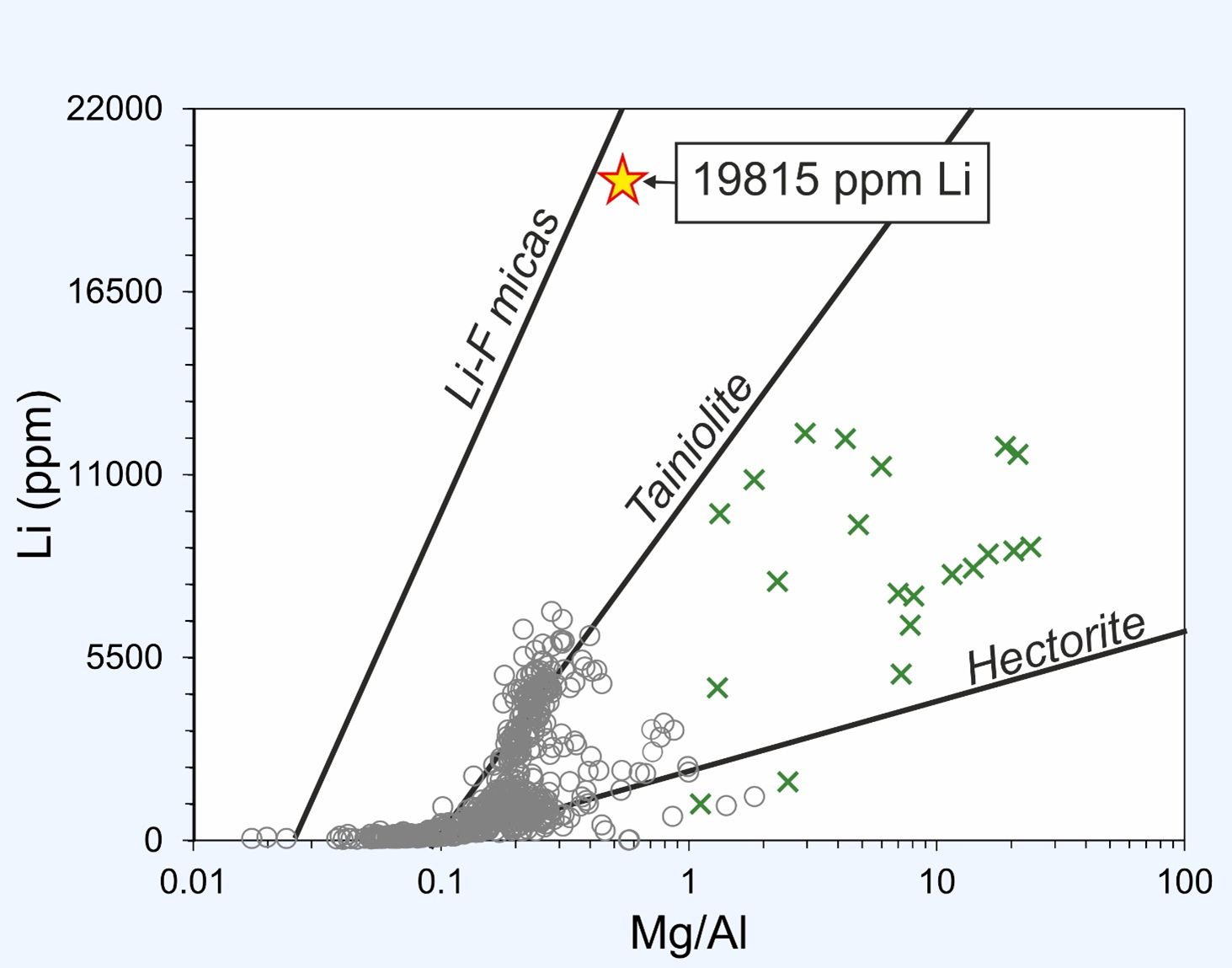
One method to understand the context of this work is to include it in the lithium clay classification scheme of Putzolu et al. (2025), which plots lithium grade against Mg/Al ratios (Fig. 3).
Within this classification scheme, existing assay data from Bonnie Claire plots along two distinct trends. Low-grade samples plot along a hectorite (smectite) trend, while high-grade samples plot much closer to a lithium illite (tainiolite) trend. The current 19,815 ppm Li assay from the clay fraction plots along the high-grade trend of the existing drill data, closer to the theoretical composition for Li-F micas than that of tainiolite.
In comparison, LA-ICP-MS data of lithium clays from Thacker Pass (Emproto et al., 2025) plot as a broad scatter between the hectorite and tainiolite lines.
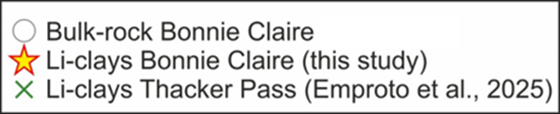
Figure 3: Li concentrations and Mg/Al ratio of clay fraction from N21 plotted in the lithium clay classification scheme of Putzolu et al. (2025). Assay data from Bonnie Claire and LA-ICP-MS data of lithium clays from Thacker Pass (Emproto et al., 2025) are plotted for comparison.
Discussion
This analysis is the first of a suite of samples analysed by the Department of Earth Sciences ("DiSTAR") at the University of Naples Federico II, of Naples, Italy. Each of the samples will illustrate different aspects of lithium residence at Bonnie Claire.
The bulk-rock XRD analysis suggests that sample N21 was a partially altered tuffaceous sediment, bearing relict igneous phases (plagioclase) and zeolite formed after glassy material (analcime). The XRD analysis of the clay fraction demonstrates that the clay fraction is microcrystalline illite, with no significant smectites, illite/smectite mixed layers or mica. The SWIR analysis confirms the XRD results, supporting that illite is the prevailing clay mineral.
The current ICP-OES analysis provided an overall assay of 19,815 ppm lithium, reflecting a high Li and relatively low Mg illite. This plots along the same trend between tainiolite & Li-F micas as high-grade bulk rock assays at Bonnie Claire. The magnitude of this assay suggests the possibility of intersecting higher grades in clay-rich claystones within the Lower Zone at Bonnie Claire.
References
Emproto, Christopher, Thomas R. Benson, Catherine A. Gagnon, Woohyeon Baek, Daniel Ibarra, and Adam C. Simon. "Clay chemistry of the Thacker Pass deposit, Nevada: Implications for the formation of high-grade volcano-sedimentary lithium resources." Economic Geology 120, no. 5 (2025): 1047-1070.
Putzolu, F., Armstrong, R.N., Benson, T.R., Boutt, D.F., Butler, K.L., Dolgopolova, A., Herrington, R.J., Ibarra, D.E. and Munk, L.A., 2025. Volcano-sedimentary deposits: Overview of an emerging type of lithium resource. Economic Geology, 120(3), pp.541-573.
PDAC Presentation
Dr. Jeff Wilson, the VP Exploration for Nevada Lithium will be presenting in the Exploration Insights technical session at the upcoming Prospectors and Developers Association of Canada Convention in Toronto next month. The presentation is entitled "The Bonnie Claire volcano-sedimentary Li-B deposit" and will take place on Sunday, March 1, at 2 p.m., in Room 716.
This will be the first technical presentation about Bonnie Claire at a major conference. The presentation will provide an introduction to the geological characteristics of the volcano-sedimentary Li-B deposit class and the relative position of the Bonnie Claire deposit.
Further details are available at:
https://pdac.ca/convention-2026/programming-2026/exploration-insights-2026/the-bonnie-claire-fault-bounded-volcano-sedimentary-li-b-deposit-nevada-2026
Quality Assurance / Quality Control (QAQC)
Drill core from BC2402C were sampled by DiSTAR staff under supervision of Nevada Lithium personnel at the Company's core facility at Betty Nevada. All samples were transported by Nevada Lithium personnel to Reno, Nevada and shipped by courier to the DiSTAR facility in Naples Italy.
All XRD, SWIR & ICP-OES analyses were carried out at the DiSTAR facility in Naples Italy.
Processing of the bulk-rock XRD data was carried out by using the PDF-2 mineral library of the International Centre of Diffraction data (https://www.icdd.com/pdf-2/). For SWIR acquisitions on clay fraction, the pre-processing step included a standard radiometric calibration. The SWIR data recorded as digital numbers were converted into radiance by subtracting the dark-reference measurements and applying sensor-specific calibration. Then, the measured radiance was converted into reflectance by normalizing the data to the reflectance measurements acquired on R99 and R80 Spectralon white reference calibration panels. ICP-OES Samples were analyzed at the DiSTAR laboratory in Naples Italy, BC. Quality control in the form of duplicates, standards and blanks was provided by the laboratory. These were reviewed and found to be within target ranges.
QP Disclosure
Jeff Wilson, PhD, FGC, P.Geo., Vice President of Exploration for Nevada Lithium is the "Qualified Person" as such term is defined in NI 43-101, who has reviewed and approved the technical information in this news release, and is not independent of the Company.
About Nevada Lithium Resources Inc.
Nevada Lithium Resources Inc. is a mineral exploration and development company focused on shareholder value creation through its core asset, the Bonnie Claire Lithium Project, located in Nye County, Nevada, where it holds a 100% interest.
The Company recently filed a PEA on the Bonnie Claire Lithium Project. The PEA has an effective date of March 31, 2025 and presents a $6.829 billion after-tax Net Present Value ("NPV") at an 8% discount rate, based on $24,000/tonne Li2CO3, $950/tonne boric acid, together with a 32.3% after-tax Internal Rate of Return ("IRR"). Results of the PEA were announced in the Company's news release, dated August 6, 2025. The PEA is preliminary in nature and includes Inferred Mineral Resources that are too speculative geologically to be classified as Mineral Reserves. There is no certainty that the results of the PEA will be realized.
For further information on Nevada Lithium and to subscribe for updates about Nevada Lithium, please visit its website at: https://nevadalithium.com/
On behalf of the Board of Directors of Nevada Lithium Resources Inc.
"Stephen Rentschler"
Stephen Rentschler, CEO
For further information, please contact:
Nevada Lithium Resources Inc.
Stephen Rentschler
CEO and Director
Phone: (647) 254-9795
E-mail: sr@nevadalithium.com
Media Inquiries
E-mail: info@nevadalithium.com
Find Nevada Lithium on X and LinkedIn
The TSX Venture Exchange does not accept responsibility for the adequacy or accuracy of this news release. TSX Venture Exchange has not approved or disapproved of the contents of this news release.
Cautionary Note Regarding Forward-Looking Statements
This news release contains forward-looking statements and forward-looking information (collectively, "forward-looking statements") within the meaning of applicable Canadian securities legislation. These statements relate to matters that identify future events or future performance. Often, but not always, forward looking information can be identified by words such as "could", "pro forma", "plans", "expects", "may", "will", "should", "budget", "scheduled", "estimates", "forecasts", "intends", "anticipates", "believes", "potential" or variations of such words including negative variations thereof, and phrases that refer to certain actions, events or results that may, could, would, might or will occur or be taken or achieved.
The forward-looking statements contained herein include, but are not limited to, statements regarding: the performance of the Project and the results and assumptions of the PEA, including projected economics, production rates, mine life, capital costs, operating costs, internal rate of return, net present value, payback period, sensitivity analyses, and the potential for optimization of project economics and value enhancement opportunities; potential to recover rare earth elements as a by-product of the Project; the potential development of the Project, including future permitting, feasibility studies, and development activities; mineral resource estimates, the potential to convert inferred mineral resources to indicated or measured mineral resources, and future exploration activities with the potential to expand mineral resources; mining methods, production targets, and processing strategies; the impact of new tax provisions and regulatory changes; market conditions and commodity prices for lithium carbonate and boric acid, including sustained lithium demand and prices; and the Company's ability to finance the development of the Project.
making the forward looking statements in this news release, Nevada Lithium has applied several material assumptions, including without limitation: sustained market fundamentals resulting in continued lithium and boron demand and favorable commodity price assumptions for lithium carbonate and boric acid; the receipt of any necessary permits, licenses and regulatory approvals in connection with the future development of Bonnie Claire in a timely manner and Nevada Lithium's ability to comply with all applicable regulations and laws, including environmental, health and safety laws, supported by political and regulatory stability in Nevada, USA; the availability of financing on suitable terms for the development, construction and continued operation of Bonnie Claire; the Project containing mineral resources and the accuracy of the Mineral Resource Estimate; the reliability of the PEA and its underlying assumptions; the successful application of the HBHM method; metallurgical recovery rates of 85% for lithium and 48% for boron; and capital and operating cost estimates.
Investors are cautioned that forward-looking statements are not based on historical facts but instead reflect Nevada Lithium's management's expectations, estimates or projections concerning future results or events based on the opinions, assumptions and estimates of management considered reasonable at the date the statements are made. Although Nevada Lithium believes that the expectations reflected in such forward-looking statements are reasonable, such information involves risks and uncertainties, and undue reliance should not be placed on such information, as unknown or unpredictable factors could have material adverse effects on future results, performance or achievements expressed or implied by Nevada Lithium. Among the key risk factors that could cause actual results to differ materially from those projected in the forward-looking statements are the following: fluctuations in commodity prices, including lithium and other mineral commodities; uncertainties inherent in mineral resource and reserve estimates; uncertainties inherent in mineral resource and reserve estimates, including possible variations in ore grade or recovery rates; risks associated with the development and operation of mining projects, including operating and technical difficulties, possible failures of plants, equipment or processes to operate as anticipated, and accidents; regulatory and permitting risks, including delays or inability to obtain necessary approvals, permits, consents or authorizations, and changes in laws, regulations and policies affecting mining operations; environmental risks and liabilities; financing and liquidity risks, including requirements for additional capital; market and economic conditions, including changes in general economic, business and political conditions and financial markets; competition in the lithium and boron markets; infrastructure and logistics challenges; geopolitical risks and changes in government policies; labour disputes and other risks of the mining industry; currency fluctuations; title disputes or claims; limitations on insurance coverage; timing and possible outcome of pending litigation; risks relating to epidemics or pandemics such as COVID-19, including the impact of COVID-19 on Nevada Lithium's business; as well as those factors discussed under the heading "Risk Factors" in Nevada Lithium's latest Management Discussion and Analysis and other filings of Nevada Lithium filed with the Canadian securities authorities, copies of which can be found under Nevada Lithium's profile on SEDAR+ at www.sedarplus.ca.
Should one or more of these risks or uncertainties materialize, or should assumptions underlying the forward-looking statements prove incorrect, actual results may vary materially from those described herein as intended, planned, anticipated, believed, estimated or expected. Although Nevada Lithium has attempted to identify important risks, uncertainties and factors which could cause actual results to differ materially, there may be others that cause results not to be as anticipated, estimated or intended. Nevada Lithium does not intend, and does not assume any obligation, to update this forward-looking information except as otherwise required by applicable law.
SOURCE: Nevada Lithium Resources Inc.
View the original press release on ACCESS Newswire

© 2026 Canjex Publishing Ltd. All rights reserved.