Highlights:
- RTO completed and trading commenced on the TSXV under “OGW”.
- 2026 work program now underway with RC drill rig mobilized to start inaugural bedrock sampling campaign at the Belmont Prospect near Khorixas in Namibia.
- 6,000m of RC drilling has been budgeted for bedrock target definition at the Belmont and Manga Prospects to be completed by Q2 2026.
- Extensive regional soil sampling campaign restarted on the Omatjete Licences on strike and around the Manga Prospect.
- Technical team expanded to cope with the anticipated increase in sampling volumes.
VANCOUVER, British Columbia, Feb. 18, 2026 (GLOBE NEWSWIRE) -- Ongwe Minerals Inc. (TSXV:OGW) (“Ongwe” or “the Company”) is pleased to announce that it has mobilized a Reverse Circulation (“RC”) drill rig to start its inaugural bedrock sampling campaign at the Belmont Gold Prospect in Namibia and provides an update regarding its exploration strategy for Q1 2026.
Ongwe Minerals has two flagship projects in Namibia and a dominant land position in the emerging and highly prospective Northwest Damara Belt:
- The Khorixas Project (154,000ha) which contains the Belmont Prospect, an orogenic gold system with a surface footprint of 12 x 6km and numerous high grade visible gold rock chips at surface
- The Omatjete Project (107,000ha) which contains the Manga Prospect, an orogenic gold system, 30km along strike from the recently discovered Kokoseb gold deposit (WIA Gold, 2.9Moz), with a surface footprint of 4.5 x 1km
Ongwe Minerals is focussed on progressing the Belmont and Manga Gold Prospects by outlining bedrock gold targets beneath the surface cover during the first half of 2026 which will roll into an extensive diamond drill program during the second half of 2026. Ongwe will also continue to carry out large scale regional soil and calcrete sampling programs on its current and expanding land positions. Much of the emerging Damara Belt remains unexplored due to the extensive cover of calcrete and wind-blown sand.
David Underwood, Ongwe’s CEO commented: “Now that the RTO has been completed and Ongwe has commenced trading on the TSXV, we have commenced our much-anticipated bedrock sampling program at the Belmont Prospect. Bedrock sampling is an exploration tool that was instrumental in the 2019 discovery of the 3.1Moz Twin Hills gold deposit by Osino Resources. The Ongwe team is now attempting to replicate this success by defining drill targets within the large area of anomalous gold at surface, at both Manga and Belmont, covering over 7,000ha collectively. Scout drilling at Belmont in 2024 provided proof of high-grade mineralization beneath the surface calcrete and the current campaign aims to define this mineralization into drill ready targets for H2. Once the campaign at Belmont is completed, we will move the rig to Omatjete to better define the Manga Gold Prospect. We are equally excited about the large-scale regional soil sampling program that has kicked off at Omatjete, which is aimed at testing the strike extent of the Okondeka Fault Zone which hosts both the Kokoseb and Manga discoveries.
In preparation for a significantly increased level of activity across our exploration programs, we have strengthened our technical and operational capabilities. This includes the appointment of additional geological and field staff to support the anticipated rise in sampling, analysis and data flow. In parallel, we have expanded our corporate function with the addition of a financial manager as we move into a period of accelerated exploration expenditure expected through 2026.”
Exploration Approach
A large part of the Damara Belt is covered by calcrete (which can be up to 50m thick) or wind-blown sand or both. The extensive cover has led previous companies to consider these parts unexplorable and consequently a large part of the belt remains untested. The discovery of the Twin Hills deposit by Osino Resources, through deep calcrete, has proved that geophysics, innovative sampling and assay techniques, followed by bedrock sampling is a highly effective methodology to explore in covered areas. Most of the gold deposits discovered in Namibia to date are typical orogenic in style, occurring along or adjacent to deep-seated, long-lived faults, usually at sedimentary basin margins.
Bedrock Sampling
The company has mobilized an RC drill rig (see Figure 2) to embark on a +6,000m RC bedrock sampling campaign which will be split between the Belmont prospect (Khorixas) and the Manga prospect (Omatjete). A total of 4,000m is planned for Belmont and 2,000m for Manga with flexibility to increase the scope if infill sampling is required. General line spacing will be 200m with a hole spacing of 25m. Holes are expected to range between 3m and 15m in depth with an average depth of approximately 7m. A total of two samples will be collected per hole with one sample taken in the transition zone above the bedrock and the other sample taken below the transition in bedrock.
Drilling short holes to sample bedrock is an effective method of exploration used in central Namibia as a large part of the region is covered in calcrete, wind blown sand or sheetwash alluvium. Previous work by the company has focused on surface geochemical sampling in the form of calcrete and soil sampling. These methods have outlined major gold trends at Belmont and Manga, which were both tested with limited scout drilling and showed in-situ gold mineralization. The current bedrock sampling campaign is designed to outline bedrock gold anomalies beneath the existing surface anomalies ahead of a diamond drilling campaign later in 2026.
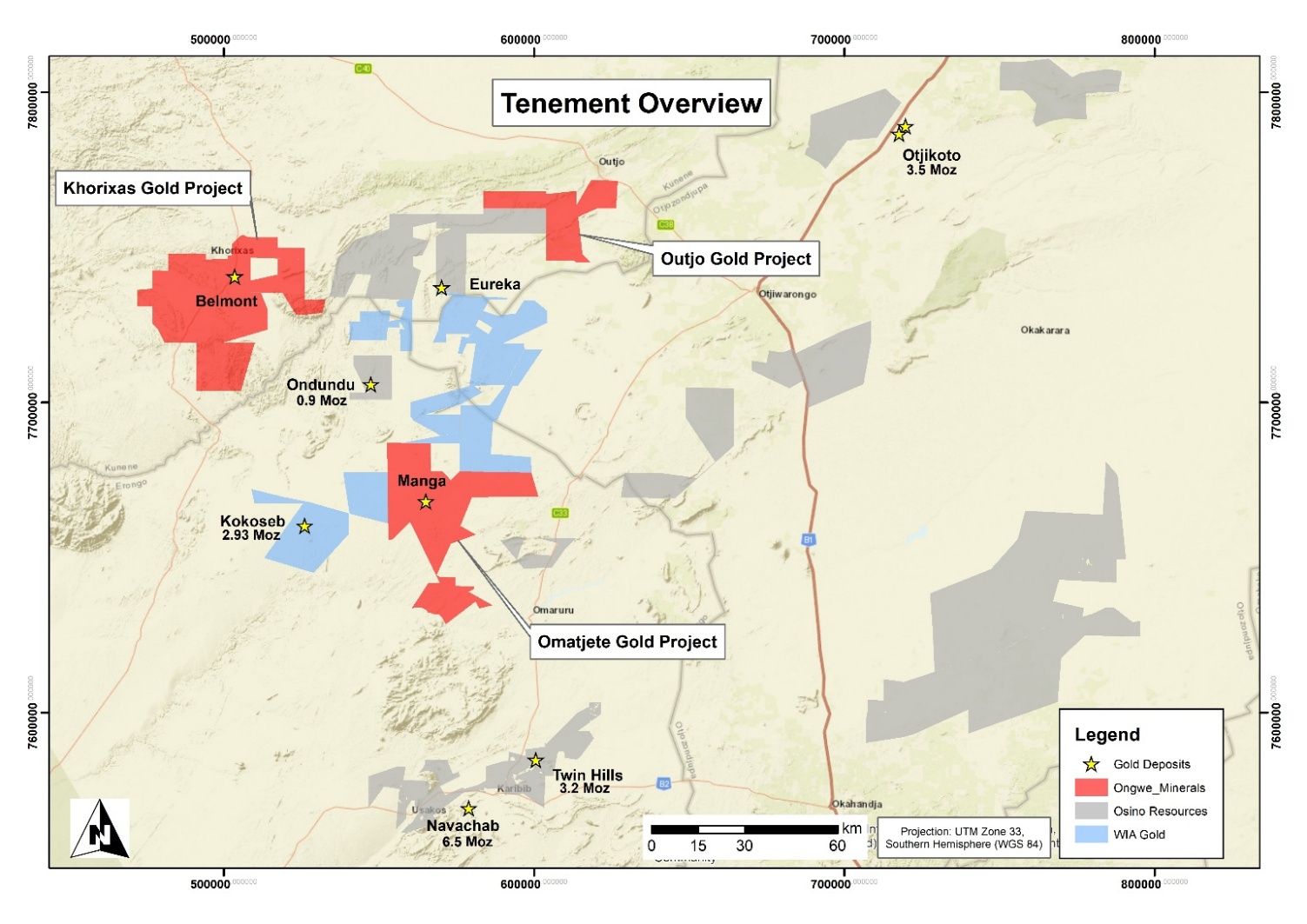
Figure 1: Company tenement map showing the location and extent of significant gold deposits as well as the newly discovered Belmont and Manga prospects.
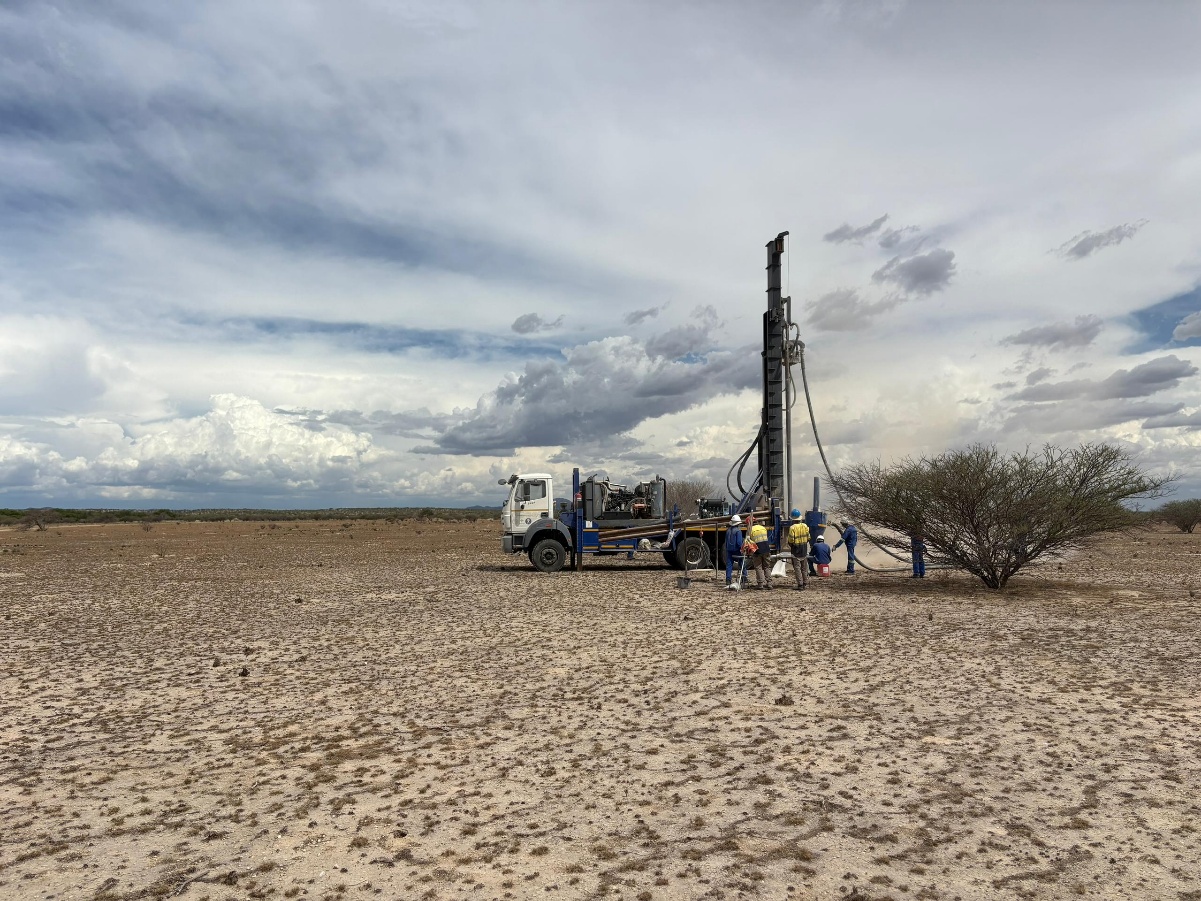
Figure 2: RC rig commencing bedrock sampling on the “Thrust Zone Target” at the Belmont prospect, Khorixas.
Bedrock Sampling – Belmont Prospect
Bedrock sampling has commenced at the Belmont Gold Prospect, situated in the northern part of the Khorixas Gold Project (see Figure 1). The planned program will initially collect bedrock samples across the high priority surface gold anomalies as illustrated in Figure 3.
The Belmont prospect spans an area of 12 × 6km, situated between the Khorixas–Gaseneirob Thrust (KGT) and the Belmont Thrust although 90% of the geology is concealed beneath calcrete and sheetwash cover. Belmont represents a greenfields discovery made through systematic calcrete and soil sampling methods which defined eighteen targets.
Individual targets appear to align with more subtle southeasterly structures visible in the aeromagnetic data, likely resulting from late-stage rotation and associated shearing along a major jog in the KGT. Several of the targets (such as BK2) display clear rock-chip trends, with grades peaking at 145.7g/t Au. In addition, many grab samples (often collected from angular float of gossanous quartz veins), contained visible gold. Limited scout drilling was conducted at the Belmont Prospect with a best intercept of 6m at 6.85g/t Au from 20m.
The current bedrock sampling campaign aims to test at least ten of the Belmont target zones and produce walk-up drill targets to be tested later in 2026.
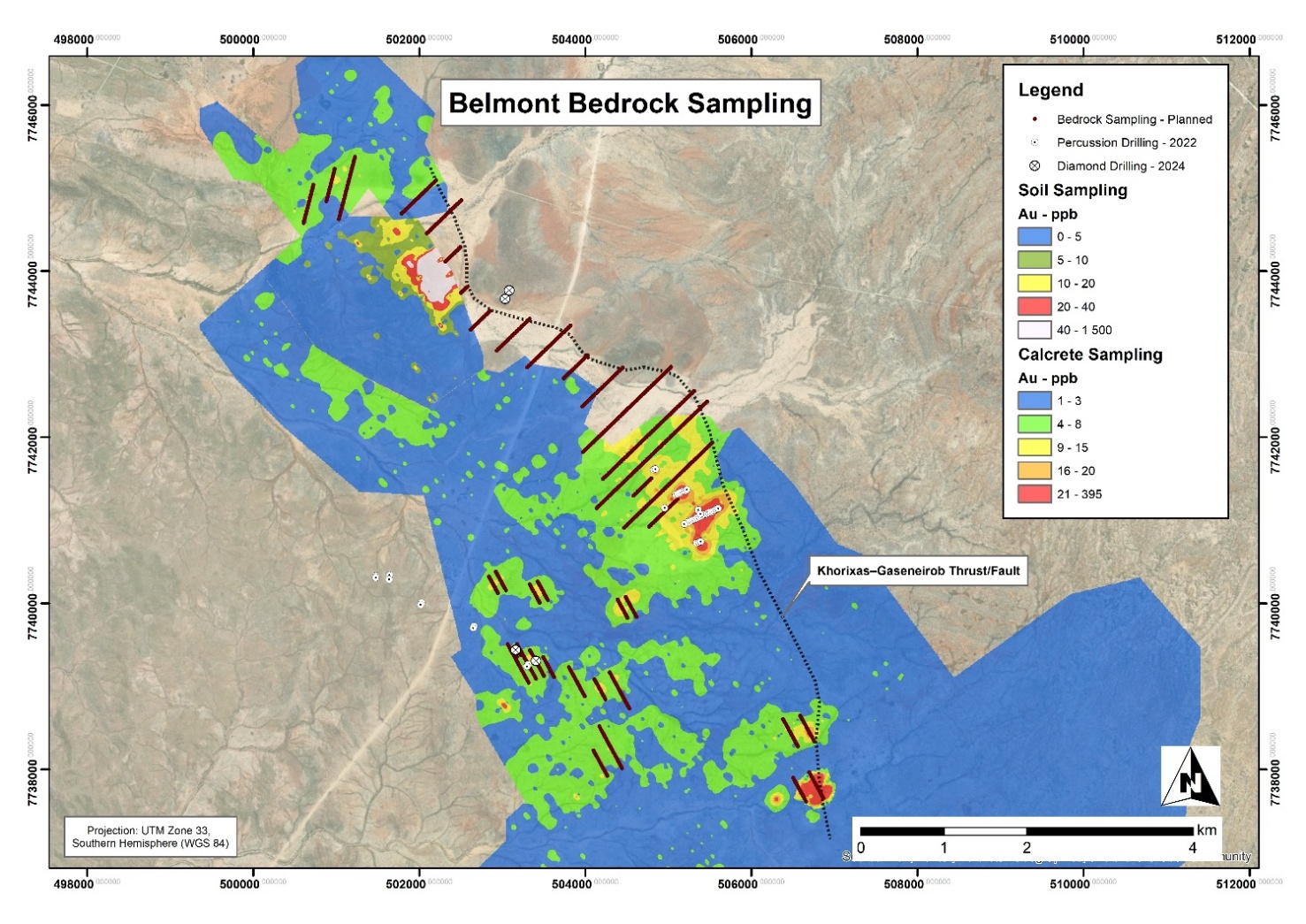
Figure 3: Belmont prospect map showing gold-in-calcrete heat map with planned bedrock sampling collar locations (brown dots).
Bedrock Sampling – Manga Prospect
Following the completion of the bedrock sampling campaign at Belmont, the RC rig will move to the Manga Gold Prospect, Omatjete (see Figure 1). The planned program will collect bedrock samples across the length of the surface gold anomaly as illustrated in Figure 4.
The Manga Prospect is a greenfields gold discovery on strike from WIA Gold’s 2.9Moz Kokoseb deposit. The prospect was first detected as a broad arsenic-in-soil anomaly identified using a portable XRF. Follow-up sampling and laboratory assays confirmed a coincident gold anomaly extending for more than 4km. Manga is situated within Kuiseb Formation schists which are mostly covered by 1 – 15 m of calcrete and sheetwash. The gold anomaly is immediately adjacent to the Okondeka Fault Zone and bordered on three sides by syn- to late-tectonic granitic intrusions (a very similar litho-structural setting to Kokoseb).
A maiden 1,800 m RC drill program was completed in October 2024, with all eleven holes intersecting sulphide and gold mineralization (arsenopyrite > pyrrhotite > pyrite > chalcopyrite) hosted in altered quartz biotite schists. Intercepts included 138 m at 0.22 g/t Au and 18 m at 0.5 g/t Au. While overall grades were modest, the final two holes, testing a parallel trend and an along-strike extension – returned some of the most encouraging results. Subsequent mapping and rock-chip sampling confirmed the presence of higher-grade gold, with assays up to 19.75 g/t Au from arsenic-rich, quartz-sulphide-veined biotite schist.
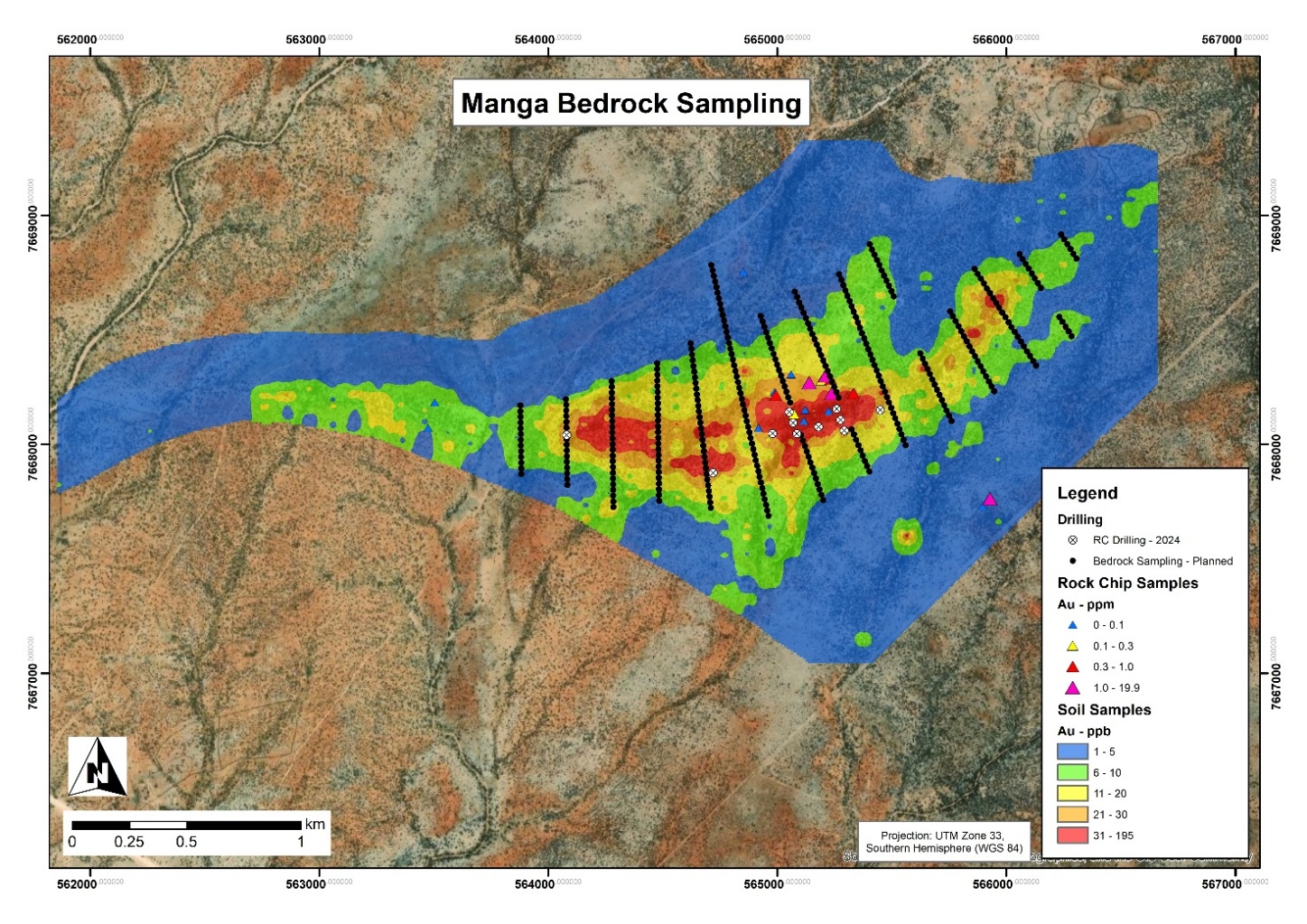
Figure 4: Manga prospect map showing gold-in-soil heat map with planned bedrock sampling collar locations (black dots).
Expanded Regional Exploration Strategy
In parallel with the ongoing bedrock sampling campaign, the Company has initiated an aggressive regional soil sampling program. Approximately 10,000 soil samples are planned across the three project areas, with the potential for additional infill sampling where new regional anomalies are identified. Line and sample spacing will be set at 200m.
The program is designed to significantly expand the Company’s exploration footprint by testing the strike extent of interpreted regional structures, including the extension of Okondeka Fault Zone located east of the Manga discovery. All regional exploration is focused on previously unexplored areas, representing true greenfield targets.
Soil sampling will be complemented by detailed geological mapping and rock chip sampling. All samples will initially be analysed using the Company’s in-house portable XRF laboratory, with all identified trace element anomalies subsequently submitted for gold analysis.
About Ongwe Minerals Inc.
Ongwe Minerals Inc. is a Canadian listed gold exploration company focused on the discovery and advancement of new gold systems in Namibia. The Ongwe team, previously with Osino Resources (sold to Shanjing International for CAD$368M), has a history of making and advancing gold discoveries in Namibia, including Osino’s Twin Hills (3.1Moz, currently in development) and Eureka deposits, and the advancement and sale of Auryx Gold’s Otjikoto gold deposit (in production, sold to B2Gold for CAD$180M).
The company’s current focus is on three promising gold projects in the emerging Northwest Damara gold belt, with a focus on the Omatjete and Khorixas Projects.
The Omatjete Gold Project is strategically located along the regional Okondeka Fault Zone, which also hosts the Kokoseb gold deposit (WIA Gold, ~2.9Moz). Early surface work by Ongwe has led to the discovery of the Manga Gold Prospect which has a 4.5km x 1km footprint of gold in soil and early scout drill assays indicating gold in bedrock. This area has significant growth potential and work is ongoing to better define the strike extent of the Manga discovery along the Okondeka Fault Zone.
The Khorixas Gold Project is situated just 60 km west of Osino's Eureka gold project adjacent to the northern margin of the Damara Orogenic Belt. Khorixas hosts two large-scale surface discoveries called Belmont and K17. The Belmont prospect has a surface gold footprint of approximately 12 × 6km and lies between the regional scale, basin margin, Khorixas-Gaseneirob Fault and the Belmont Thrust Zone. Calcrete and grab sampling to date have indicated eighteen target areas.
Qualified Person’s Statement
Carl Joone, BSc. (Hons) is the President and Co-Founder of Ongwe Minerals Inc. and has reviewed and approved the scientific and technical information in this news release and is a registered Professional Natural Scientist with the South African Council for Natural Scientific Professions (Pr. Sci. Nat. No. 172695) and a Qualified Person for the purposes of National Instrument 43-101.
ON BEHALF OF THE BOARD OF DIRECTORS
“Dave Underwood”
Chief Executive Officer
Neither the TSX Venture Exchange nor its Regulation Services Provider (as that term is defined in the policies of the TSX Venture Exchange) accepts responsibility for the adequacy or accuracy of this press release.
Cautionary Statements Regarding Forward Looking Information
This press release contains "forward-looking information" within the meaning of applicable Canadian securities legislation. Forward-looking information includes, without limitation, statements regarding the use of proceeds from the Company's future plans or prospects of the Company, including prospects for economic recoverability of mineral resources. Generally, forward-looking information can be identified by the use of forward-looking terminology such as "plans", "expects" or "does not expect", "is expected", "budget", "scheduled", "estimates", "forecasts", "intends", "anticipates" or "does not anticipate", or "believes", or variations of such words and phrases or state that certain actions, events or results "may", "could", "would", "might" or "will be taken", "occur" or "be achieved". Forward-looking statements are necessarily based upon a number of assumptions that, while considered reasonable by management, are inherently subject to business, market and economic risks, uncertainties and contingencies that may cause actual results, performance or achievements to be materially different from those expressed or implied by forward-looking statements. Although the Company has attempted to identify important factors that could cause actual results to differ materially from those contained in forward-looking information, there may be other factors that cause results not to be as anticipated, estimated or intended. There can be no assurance that such information will prove to be accurate, as actual results and future events could differ materially from those anticipated in such statements. Accordingly, readers should not place undue reliance on forward-looking information. Other factors which could materially affect such forward-looking information are described in the risk factors in the Company's most recent annual management's discussion and analysis which is available on the Company's profile on SEDAR at www.sedarplus.ca. The Company does not undertake to update any forward-looking information, except in accordance with applicable securities laws.
Photos accompanying this announcement are available at:
https://www.globenewswire.com/NewsRoom/AttachmentNg/a488af4f-8f65-443c-bcab-07d5f73a09e6
https://www.globenewswire.com/NewsRoom/AttachmentNg/699aaaec-83e2-49fa-a324-b116689caef4
https://www.globenewswire.com/NewsRoom/AttachmentNg/32f7ba3a-9a4d-4939-90c6-fd71afbb1f47
https://www.globenewswire.com/NewsRoom/AttachmentNg/aab641f2-16e5-4a12-83de-ecc918c28870



Figure 1
Company tenement map showing the location and extent of significant gold deposits as well as the newly discovered Belmont and Manga prospects.
Figure 2
RC rig commencing bedrock sampling on the “Thrust Zone Target” at the Belmont prospect, Khorixas.
Figure 3
Belmont prospect map showing gold-in-calcrete heat map with planned bedrock sampling collar locations (brown dots).
Figure 4
Manga prospect map showing gold-in-soil heat map with planned bedrock sampling collar locations (black dots).
© 2026 Canjex Publishing Ltd. All rights reserved.