(via TheNewswire)
VANCOUVER, BRITISH COLUMBIA, August 18, 2026 – TheNewswire - (TSXV: PINN, OTCQB: PSGCF, Frankfurt: P9J) – Pinnacle Silver and Gold Corp. (" Pinnacle " or the “ Company ") is pleased to provide an update on the ongoing underground drilling program at the Potrero gold-silver property in Durango, Mexico. As announced on May 5, 2026 , the program comprises more than 100 short, closely spaced holes from with the historic mine workings to better understand the size, shape and average grade of the mineralized zones.
HIGHLIGHTS
58 holes drilled to date out of a planned 108
Dos de Mayo vein displaying all the typical characteristics of a low sulphidation epithermal breccia vein
Drill holes from the upper level of the historic Pinos Cuates mine returned individual assays up to 59.2 grams per tonne gold (g/t Au) and 424 grams per tonne silver (g/t Ag) over 1.07 metres, where fine grained visible gold was observed
A horizontal hole, drilled at a shallow angle to the vein, extended the known strike length of the mineralization to the northwest by approximately 20 metres including a 13.18 metre core length assaying 9.69 g/t Au and 143 g/t Ag, while the southeast strike extent was extended with assays returning up to 9.54 g/t Au and 134 g/t Ag over 1.5 metres
Potential strike length of Pinos Cuates mineralized zone extended to at least 70 metres
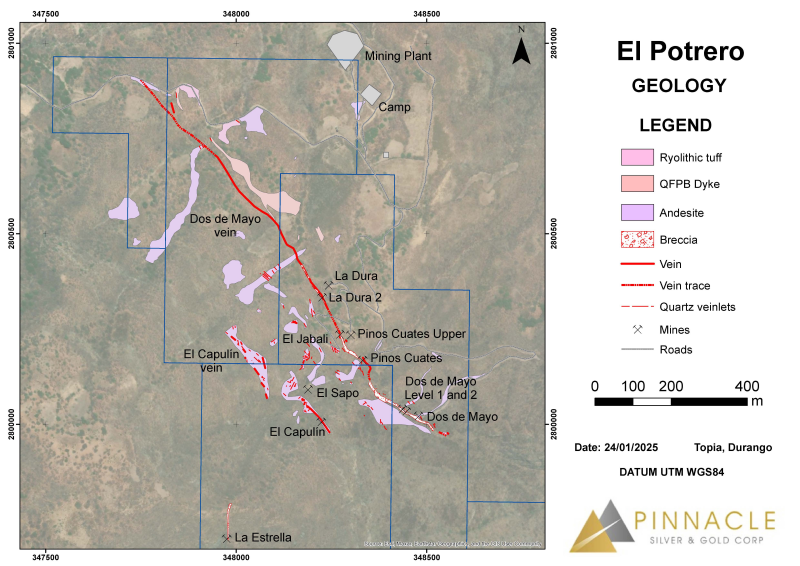
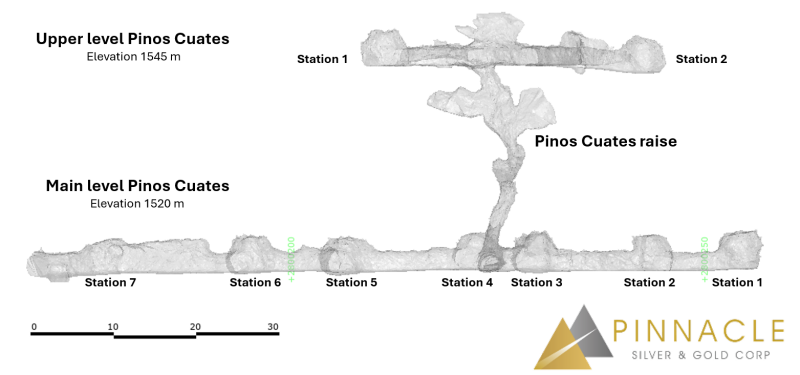
To date, 58 holes have been drilled and assays received for the first 37. For logistical reasons, the first 16 holes were drilled at the portals of the three historic mines (three at Pinos Cuates, six at La Dura and seven at Dos de Mayo – see Figure 1 below) and these will be discussed once drilling is complete in those areas. The majority of the holes have been drilled on the two levels of the Pinos Cuates mine (Figure 2), the central of the three along the Dos de Mayo vein structure. Drilling is ongoing at Pinos Cuates and it is anticipated that the drill will move to Dos de Mayo starting with hole EPUG26084.
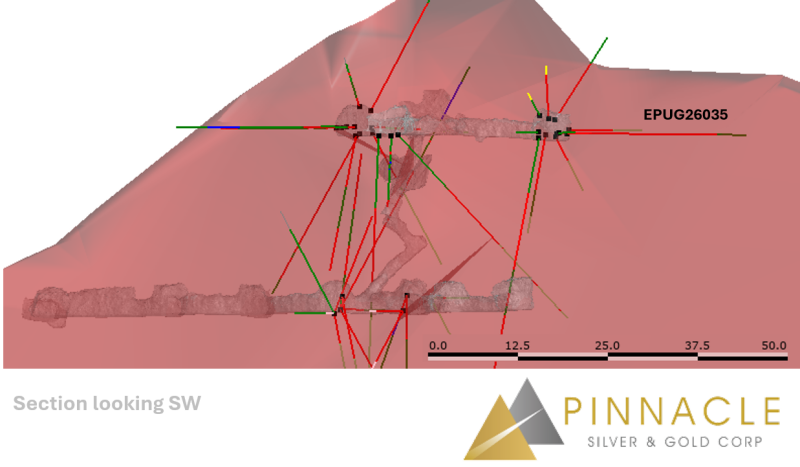
Of the results received so far, the most significant are from hole EPUG26035 in the upper level of Pinos Cuates, as it was drilled horizontally from the end of the underground workings and at a shallow angle to the strike of the vein (Figure 3). The objective of this hole was to determine the potential extent of mineralization along strike to the northwest. While this makes it difficult to calculate the actual width of the mineralized zone in this hole, it was confirmed that there is good mineralization for at least the next 20 metres along strike in that direction. The best part of this intersection assayed 9.69 g/t Au and 143 g/t Ag over a core length of 13.18 metres, with one sample containing fine grained visible gold assaying 59.2 g/t Au and 424 g/t Ag over 1.07 metres (see Table 1 below).
Similarly, holes EPUG26025 and EPUG26026 were drilled along strike to the southeast and extended the mineralization in that direction by up to 21 metres with intercepts of 0.97 g/t Au and 16 g/t Ag over 4.50 metres and 9.54 g/t Au and 134 g/t Ag over 1.5 metres, respectively. Consequently, the overall strike length of the mineralized zone at Pinos Cuates upper level has been extended to at least 70 metres. Upcoming surface drilling will further delineate this mineralization at varying depths and farther along strike to the northwest and southeast.
“The first results from the Pinos Cuates mine are extremely encouraging,” stated Robert Archer, President and CEO of Pinnacle. “As we have recently demonstrated from the underground channel sampling at the Dos de Mayo mine, higher-grade mineralization occurs in sub-vertical ‘shoots’ separated by lower-grade vein material. Given that the underground drilling is being conducted either in or adjacent to the vein, we have to keep in mind that some of the mineralization here has already been mined, but the drill holes are proving to be invaluable in improving our understanding of the El Potrero mineralizing system.”
Click Image To View Full Size
Figure 1: Location of the historic mine workings on the Dos de Mayo vein system
Results
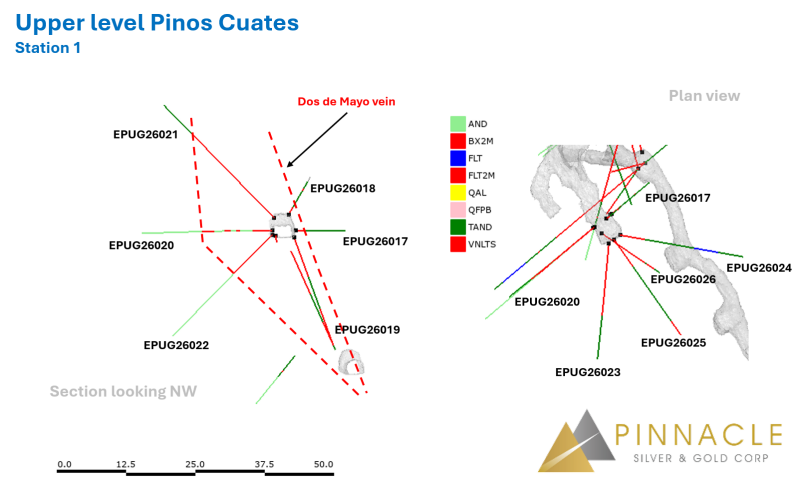
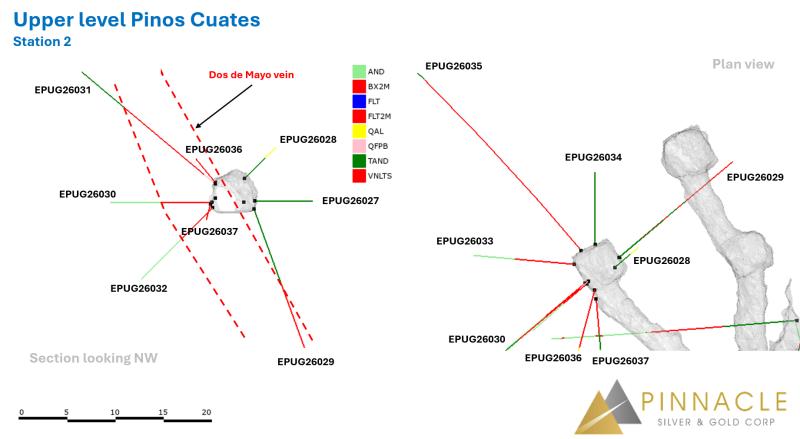
Results discussed herein include EPUG26017 to EPUG26037, inclusive, with 10 and 11 holes drilled from stations 1 and 2, respectively, on the upper level of the Pinos Cuates mine (Figures 2-5). On the main level, 18 drill holes have been drilled from three stations (assays pending), with 26 drill holes still to be drilled at four stations (Figures 2 and 3).
The best assay results are associated with zones of strong silicification and oxidation with veinlets of dark gray to black quartz, which can occur near either the hangingwall or footwall contacts or within the centre of the vein, but always cutting across the brecciated texture. It has been observed that higher grade material can sometimes be surrounded by a halo of lower grade material. While the latter may not always be economic on its own, it will be important when included into necessary dilution, rather than zero grade material.
Table 1: Highlights of drill hole intercepts from Pinos Cuates Upper Level
Hole_ID
|
Azimuth
|
Dip
|
Depth
|
Area
|
From
|
To
|
Core Length
|
Est. TW
|
Au g/t
|
Ag g/t
|
EPUG26019
|
50
|
-70
|
20.00
|
Pinos Cuates Upper Level
|
15.75
|
16.50
|
0.75
|
0.49
|
1.95
|
36
|
EPUG26021
|
230
|
+45
|
28.50
|
Pinos Cuates Upper Level
|
12.00
|
13.50
|
1.50
|
1.36
|
4.48
|
28
|
|
|
|
|
|
|
27.00
|
28.50
|
1.50
|
1.36
|
3.26
|
5
|
EPUG26023
|
185
|
0
|
21.00
|
Pinos Cuates Upper Level
|
4.90
|
6.00
|
1.10
|
Along strike
|
3.01
|
9
|
|
|
|
|
|
|
4.90
|
9.76
|
4.86
|
Along strike
|
1.27
|
9
|
EPUG26025
|
145
|
0
|
21.00
|
Pinos Cuates Upper Level
|
16.50
|
21.00
|
4.50
|
Along strike
|
0.97
|
16
|
EPUG26026
|
125
|
-60
|
25.50
|
Pinos Cuates Upper Level
|
1.50
|
3.00
|
1.5
|
Along strike
|
1.73
|
42
|
|
|
|
|
|
|
9.00
|
10.50
|
1.5
|
Along strike
|
9.54
|
134
|
EPUG26029
|
50
|
-70
|
45.00
|
Pinos Cuates Upper Level
|
10.50
|
11.70
|
1.20
|
0.91
|
2.67
|
58
|
|
|
|
|
|
|
24.97
|
28.94
|
3.97
|
3.01
|
1.05
|
29
|
|
|
|
|
|
|
43.50
|
44.00
|
0.50
|
0.37
|
10.20
|
208
|
EPUG26030
|
230
|
0
|
10.50
|
Pinos Cuates Upper Level
|
0.00
|
0.82
|
0.82
|
0.70
|
1.88
|
27
|
|
|
|
|
|
|
3.00
|
3.92
|
0.92
|
0.79
|
1.80
|
29
|
|
|
|
|
|
|
0.00
|
3.92
|
3.92
|
3.40
|
1.07
|
31
|
EPUG26031
|
230
|
+40
|
18.00
|
Pinos Cuates Upper Level
|
6.98
|
8.48
|
1.50
|
1.46
|
1.64
|
11
|
EPUG26032
|
230
|
-45
|
10.50
|
Pinos Cuates Upper Level
|
0.00
|
4.50
|
4.50
|
4.30
|
0.93
|
51
|
|
|
|
|
|
|
8.18
|
8.80
|
0.62
|
0.58
|
1.60
|
7
|
EPUG26033
|
275
|
0
|
10.50
|
Pinos Cuates Upper Level
|
3.52
|
5.62
|
2.10
|
Along strike
|
6.93
|
94
|
|
|
|
|
|
|
0.00
|
5.62
|
5.62
|
Along strike
|
3.16
|
52
|
EPUG26035
|
320
|
0
|
28.00
|
Pinos Cuates Upper Level
|
0.45
|
3.75
|
3.30
|
Along strike
|
1.41
|
69
|
|
|
|
|
|
|
15.90
|
16.97
|
1.07
| Along strike |
59.20
|
424
|
|
|
|
|
|
|
7.82
|
21.00
|
13.18
|
Along strike
|
9.69
|
143
|
EPUG26036
|
195
|
+45
|
10.50
|
Pinos Cuates Upper Level
|
1.50
|
7.50
|
6.00
|
Along strike
|
1.26
|
93
|
EPUG26037
|
175
|
-65
|
15.00
|
Pinos Cuates Upper Level
|
1.50
|
8.35
|
6.85
|
Along strike
|
3.03
|
72
|
This underground drilling campaign, in conjunction with drift mapping and channel sampling has allowed for the estimation of the true thickness of the Dos de Mayo vein, at the upper Pinos Cuates level stations, as varying from 6.50 to 7.00 metres in width. However, none of the drill holes cut the entire structure and therefore the estimated true width on the table does not represent the full vein width. The reason is that the holes are drilled from the workings within the structure and therefore the holes are drilled towards the footwall or hanging wall but never through the whole structure.
Unfortunately, oxidation and fracturing of the rock resulted in very poor core recoveries in some holes, locally averaging as low as 20%. With the gold-silver being very fine grained (50 to 80 microns as per the mineralogical studies reported on June 2, 2026 ), it is likely that some of this is being washed away by the water used in drilling. While efforts by the contractor to improve recoveries have been somewhat successful, checks are also being undertaken by panel-sampling the rock face, and resampling the initial part of some holes. If these initiatives improve the assay grades, some holes may be re-drilled.
Click Image To View Full Size
Figure 2: Longitudinal section of the historic Pinos Cuates mine showing locations of drill stations
Geology
The Dos de Mayo vein is the principal mineralized structure on the northern part of the Potrero property. It trends northwest-southeast and dips moderately to steeply to the northeast (see Figure 1). It is a complex structure composed of fault zones of reddish to light brown clayey material, subparallel veinlets and stockwork, but its main body is characterized as a polymictic breccia, containing angular to subrounded clasts of andesite and andesitic tuff (which contains rhyolite clasts), a chalcedonic quartz vein, quartz-calcite veinlets and occasionally a colloform quartz vein; all supported by a matrix of chalcedonic, colloform, cryptocrystalline and lattice-bladed quartz, silicification, and reddish-brown oxides. A vuggy texture with oxide-filled boxwork is also common and is locally host to fine grained visible gold.
Click Image To View Full Size
Figure 3: Longitudinal section of the historic Pinos Cuates mine showing holes drilled to date
Click Image To View Full Size
Figure 4: Plan and cross-sectional views of Station 1 drill holes on upper level of the historic Pinos Cuates mine
Click Image To View Full Size
Figure 5: Plan and cross-sectional views of Station 2 drill holes on upper level of the historic Pinos Cuates mine
The Dos de Mayo vein is located at the fault contact between an andesite flow below and an andesitic tuff above. Its characteristic alteration is silicification (moderate to intense) and oxidation (moderate to strong), with halos of argillic alteration and oxidation. Sericite has been observed in the alteration halos in some drill holes. The andesitic host rocks are affected by regional propylitization.
Oxides such as hematite, jarosite, and limonite, suggest the destruction of primary sulphides. Gold-silver mineralization has also been observed as ginguro in gray bands within the colloform quartz and as free gold in dark gray to black colloform quartz bands.
There is evidence of several pulses of hydrothermal activity: brecciation, quartz-silica infilling, further fracturing, and more colloform quartz-chalcedony. The presence of colloform quartz, brecciation, and oxidation of sulphides is consistent with a relatively shallow position within an epithermal system.
Surface drilling is anticipated to commence in September-October and will fill in gaps between the historic mines in addition to testing up and down dip and along strike to the northwest on the Dos de Mayo vein. Other mineralized veins such as El Capulin and La Estrella will also be drilled for the first time ever. The combined results will then be used to generate an internal resource estimate that will, in turn, be used to develop a preliminary mine plan.
QA/QC
The technical results contained in this news release have been reported in accordance with National Instrument 43-101 Standards of Disclosure for Mineral Projects (“NI 43-101”). Pinnacle has implemented industry standard practices for sample preparation, security and analysis given the stage of the Project. This has included common industry QA/QC procedures to monitor the quality of the assay database, including inserting certified reference material samples and blank samples into sample batches on a predetermined frequency basis.
Chip channel sampling was completed across exposed mineralized structures using a hammer and maul. The protocol for sample lengths established that they were not longer than two metres or shorter than 0.3 metres. The veins tend to be steeply dipping to vertical, and so these samples are reasonably close to representing the true widths of the structures. Samples were collected along the structural strike or oblique to the main structural trend.
The sampling and assay data from the core sampling and reporting are monitored through a QAQC program designed according to best industry practice. Samples from HQ and NQ sized drill core are selected by Pinnacle geologists and cut into halves with a diamond saw at the project site. Half of the core is retained at the site for reference purposes. Sample intervals vary from 0.2 to 1.5 metres in length for HQ core, and from 0.35 to 1.5 metres for NQ cores, with samples being selected to honour geological contacts.
All samples were bagged in pre-numbered plastic bags; each bag had a numbered tag inside and were tied off with adhesive tape and then bulk bagged in rice bags in batches not to exceed 40 kg. They were then numbered, and batch bags were tied off with plastic ties and delivered directly to the SGS laboratory facility in Durango, Mexico for preparation and analysis. The lab is accredited to ISO/IEC 17025:2017. All Samples were delivered in person by the contract geologist who conducted the sampling under the supervision of the QP.
SGS sample preparation code G_PRP89 including weight determination, crushing, drying, splitting, and pulverizing was used following industry best practices where all samples were crushed to 75% less than 2 mm, riffle split off 250 g, pulverized split to >85% passing 75 microns (μm). All samples were analyzed for gold using code GA_FAA30V5 with a Fire Assay determination on 30g samples with an Atomic Absorption Spectography finish. An ICP-OES analysis package (Inductively Coupled Plasma – Optical Emission Spectrometry) including 33 elements and 4-acid digestion was performed (code GE_ICP40Q12) to determine Ag, Zn, Pb, Cu and other elements.
Qualified Person
Mr. Jorge Ortega, P. Geo, a Qualified Person as defined by National Instrument 43-101, and the author of the NI 43-101 Technical Report for the Potrero Project, has reviewed, verified and approved for disclosure the technical information contained in this news release.
About the Potrero Property
El Potrero is located in the prolific Sierra Madre Occidental of western Mexico and lies within 35 kilometres of four operating mines, including the 4,000 tonnes per day (tpd) Ciénega Mine (Fresnillo), the 1,000 tpd Tahuehueto Mine (Luca Mining) and the 250 tpd Topia Mine (Guanajuato Silver).
High-grade gold-silver mineralization occurs in a low sulphidation epithermal breccia vein system hosted within andesites of the Lower Volcanic Series and has three historic mines along a 500 metre strike length. The property has been in private hands for almost 40 years and has never been systematically explored by modern methods, leaving significant exploration potential.
A previously operational 100 tpd plant on site can be refurbished / rebuilt and historic underground mine workings rehabilitated at relatively low cost in order to achieve near-term production once permits are in place. The property is road accessible with a power line within three kilometres.
Pinnacle will earn an initial 50% interest immediately upon commencing production. The goal will then be to generate sufficient cash flow with which to further develop the project and increase the Company’s ownership to 100% subject to a 2% NSR. If successful, this approach would be less dilutive for shareholders than relying on the equity markets to finance the growth of the Company.
About Pinnacle Silver and Gold Corp.
Pinnacle is focused on the development of precious metals projects in the Americas. The high-grade Potrero gold-silver project in Mexico’s Sierra Madre Belt hosts an underexplored low-sulphidation epithermal vein system and provides the potential for near-term production . In the prolific Red Lake District of northwestern Ontario, the Company owns a 100% interest in the past-producing, high-grade Argosy Gold Mine and the adjacent North Birch Project with an eight-kilometre-long target horizon . With a seasoned, highly successful management team and quality projects, Pinnacle Silver and Gold is committed to building long -term , sustainable value for shareholders.
Signed: “Robert A. Archer”
President & CEO
For further information contact :
Email: info@pinnaclesilverandgold.com
Tel.: +1 (236) 455 – 3238
Website: www.pinnaclesilverandgold.com
Neither the TSX Venture Exchange nor the Investment Industry Regulatory Organization of Canada accepts responsibility for the adequacy or accuracy of this release .
Copyright (c) 2026 TheNewswire - All rights reserved.
© 2026 Canjex Publishing Ltd. All rights reserved.