(via TheNewswire)
Vancouver, British Columbia, September 21st, 2026 – TheNewswire – Prismo Metals Inc. (the “Company ” or “Prismo ”) (CSE: PRIZ) (OTC: PMOMF) is pleased to announce the completion of its 2026 surface reconnaissance program at the Silver King project in the Pioneer Mining District near Superior, Arizona. Carried out in stages since April and previously reported in part (see news releases dated May 12 and July 15, 2026), the program combined district-scale alteration mapping, 90 rock-chip samples, induced polarization geophysics and the results of Phase 1 drilling into a single geological model.
Highlights of the Completed Reconnaissance Program
• Alteration system now measures approximately 2.1 by 2.4 kilometres , enlarged and refined by the recent field work, and remaining open beneath post-mineral volcanic cover to the east.
• Potassic alteration more than doubled in area , measuring 650 metres by 300 metres centred on an outcropping quartz diorite. Newly visited dumps at the “No Name” and “Crater” shafts contain blocks mined from depth showing pervasive disseminated pyrite, magnetite and secondary biotite replacing mafic minerals.
• Porphyry-style “B” quartz veinlets identified with chalcopyrite-magnetite centrelines and thin feldspar selvages, cutting earlier “A” veins. The presence and cross-cutting relationship of the two vein types is evidence of a volatile-rich, multi-phase mineralized system at depth.
• Phyllic alteration mapped across roughly 1.3 by 1.8 kilometres , overprinting the central potassic and outer propylitic zones at the Bilk shaft, between Silver King and Wheel, and at a newly identified location 250 metres to the southeast. Phyllic overprinting potassic is an indicator of potentially augmented grades.
• Pyrite halo significantly expanded and better defined , measuring approximately 2 by 1.2 kilometres, offset by a fault to the north and continuing beneath volcanic cover to the east, so that its full extent cannot yet be determined.
• Classic peripheral zoning confirmed — a propylitic zone extending outward beyond the pyrite halo, peripheral manganese occurrences, and copper-gold-magnetite skarns at Black Diamond and around the Crown zone.
• Multiple hydrothermal and phreatic breccias mapped , including the Silverado Wash breccia carrying a 12-centimetre fragment of intensely phyllic-altered granite — a rock type not exposed anywhere on the property — and the Crown zone, interpreted as at least partly a phreatic breccia, anomalous in gold and molybdenum with magnetite skarns on its fringes.
• 90 rock samples collected to date, together with 27 “green rock” samples submitted for mineral chemistry study. The reconnaissance results integrate with Phase 1 drilling (eight holes, 1,272 metres), in which hole SK-26-07 intersected potassic alteration with disseminated pyrite and chalcopyrite at depth, and with induced polarization geophysics showing increasing sulphide response with depth.
Next Steps
Prismo has concluded the field reconnaissance phase at Silver King. Four sequential work programs will determine where the Company drills a deep porphyry test.
1. Assay results from the final surface samples
Assays from a further 23 surface rock samples are expected shortly. These will complete the geochemical coverage of the mapped system and will be integrated with the existing 90-sample dataset to refine the district-scale metal zoning patterns already observed.
2. Green rock mineral chemistry study
Twenty-seven “green rock” samples are being evaluated by Dr. Jamie Wilkinson in conjunction with the Natural History Museum in London. Mineral chemistry of propylitic minerals is a published technique for estimating distance and direction to a porphyry centre, and is intended to provide an independent vector toward the centre of the system. Results are expected shortly.
3. Magnetotelluric (MT) survey
Discussions are underway to engage a geophysical contractor to complete an MT survey across the property. The induced polarization survey completed prior to Phase 1 drilling penetrated to approximately 225 metres; an MT survey would model the buried sulphide system to substantially greater depth, which is necessary given the muted surface expression of the system.
4. Deep drill testing
No deep porphyry drilling has been carried out on the property in modern times. The Company intends to design a deep drill program to test the postulated porphyry target directly upon completion of the work described above.
Alain Lambert, President and Chief Executive Officer, commented: “We began this program with a drill intercept and a hypothesis. We end it with a mapped alteration system more than two kilometres across, zoned in the pattern that develops above porphyry copper deposits, and sitting 3.4 kilometres from Resolution.”
He added: “What I find most compelling is not any single result but the convergence: the mapping, the surface geochemistry, the induced polarization response and the deep intercept in SK-26-07 are all pointing in the same direction. The surface expression is muted, which tells us the target is deep — and depth is precisely why this ground has been overlooked for a century and a half. Our task now is to further refine the geometry of the system before selecting drill sites, and that is what the green-rock mineral chemistry work with Dr. Wilkinson and a deeper-penetrating geophysical survey are designed to deliver.”
Dr Linus Keating, CPG, a Special Advisor to Prismo stated: “The evolving picture of zonation and mineralization at Silver King is an exciting development. Although the project fits in some ways into the classic Lowell & Guilbert model, Silver King is unique unto itself and may well provide some great surprises as the Plan of Attack is implemented.”
Plan of Attack
Assays from an additional 23 surface samples are expected shortly. To further evaluate the zoning and potential of the Silver King system, 27 “green rock” samples were collected and are currently being evaluated by Dr Jamie Wilkinson (see news release dated June 9th , 2026) in conjunction with the Natural History Museum in London. Results are expected shortly.
Evaluation of the project will continue using the awaited geochemical samples and “green rock study” results. Discussions are underway to engage a geophysical contractor to conduct an MT survey across the property that should give us much deeper modeling of the buried sulfide system than is currently possible.
Dr Craig Gibson, Chief Exploration Officer of the Company stated, “No deep porphyry drilling has been carried out on the property in modern times. The geological model along with the upcoming analyses will allow us to select drill sites to best explore the deeper porphyry potential “.
Technical Discussion
Strong Evidence Points Towards a Hidden Porphyry Copper System at Silver King
Building onto the case for a porphyry copper style target at Silver King, field reconnaissance recently completed has enlarged and refined alteration zoning, controlling basement structures, and surface mineralization. Silver King’s exposed alteration now measures 2.1 x 2.4 kilometers, with significant additional extent likely hidden beneath post-mineral volcanic cover to the east.
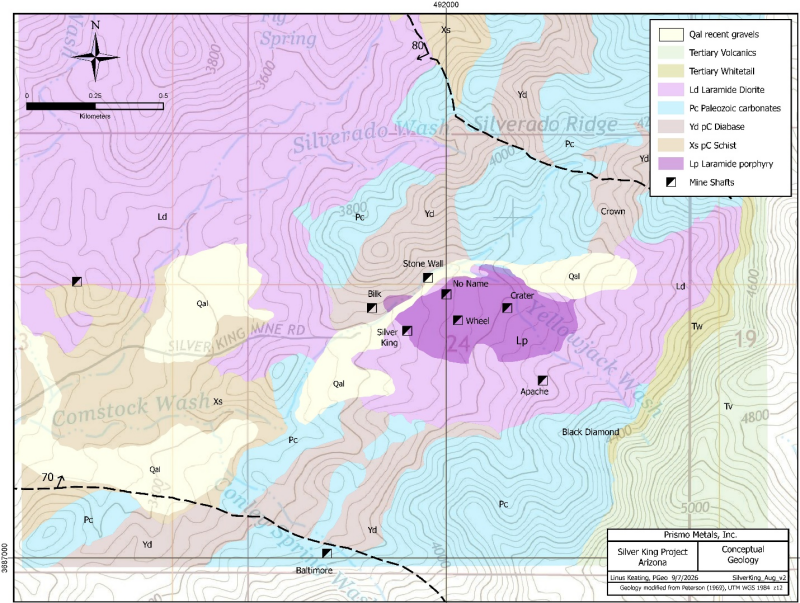
The extent of potassic alteration, an important central feature of the classic porphyry model, previously identified from dump material at the Bilk Shaft, the Stone Wall shaft and in SK-07 drillhole; has more than doubled in area. Adding to this zone, the newly visited “No Name” and “Crater” shaft’s dumps (Figure 1) exhibit blocks (that were mined from depth) of strongly altered Laramide quartz diorite with pervasive disseminated pyrite, magnetite, secondary biotite replacing mafic minerals, patches of sericite, and important veining.
Click Image To View Full Size
Figure 1: Overview of Silver King project geology, mine shafts and important features.
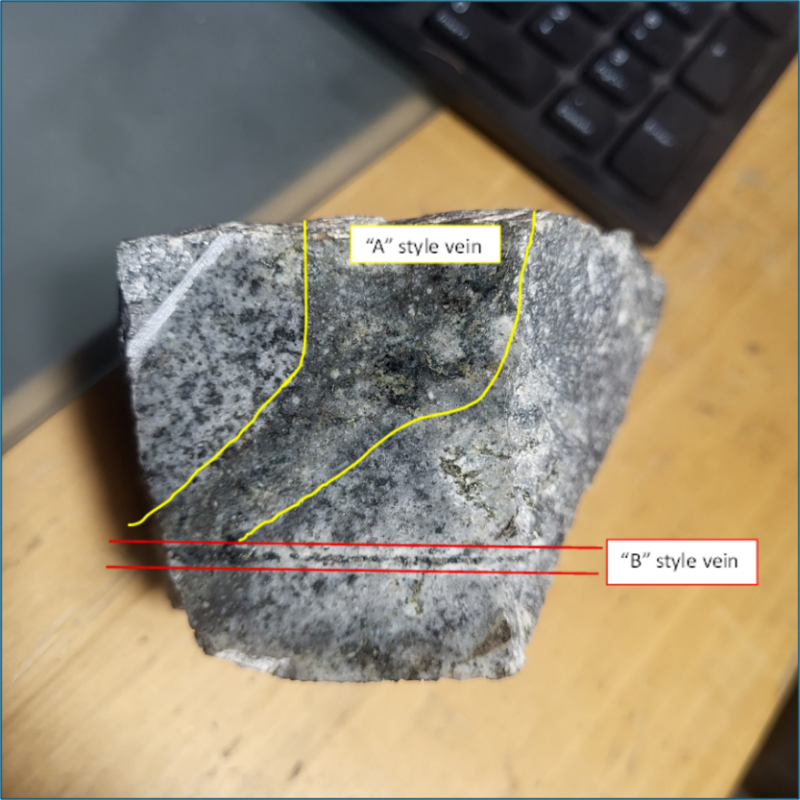
Centered on an outcropping quartz diorite intrusive (dark purple in Figure 1), potassic-style alteration measures 650 × 300 m. Veining within the potassic zone is typical, most importantly displaying porphyry-style “B” quartz veinlets with chalcopyrite–magnetite centrelines and thin feldspar selvages cutting early “A”-style veins (Figure 2). “B” veins form during higher-temperature intrusive events—often associated with an upwelling intrusive body—and can be an important part of ore deposition. “A” veins tend to be earlier, lower-temperature features associated with the peripheries of the upward-stoping intrusive. The presence and cross-cutting relationships of the two vein types provide good evidence that a volatile-rich, multiphase mineralized system may exist at depth. Although not yet seen at present exposures, where sufficient stockworks of “B” veins lace the host rock, that rock is likely to be ore grade.
Click Image To View Full Size
Figure 2: Sinuous early “A” vein (yellow), containing chlorite, potassium feldspar, magnetite and early biotite, cut by a linear “B” quartz vein (red) featuring a dark pyrite–chalcopyrite–magnetite centreline with light quartz–feldspar edges, in a matrix of silicified, phyllic-altered quartz diorite with 3% disseminated pyrite and rare patches of chalcopyrite. Sample #544642 from the “No Name” shaft; assay awaited.
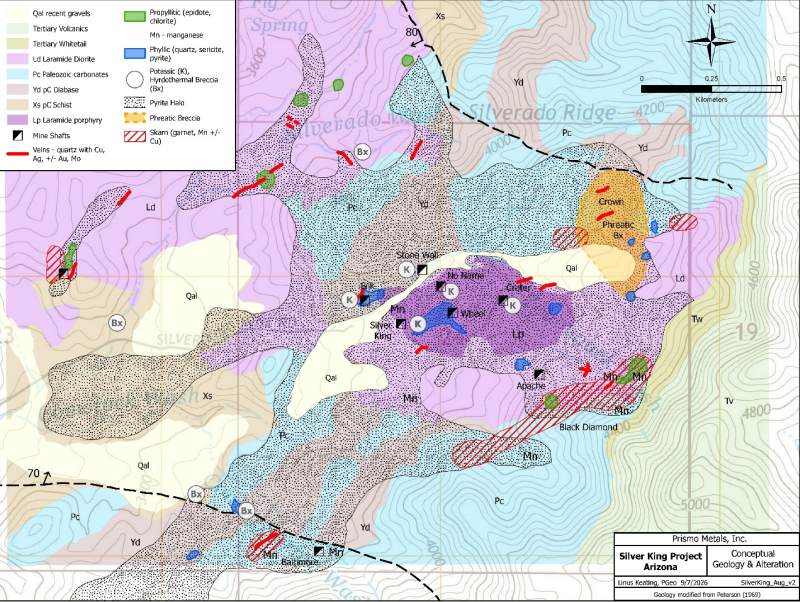
Prismo previously indicated that it was finding potassic indicators at Silver King. Particularly exciting is that field reconnaissance has now confirmed a region of potassic zoning and other features (Figure 3) that crudely fit the classic Lowell & Guilbert model (1) . The model posits that copper-bearing ore bodies that typically occupy a shell-like zone straddling the boundary between the potassic and phyllic alteration zones surrounded on the outside by lower temperature propylitic alteration. Termed “porphyry copper deposits” these ore bodies can be very large, generally containing from 100 million to several billion tons of copper ore(2) .
Augmenting the potassic region described above, and roughly concentric about it, recent mapping has identified patches of a phyllic zone overprinting the central potassic and outer propylitic zones. Stretching across an area of roughly 1.3 × 1.8 km, typical phyllic patches appear particularly at the Bilk Shaft, between Silver King and Wheel (the historic glory hole area), and at a new location 250 m to the southeast (sample #544659; see Figures 3 and 4).
Click Image To View Full Size
Figure 3: Reconnaissance map showing key alteration zones. “ K ” denotes potassic alteration; blue patches indicate phyllic locations; green represents propylitic alteration; “Mn” denotes manganese; red cross-hatching indicates skarn with manganese, copper and magnetite; red lines indicate mineralized quartz veins; and the stipple pattern marks the approximate extent of the pyrite halo. Light-yellow areas are covered by post-mineral alluvium, possibly concealing additional alteration.
The presence of phyllic alteration overprinting potassic is an important indicator of potentially augmented ore grades(3) . Associated with the intrusive system’s gradual collapse after reaching its highest levels, phyllic alteration occurs when the formerly rising magma fluids begin to mix with ground water resulting in major chemical changes, sometimes depositing significant copper and other metals. Phyllic-associated minerals such as white micas (sericite) quartz, and pyrite are deposited replacing previously deposited potassic and propyllitic minerals.
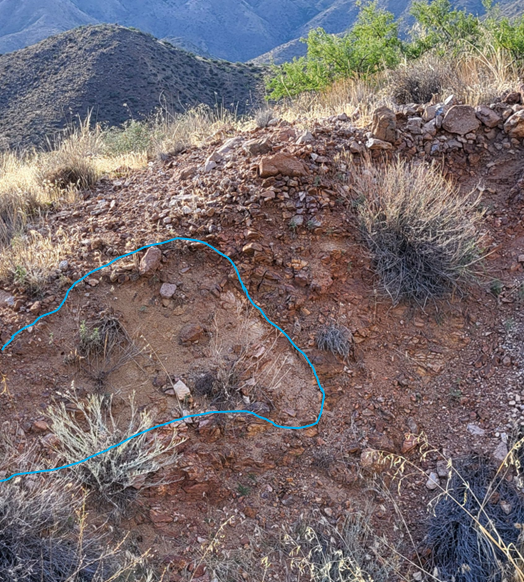
Figure 4: Outcrop in a small prospect pit exposing phyllic alteration, with brick-red oxidation after abundant pyrite, quartz veining, abundant sericite and scattered malachite (copper oxide), cutting argillized greenish quartz diorite within the blue outline. Sample #544659.
A pyrite halo at Silver King, described in previous releases, has been significantly expanded and better defined by the recent mapping. So named because it creates a large footprint around the entire porphyry system, such halos help to identify the maximum outer reach of intrusive-derived fluids. Measuring 2 × 1.2 km, the halo appears to be offset by a fault on the north side and disappears under volcanic cover to the east, remaining open in those areas so that its full extent cannot yet be determined (see the stipple pattern in Figure 4).
The outer, cooler, fringes of porphyry systems often exhibit key alteration features; recent mapping at Silver King confirms these are present. A propylitic zone has been defined that extends from the interior of Silver King alteration outwards beyond the pyrite halo (green patches on Figure 3). Propylitic alteration, composed of “green minerals” such as chlorite, epidote, calcite, actinolite, and minor feldspar, is usually preserved on the outer lowest temperature extent of intrusive systems. Manganese in porphyry systems often occurs in peripheral zones because it has been removed by the central magmatic fluids of the intrusive system and redeposited on its outer colder fringes. The “Mn” notations on Figure 3 denote sites where significant manganese is present.
Additionally, research shows that during the 1940’s manganese was commercially produced from mines along the southwestern edge of the Silver King system (Magma Chief, and Baltimore mines) (4) . Skarns containing significant manganese (also magnetite, some copper and gold) occur around the eastern and southeastern edges of the Silver King system particularly at “Black Diamond” and around the “Crown” zone.
This is partially due to the presence of amenable carbonate rocks located there but may also be an additional indicator that a robust metal-bearing system is nearby. Both the extent of manganese and skarns cannot fully be determined as they likely continue beneath post-mineral volcanics to the east and southeast. The high-grade epithermal silver +/- copper, lead, zinc veins encountered by Prismo’s recent drilling around the Silver King shaft may well be due to late, lower temperature fluids emitted during the waning stages of a mineralized porphyry, further indicative that a productive system is present.
Hydrothermal and phreatic breccias present around the Silver King system are further important indicators of porphyry activity at depth; marked on Figure 3 by a “Bx” symbol. On the west and north sides of the property these breccias contain matrix supported, rounded polylithologic fragments; matrix and fragments are cut by aplite dykelets.
In Silverado Wash to the north, the breccia contains large, milled fragments with high pyrite content, a fine-grained chlorite-silica matrix, and a 12 cm fragment of intensely phyllic altered granite, a rock type not present anywhere on the surface. To the south breccia occurrences lack the aplite fingers and are more monolithologic but often contain sericitized matrix. Most interesting is the Crown zone on the northeast side of the project. Crown is at least partially a phreatic breccia that displays small volcanic style quartz eyes on its fringes, locally intense quartz veining, is highly anomalous in both gold and molybdenum, and hosts magnetite skarns around its fringes.
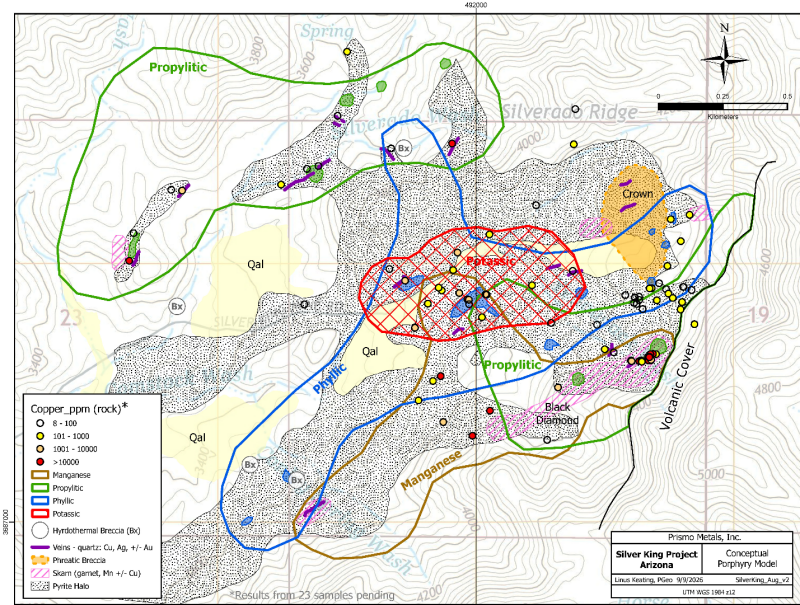
A complete summary of the Silver King alteration system is presented in Figure 5. Taken together, potassic, phyllic, and propylitic alteration all crudely concentrically zoned within a larger pyrite halo and surrounded by typical “fringe” alteration of manganese and skarns is good evidence that a porphyry copper system is present at depth. Surface rock geochemistry also shows high copper concentrations nearer to the potassic center of the system.
Click Image To View Full Size
Figure 5: Field evidence of geological zoning at the Silver King project, together with copper geochemistry. Note the extent of post-mineral volcanic cover to the east and southeast.
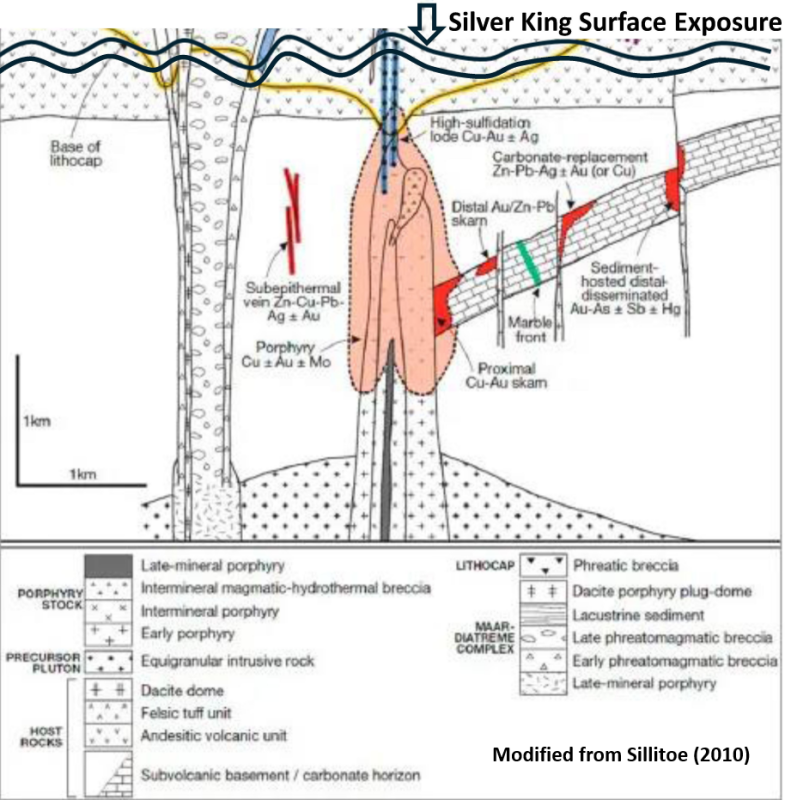
It is suspected that the size and positioning of the various alteration zones is indicative that the mineralized system is only partially exposed at surface elevations. A small footprint, vertically extensive system, potentially enriched to high grades, is envisioned. It is possible that at moderate depths this system could coalesce, enlarge, and become more coherent. Copper (and likely molybdenum and gold grades) may also become more prominent. A reasonable conceptual model showing the possible surface of Silver King is shown in Figure 6.
Click Image To View Full Size
Figure 6: Concept of relative exposure level for the proposed Silver King porphyry system.
Corporate transactions
Prismo also announces that it has closed the debt settlement transaction announced in its September 11, 2026 news release.
Sources
(1) The classic Lowell & Guilbert model (1970) is the foundational descriptive model of hypogene hydrothermal alteration and mineralization zoning in porphyry copper deposits. It was developed from detailed study of the faulted San Manuel–Kalamazoo deposit in Arizona and comparison with ~27 other deposits.
It describes roughly concentric (coaxial) shells centered on a porphyritic intrusive stock:
Potassic core — secondary K-feldspar + biotite ± anhydrite + quartz. This often contains a low-grade or barren inner core with mostly disseminated sulfides.
Phyllic (sericitic) zone — quartz + sericite + abundant pyrite. The main copper “ore shell” commonly sits near the potassic–phyllic transition.
Argillic zone — clay minerals (kaolinite ± other clays).
Propylitic halo — chlorite + epidote + carbonate (often extensive).
A pyrite-rich halo typically surrounds the ore shell. Mineralization style also changes outward and upward: disseminations in the core, then microveinlets/veinlets, then more discrete veins.
https://pubs.geoscienceworld.org/segweb/economicgeology/article-abstract/65/4/373/18036/Lateral-and-vertical-alteration-mineralization?redirectedFrom=fulltext
(2) https://pubs.usgs.gov/sir/2010/5070/b/ and https://www.researchgate.net/publication/228668686_Porphyry_deposits
(3) https://link.springer.com/article/10.1007/s00126-025-01398-0
(4) https://stacks.cdc.gov/view/cdc/206383/cdc_206383_DS1.pdf
Qualified Person
Dr. Craig Gibson, PhD, CPG, a Qualified Person as defined by National Instrument 43-101 - Standards of Disclosure for Mineral Projects and Chief Exploration Officer and a director of the Company, has reviewed and approved the technical disclosures in this news release.
The historical data presented in this news release was obtained from public sources and should be considered incomplete. The historical information is not compliant with NI 43-101, has not been independently verified by the Company and should not be relied upon. The Company is using the historical information solely as a guide to assist exploration planning.
References to mineralization at the Magma Mine, the Resolution deposit or other nearby properties are not necessarily indicative of mineralization on the Silver King Project.
About Silver King
Discovered in 1875, the Silver King mine was one of Arizona’s important historic silver producers, reportedly yielding nearly 6 million ounces of silver at grades of up to 61 oz/t. The Silver King mine is located approximately 3 km from the main shaft of the Resolution Copper project, a joint venture between Rio Tinto and BHP and believed to be one of the world’s largest undeveloped copper deposits.
The Silver King land position is surrounded by Resolution Copper’s claim block. Selected samples from small-scale production in the late 1990s returned grades as high as 644 oz/t silver (18,250 g/t) and 0.53 oz/t gold (15 g/t). These historical figures and selected sample results have not been verified by the Company and should not be considered representative of mineralization on the Silver King Project.
About Prismo Metals Inc.
Prismo (CSE: PRIZ) is a mining exploration company focused on advancing its Silver King, Ripsey and Hot Breccia projects in Arizona and its Palos Verdes silver project in Mexico.
Please follow @PrismoMetals on Twitter , Facebook , LinkedIn , Instagram , and YouTube
Prismo Metals Inc.
1100 - 1111 Melville St., Vancouver, British Columbia V6E 3V6
Phone: (416) 361-0737
Contact:
Alain Lambert, Chief Executive Officer alambert [at] cpvcgroup [dot] ca
Neither the Canadian Securities Exchange nor its Market Regulator (as that term is defined in the policies of the Canadian Securities Exchange) accepts responsibility for the adequacy or accuracy of this release.
Cautionary Note Regarding Forward-Looking Information
This news release includes certain statements and information that may constitute forward-looking information within the meaning of applicable Canadian securities laws. Forward-looking statements relate to future events or future performance and reflect management’s expectations or beliefs regarding future events.
Forward-looking statements in this news release include statements regarding the Company’s exploration model for Silver King, the potential for a concealed porphyry copper system, geological interpretations, planned field work, sampling, geophysics and drilling, and the timing, costs and results of future exploration work.
Forward-looking statements involve risks and uncertainties, and actual results may differ materially from those suggested. These risks include the speculative nature of mineral exploration, uncertainty in geological interpretation, permitting, access, financing, operational risks and the possibility that future work will not confirm the current geological model.
The Company has applied material assumptions, including assumptions regarding the availability of financing, exploration crews and equipment, project access, required approvals and permits, and the reliability of current geological interpretations.
There can be no assurance that forward-looking statements will prove accurate. Readers should not place undue reliance on forward-looking statements. The Company does not undertake to update forward-looking information except in accordance with applicable securities laws.

Copyright (c) 2026 TheNewswire - All rights reserved.
© 2026 Canjex Publishing Ltd. All rights reserved.