Montreal, Quebec--(Newsfile Corp. - April 2, 2026) - Québec Innovative Materials Corp. (CSE: QIMC) (OTCQB: QIMCF) (FSE: 7FJ) ("QIMC" or the "Company") is pleased to report results from a soil-gas geochemical survey conducted in November 2025 over its New Salem zone within the Cumberland Basin, Nova Scotia.
The survey defined a 1.5 km-long section crosscutting the faulted contact between the Rapid Brook (Horton Gp) and Ragged Reef (Cumberland Gp) Formations.
The survey demonstrated the presence of a methane-rich anomaly, extending over 450 m, closely associated with large ethane, propane and butane anomalies that may be consistent with a potential thermogenic contribution to these gases.
All samples were independently analyzed by GeoFrontiers Corporation (Texas) using gas chromatography methods, providing external verification of analytical results.
The Company believes these results support continued evaluation of the New Salem zone through follow-up geochemical, geophysical surveys, and drill-target definition.
DISCOVERY HIGHLIGHTS
450 m continuous C1-C4 soil-gas anomaly defined across 8 stations within EL56912 license block
Peak methane of 87.68 ppmv with consistent presence of C2-C4 hydrocarbons across anomaly corridor
Helium concentrations exceed atmospheric reference levels at all sample locations, indicating diffusive anomaly footprint
Management Commentary
"The results we are reporting today represent an important step forward in QIMC's exploration program within the Cumberland Basin. The scale and consistency of the anomaly identified at New Salem highlight the potential of this emerging exploration target within the Cumberland Basin. Our R2G2 exploration approach has identified a continuous 450 m multi-analyte soil-gas anomaly, supported by independently verified data from GeoFrontiers, providing a strong technical foundation for follow-up work. The consistency of the hydrocarbon and helium signatures across the surveyed corridor suggests a potential deeper geological source rather than isolated biogenic near-surface occurrences. These results support advancing the New Salem zone toward targeted geochemical and geophysical surveys and drill-ready definition. We believe this area warrants further systematic evaluation as part of our broader exploration strategy in the basin, and we look forward to progressing to the next phase of work."
- John Karagiannidis, Chief Executive Officer
SURVEY METHODOLOGY OVERVIEW
The November 2025 program was conducted within Exploration License EL56912, a license block situated near New Salem and Apple River, Cumberland County, Nova Scotia, as illustrated in Figure 1. The survey comprised a single contiguous traverse of approximately 1.5 kilometres, with 28 sample stations spaced at approximately 50-metre intervals running north-south through the central portion of the license block. Sampling on the northern segment (stations 100-1400) was completed on November 20, 2025, and the southern segment (stations 1500-1750) on November 21, 2025.
Soil-gas sampling was conducted using a standardized protocol designed to ensure reproducibility, minimal atmospheric contamination, and high analytical precision. All field sampling equipment, including steel probes and gas-tight collection vessels were supplied by GeoFrontiers (Texas, USA), whose systems are specifically engineered for shallow soil-gas geochemical surveys. Gas samples were drawn into pre-evacuated, leak-tested containers provided by GeoFrontiers, ensuring stable storage and transport. Analyses were performed by GeoFrontiers' laboratory in Texas, using high-sensitivity gas chromatography optimized for low-level hydrocarbon detection. Methane, ethane, ethylene, propane, propylene, i-butane, n-butane, and helium were quantified using calibrated multi-detector systems capable of resolving trace-level variations in both saturated and unsaturated hydrocarbons.
All 28 samples were shipped to GeoFrontiers Corporation (Texas) for independent gas chromatography analysis and quality control verification, providing independent data integrity.
FIGURE 1: EXPLORATION LICENSE EL56912 - SOIL-GAS SURVEY TRAVERSE LOCATION MAP
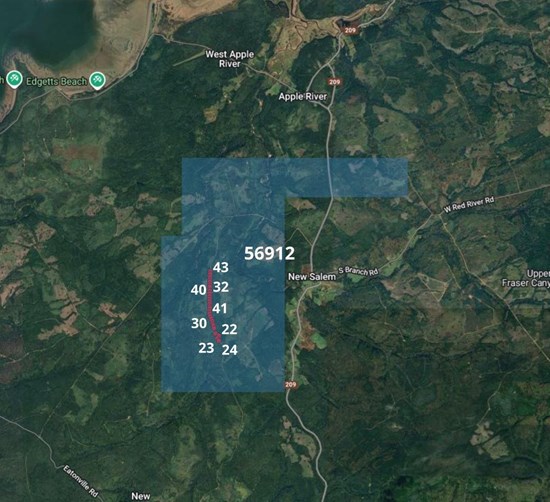
Figure 1. Satellite base map showing Exploration License EL56912 (blue shaded area) with the November 2025 soil-gas survey traverse (red dotted line) and sample station numbers. The traverse is located near New Salem, Cumberland County, Nova Scotia. Source: QIMC field operations, November 2025.
To view an enhanced version of this graphic, please visit:
https://images.newsfilecorp.com/files/7968/290988_d966ee5ae490c9d1_001full.jpg
KEY ANALYTICAL RESULTS - C1-C4 HYDROCARBONS & HELIUM (PPMV)
| Parameter | Minimum
(ppmv) | Maximum
(ppmv) | Mean (ppmv) | Stations > 5
ppmv | Atmospheric Background |
| Methane (C1) | 1.88 | 87.68 | 8.99 | 12 / 28 | 1.7-2.0 |
| Ethane (C2) | 0.0073 | 1.615 | 0.311 | - | < 0.001 |
| Propane (C3) | 0.019 | 0.5033 | 0.099 | - | < 0.001 |
| Total Butanes (C4) | 0.0406 | 0.196 | 0.095 | - | < 0.001 |
| Helium (He) | 5.306 | 5.722 | 5.456 | 28 / 28 | 5.240 |
Note: All concentrations expressed in parts per million by volume (ppmv). Atmospheric background values represent typical near-surface reference levels for Cumberland Basin geology. Helium atmospheric background = 5.240 ppmv.
HYDROCARBON GAS RESULTS
The survey recorded a peak methane (C1) concentration of 87.68 ppmv, measured at station QIMC-ARE-1050 within the EL56912 traverse corridor. Twelve of the 28 stations (43%) returned methane values in excess of 5.0 ppmv, with a cluster of seven consecutive stations recording values between 5.7 ppmv and 87.7 ppmv, a pattern consistent with a coherent sub-surface source rather than isolated near-surface contamination. The survey-wide mean methane concentration of 8.99 ppmv is substantially above typical crustal background for this geological setting.
Of particular significance to the Company's exploration thesis is the consistent presence of heavier hydrocarbon components (C2-C4) across the anomalous zones within the EL56912 license block. Ethane (C2) reached a peak value of 1.61 ppmv, propane (C3) a peak of 0.503 ppmv, and total butanes (C4) a combined peak of 0.211 ppmv. The co-occurrence of these wet-gas constituents with elevated methane (Figure 2) may indicate a potential thermogenic contribution, distinguishing the observed anomalies from potential shallower biogenic methane sources. The combined C2-C4 fraction reached a maximum of 2.31 ppmv, further supporting a potential thermogenic contribution to the observed gas signature.
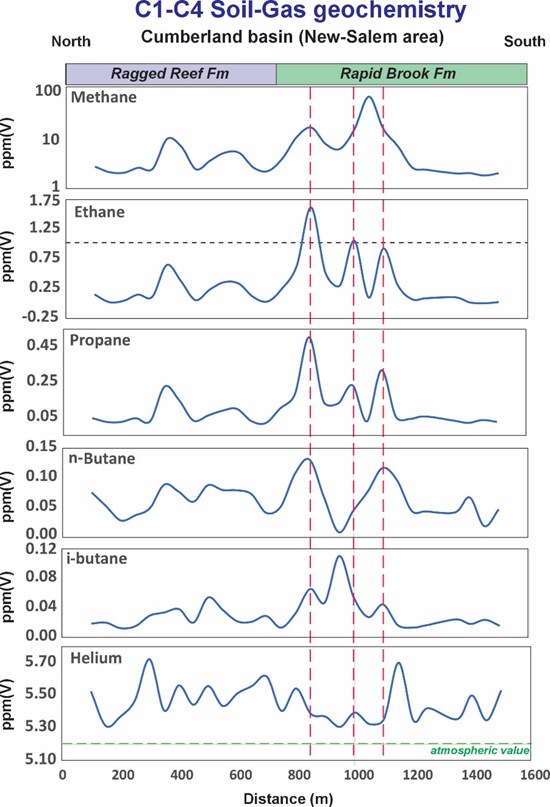
Figure 2. Sections of the soil-gas data showing C1-C4 hydrocarbons and helium from the New Salem survey.
To view an enhanced version of this graphic, please visit:
https://images.newsfilecorp.com/files/7968/290988_d966ee5ae490c9d1_002full.jpg
The soil-gas anomalies observed along the section show methane-to-(ethane + propane) ratios that are too low to be attributed to biogenic sources generated by the decomposition of forest organic matter. The strong correlation among these gases provides evidence that may be consistent with a thermogenic contribution within the underlying rock. The elevated concentrations of C₂-C₄ hydrocarbons relative to methane may be consistent with a gas composition that includes heavier hydrocarbon components.
The spatial coherence of the hydrocarbon anomaly across 1.5 kilometres of continuous traverse within a single license block underscores the potential scale of the underlying prospective structure.
HELIUM RESULTS
A notable feature of the dataset is the consistent elevation of soil-gas helium across the entire 28-station survey. Atmospheric helium concentration is approximately 5.240 ppmv; every single sample collected during the November 2025 program returned helium values above this threshold, ranging from a low of 5.306 ppmv to a high of 5.722 ppmv, with a survey mean of 5.456 ppmv. This represents an average anomaly of approximately 4.0% above atmospheric background, with the peak station exhibiting an anomaly exceeding 10.8% above background.
Helium in soil-gas surveys is widely recognized as a tracer of deep crustal or mantle-derived fluid pathways. The absence of any background-level stations, all 28 sample points returning more elevated helium, suggests that the entire surveyed corridor may indicate potential diffusive fluid migration pathways to the near surface.
INDEPENDENT LABORATORY VERIFICATION
All 28 soil-gas samples were independently analyzed by GeoFrontiers Corporation, a specialized geochemical laboratory based in Texas with extensive experience in petroleum and critical mineral soil-gas surveys across North America. GeoFrontiers utilized gas chromatography methods to quantify C1-C4 hydrocarbon fractions and helium concentrations in all submitted samples. The independent verification report, confirms the integrity of sampling procedures and the accuracy of the reported analytical values. QIMC management considers the GeoFrontiers verification to be an essential component of the Company's commitment to rigorous, independent quality data standards.
WHY THIS MATTERS TO INVESTORS
The identification of a thermogenic gas anomaly zone within the Cumberland Basin system represents an important exploration development in the Company's current program. Even if the Cumberland Basin has not produced commercial natural gas in the past, geological and new geochemical evidence shows it is prospective and could be comparable to nearby producing basins.
Until now, the subsurface potential of the EL56912 corridor near New Salem had never been systematically evaluated using modern multi-analyte soil-gas techniques, and no oil or gas drilling has been conducted in the area. In addition, no deep seismic surveys have been acquired. As a result, our findings highlight the need for further exploration to properly assess the full resource potential of the western part of the Cumberland Basin.
QIMC deployed its proprietary R2G2 exploration methodology to identify and evaluate this area. R2G2 is a systematic, staged exploration workflow that integrates near-surface soil-gas geochemistry,geophysics, structural geology, and subsurface modeling to define drill-ready targets. The November 2025 survey represents the successful completion of Stage 1 of the R2G2 workflow and directly unlocks Stage 2: targeted geochemical and geophysical acquisition and drill-target definition within EL56912.
The significance of the current dataset can be summarized across three dimensions:
Scale of Anomaly: A 1.5-kilometre section containing a 450 m continuous soil-gas anomaly, with an associated diffusive helium response, is noteworthy for a first-pass survey and may be consistent with a potential deeper geological source rather than a localized seep.
Helium Optionality: The consistent above-background helium diffusive anomaly introduces a dual-commodity exploration thesis. Helium is a strategically critical, non-renewable gas commanding significant market premiums, and its co-occurrence with thermogenic hydrocarbons in the Cumberland Basin is a previously under-appreciated exploration vector.
Wet Condensate Gas: The C2-C4 signature may be consistent with a wet-gas signature. Unlike dry gas, a wet-gas signature may be associated with the presence of liquid hydrocarbon components.
QIMC management intends to advance the EL56912 new zone through a staged program of targeted geochemical and geophysical surveys and drilling of the identified anomaly corridor. The Company will provide further updates as the program advances. We are moving forward with the next phase of work to further define this emerging target.
SCIENTIFIC COMMENTARY
By Professor Marc Richer Lafleche, INRS — Institut National de la Recherche Scientifique
During the 2025 hydrogen exploration program, the study area was expanded to include the southern Cumberland Basin near New Salem. Soil-gas surveys were conducted to evaluate the transition zone between the Cobequid Highlands (Advocate area) and the northern margin of the Cumberland Basin. Initial field measurements by QIMC detected samples enriched in volatile organic compounds. In response, the exploration team carried out a second soil-gas campaign specifically targeting C1-C4 hydrocarbons in the near-surface environment. The methodology follows the INRS approach used to assess hydrocarbon potential in the Lower St. Lawrence region and is based on a sampling and analytical protocol developed by GeoFrontiers (Texas, USA).
The results presented in this press release indicate that, in addition to hydrogen potential, the Cumberland region may also host hydrocarbon systems supporting a phase 2 program in the area. Anomalies observed along the forest road in the New Salem sector provide evidence for thermogenic hydrocarbons within the basin's geological formations. Because soil-gas surveys are a direct detection technique, the anomalies measured at surface may indicate potential migration of hydrocarbons to the surface. Although these data cannot quantify subsurface resources, they are highly effective for focusing follow-up exploration and reducing the area requiring more intensive and costly methods such as seismic reflection and drilling.
Favourable geological setting for natural gas and condensate in the Cumberland region and the New Salem area (Figure 3)
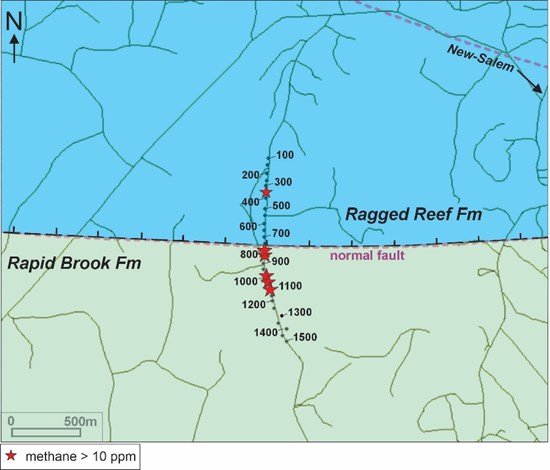
Figure 3 - Figure showing the geology, the normal fault responsible for the subsidence, the station numbers, and the anomalies exceeding 10 ppm of CH₄.
To view an enhanced version of this graphic, please visit:
https://images.newsfilecorp.com/files/7968/290988_d966ee5ae490c9d1_003full.jpg
Beyond its history as a coal-producing district, the Cumberland Basin exhibits geological characteristics favourable to several energy resources, including geothermal energy, natural gas, condensates, and notably natural hydrogen, as demonstrated by QIMC's 2025-2026 work. Previous studies of the basin's hydrocarbon potential have identified credible prospects for thermogenic gases dominated by methane with variable condensate fractions (Nova Scotia Department of Energy, Open File 2017-03). Despite geochemical and stratigraphic evidence, the western Cumberland region remains underexplored for natural gas and suffers from a low density of geoscientific data. Accordingly, the QIMC-INRS team considers the area an excellent candidate for an integrated geophysical, structural, and geochemical study to pinpoint high-potential targets.
Available Nova Scotia government data suggest that hydrocarbon sources in the Cumberland Basin are likely lacustrine or deltaic shales and coal-rich strata. Analyses of these organic-rich units have returned Type III and locally mixed Type II-III kerogen signatures, with maturity levels consistent with thermogenic gas generation. These characteristics may explain the soil-gas anomalies observed at New Salem and support the expectation of a gas ± condensate system.
The Cumberland Basin hosts a variety of potential structural traps produced by syn-rift extension and later compressional reactivation. These include fault-bounded closures, anticlines above listric normal faults, tilted and rotated fault blocks, thrust-related compartments, and inversion-related hanging-wall anticlines. Some of these structures are likely present in the New Salem area, but the absence of drilling and seismic surveys prevents detailed documentation of their geometry. However, QIMC soil-gas anomalies reported here occur exclusively over sedimentary rocks of the Rapid Brook Formation (Horton Group). These rocks are separated from the younger sedimentary rocks of the Ragged Reef Formation (Cumberland Group) by a major east-west-trending normal fault. A plausible hydrocarbon context could involve the conglomerates and sandstones of the Rapid Brook Formation, which may offer sufficient porosity and permeability to act as reservoirs. The presence of argillites, reported in Nova Scotia government databases, may locally provide an effective seal. Structurally, the trapping mechanism could be linked to the normal fault, forming a classic "tilted fault-block" trap common in extensional basins. The southward dip of the Rapid Brook Formation, combined with the northward downthrow of the fault, provides an optimal trap geometry. The Rapid Brook Formation could represent a credible gas target if it shares the organic richness, thickness, and maturity attributes of known Maritime shales. However, current public and industry data remain limited, making focused data acquisition, including an initial regional soil-gas geochemical program, essential for targeting priority exploration areas and estimating the hydrocarbon potential of the western Cumberland Basin.
Reference:
Hayes et al., 2017. Assessment of Oil and Gas Potential Windsor and Cumberland Basins. Petrel Robertson Consulting Ltd. Open File 2017-03 report for the Nova Scotia Department of Energy.
About Québec Innovative Materials Corp. (QIMC)
Québec Innovative Materials Corp. is a North American exploration and development company advancing a portfolio of natural hydrogen and critical mineral projects. The Company is advancing its district-scale hydrogen exploration model across Québec, Ontario, Nova Scotia, and Minnesota (USA), leveraging its proprietary R2G2™ framework developed in collaboration with INRS. QIMC is committed to sustainable development, environmental stewardship, and innovation, with the objective of supporting clean energy and decarbonization initiatives.
Disclaimer
Neither the Canadian Securities Exchange nor its Regulation Services Provider accepts responsibility for the adequacy or accuracy of this release.
Forward-Looking Statements
This press release contains "forward-looking statements" and "forward-looking information" within the meaning of applicable Canadian securities legislation. These statements are based on expectations, estimates, and projections as of the date of this press release and involve known and unknown risks, uncertainties, and other factors that may cause actual results, performance, or achievements of the Company to differ materially from those expressed or implied.
Forward-looking statements are generally identified by words such as "expects," "anticipates," "believes," "intends," "estimates," "projects," "potential," and similar expressions, or by statements that events or conditions "will," "may," "could," or "should" occur.
Although the Company believes that the forward-looking information contained herein is reasonable as of the date of this press release, such information is subject to change and no assurance can be given that future results will be achieved. The Company undertakes no obligation to update forward-looking statements except as required by applicable law.

To view the source version of this press release, please visit https://www.newsfilecorp.com/release/290988

© 2026 Canjex Publishing Ltd. All rights reserved.