Extension drilling extended mineralization beyond the current pit-limits at depth
Infill drilling, including hole 26-SPX-RC003 (1.94 g/t Au over 16.3 m), is targeting resource upgrade and conversion within the pit limits
Infill assays are materially higher-grade than the M&I and Inferred resource grade of 1.18 g/t and 1.72 g/t, respectively
Vancouver, British Columbia--(Newsfile Corp. - June 17, 2026) - Talamore Mining Corporation (TSXV: TALA) (OTCQB: TALMF) ("Talamore" or the "Company") is pleased to report results from the first fifteen holes of an ongoing 40,000-metre infill and exploration drilling program at its wholly-owned Coffee Gold project in Canada's Yukon Territory. Drilling is currently targeting the higher-grade Supremo Extension zone (Figures 1 & 2), which currently hosts an Indicated Resource of 2,437 kt at a grade of 1.18 grams per tonne (g/t) gold for a contained 92,000 ounces of gold, and an Inferred Resource of 6,059 kt at a grade of 1.72 g/t gold for a contained 335,000 ounces of gold. The Inferred grade at Supremo Extension is significantly higher than the 1.15 g/t Au grade of the overall Coffee Gold project resource estimate and thus provides a compelling target for converting high-grade ounces to the Indicated category for inclusion in the Feasibility Study currently underway.
Today's release includes assay results from the first fifteen reverse circulation holes totalling 1,961 metres of a planned 25,000 metres of infill drilling at Supremo Extension. A total of 125 drill holes for approximately 16,500 metres have been completed to date this year.
Drilling Highlights
Highlights of the holes reported here from the Supremo Extension structural system include:
1.94 g/t Au over 16.3 m estimated true width (ETW) in hole 26-SPX-RC003
4.77 g/t Au over 3.8 m ETW in hole 26-SPX-RC008
9.28 g/t Au over 3.0 m ETW in hole 26-SPX-RC011
4.44 g/t Au over 4.0 m ETW in hole 26-SPX-RC075
7.06 g/t Au over 3.0 m ETW in hole 26-SPX-RC035
Tim Warman, President and CEO of Talamore Mining, said "We are very excited to release our first assays on the Coffee Gold Project since its acquisition in late 2025, and the first publicly released assays on the project since 2017. We are encouraged by the grades encountered in these first assays, as many are significantly higher grade than the resource grades in our September 2025 preliminary resource estimate (see press release dated September 15, 2025)." Mr. Warman continued "Our 2026 drilling program is designed to grow the resource base across the broader Coffee property, while maintaining a strong focus on the Supremo Extension target. There, our objective is to continue expanding mineralization beyond the current pit limits, increase the overall scale of the pit, and convert and add higher-grade ounces both within and adjacent to the existing resource. Having just commenced our Supremo Extension infill and expansion drilling program, these initial results support our expectation that Supremo extension will play an increasingly important role in both resource conversion and resource growth at the Coffee Gold Project."
Geology and Context of Results
The Coffee Gold project consists of multiple mineralized structural zones forming the equivalent of a large vein swarm with individual structural zones from one to over thirty metres in width and extending up to four-kilometres in strike length (Figure 1).
Holes 26-SPX-RC001, 26-SPX-RC002 and 26-SPX-RC003 (Figures 2 & 3) encountered shallow high-grade gold within 20 metres of the surface and extended the high-grade seen in previous drill holes closer to the surface. These holes also added mineralization within the current resource pit, and outside it, with mineralization remaining open at depth.
Holes 26-SPX-RC008 and 26-SPX-RC012 (Figures 2 & 4) encountered shallow higher-grade gold within 30 metres of the surface, with grade increasing with depth. These holes also added mineralization both within and outside the current resource pit, with mineralization remaining open at depth. These holes are drilled on a cross section between existing completed cross sections.
Holes 26-SPX-RC009, 26-SPX-RC011 and 26-SPX-RC013 (Figures 2 & 5) help to confirm the current resource model interpretation and shows grade increasing with depth. These holes also intercepted mineralization both within and outside the current resource pit, with mineralization remaining open at depth. These holes are drilled on a cross section between existing completed cross sections.
Holes 26-SPX-RC034, 26-SPX-RC035, 26-SPX-RC037 and 26-SPX-RC038 (Figures 2 & 6) help to confirm the current resource model and show grade increasing with depth and becoming shallower in dip., with mineralization remaining open at depth. These holes are drilled on a cross section between existing completed cross sections.
Holes 26-SPX-RC069, 26-SPX-RC075 26-SPX-RC091 (Figures 2, 7, 8 & 9) these are the most near-surface holes completed in new sections of drill holes between two existing completed cross sections. The holes encountered shallow high-grade gold within 25 to 35 metres of the surface.
Several new targets exhibiting coincident geochemical and geophysical signatures analogous to those associated with mineralized zones at the Coffee Gold Project will be tested across the 70,000-hectare property this summer.
These fifteen holes mark the start of a campaign to infill between existing completed cross sections on the Supremo Extension target, in order to increase drill density and upgrade resources from Inferred to Indicated for inclusion in the Feasibility Study currently underway. Infill and/or expansion drilling is also planned for the Supremo, Latte, Kona and Kazar deposits.
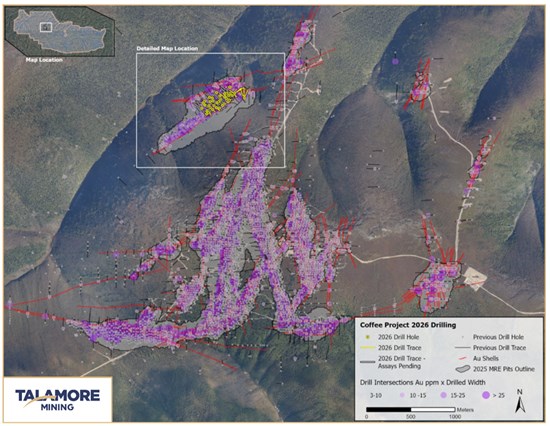
Figure 1. Known mineralized systems and existing drill holes at the Coffee Gold Project. Resource pit outlines in Figures 1 through 9 are based on the report entitled "NI 43-101 Technical Report for the 2025 Mineral Resource Estimate Update on the Coffee Gold Project, Yukon, Canada" prepared for Fuerte Metals Corporation by Micon International, with an effective date of August 21, 2025, and an issue date of October 6, 2025.
To view an enhanced version of this graphic, please visit:
https://images.newsfilecorp.com/files/7505/301700_e0df4f7c44e3698a_001full.jpg
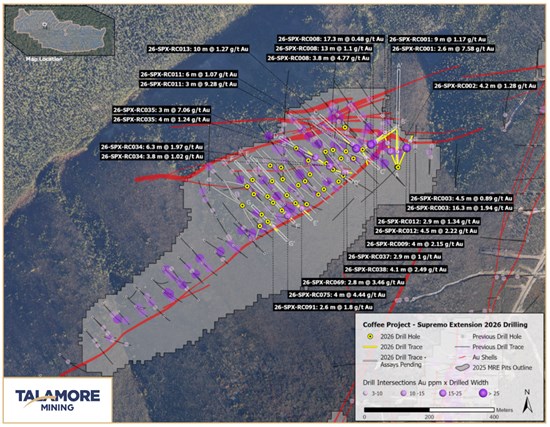
Figure 2. Location of drill holes and cross-sections from the current release, Supremo Extension.
To view an enhanced version of this graphic, please visit:
https://images.newsfilecorp.com/files/7505/301700_e0df4f7c44e3698a_002full.jpg
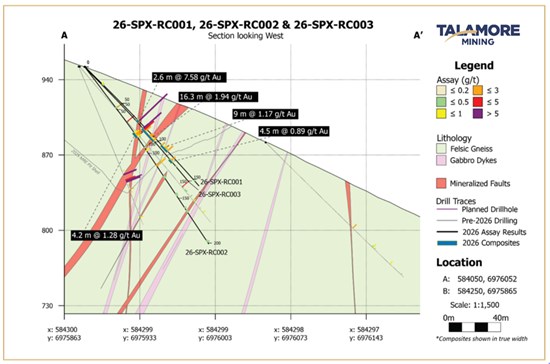
Figure 3. Cross-section A-A' through the Supremo Extension showing multiple high-grade zones.
To view an enhanced version of this graphic, please visit:
https://images.newsfilecorp.com/files/7505/301700_e0df4f7c44e3698a_003full.jpg
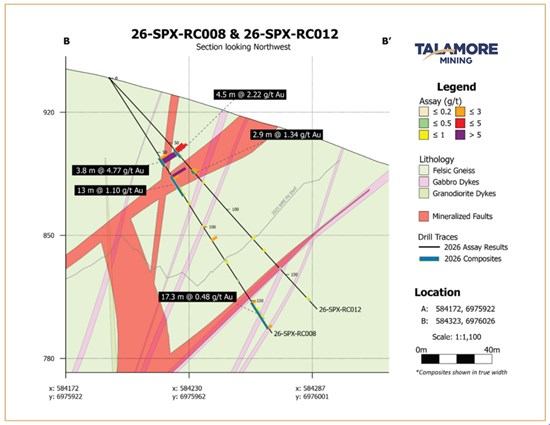
Figure 4. Cross-section B-B' through the Supremo Extension showing near surface high-grade structural zones.
To view an enhanced version of this graphic, please visit:
https://images.newsfilecorp.com/files/7505/301700_e0df4f7c44e3698a_004full.jpg
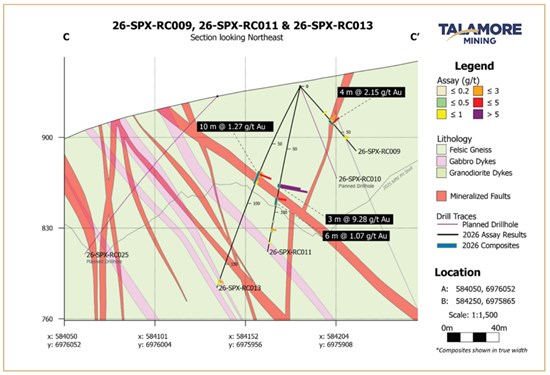
Figure 5. Cross-section C-C' through the Supremo Extension showing mineralized structures.
To view an enhanced version of this graphic, please visit:
https://images.newsfilecorp.com/files/7505/301700_e0df4f7c44e3698a_005full.jpg
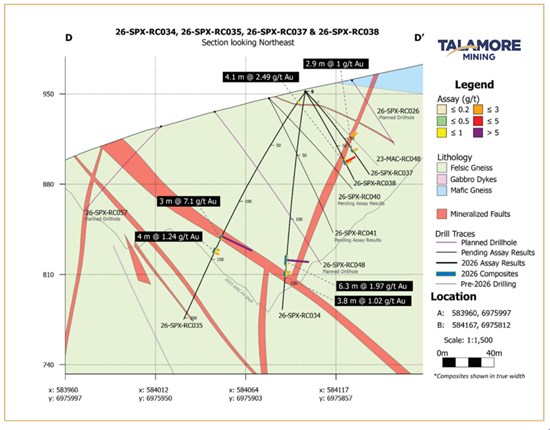
Figure 6. Cross-section D-D' through the Supremo Extension showing mineralized structures.
To view an enhanced version of this graphic, please visit:
https://images.newsfilecorp.com/files/7505/301700_e0df4f7c44e3698a_006full.jpg
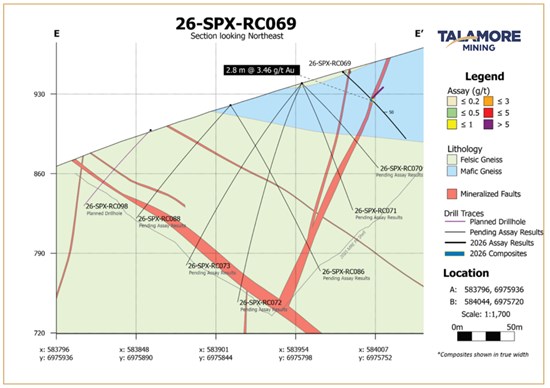
Figure 7. Cross-section E-E' through the Supremo Extension showing mineralized structures.
To view an enhanced version of this graphic, please visit:
https://images.newsfilecorp.com/files/7505/301700_e0df4f7c44e3698a_007full.jpg
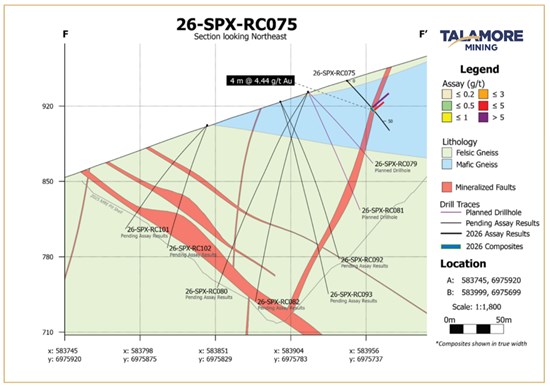
Figure 8. Cross-section F-F' through the Supremo Extension showing mineralized structures.
To view an enhanced version of this graphic, please visit:
https://images.newsfilecorp.com/files/7505/301700_e0df4f7c44e3698a_008full.jpg
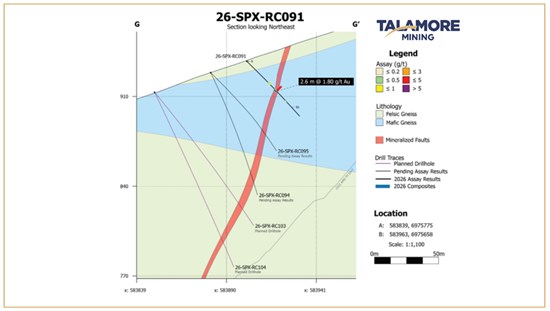
Figure 9. Cross-section G-G' through the Supremo Extension showing mineralized structures.
To view an enhanced version of this graphic, please visit:
https://images.newsfilecorp.com/files/7505/301700_e0df4f7c44e3698a_009full.jpg
Table 1. Detailed Drill results
| Drill Hole | From (m) | To (m) | Drill length (m) | Estimated true width (m) | Au g/t | Zone |
| 26-SPX-RC001 | 71.6 | 74.7 | 3.1 | 2.6 | 7.58 | Supremo Extension |
| 26-SPX-RC001 | 105.2 | 114.3 | 9.1 | 9.0 | 1.17 | Supremo Extension |
| 26-SPX-RC002 | 76.2 | 82.3 | 6.1 | 4.2 | 1.28 | Supremo Extension |
| 26-SPX-RC003 | 82.3 | 99.1 | 16.8 | 16.3 | 1.94 | Supremo Extension |
| 26-SPX-RC003 | 121.9 | 126.5 | 4.6 | 4.5 | 0.89 | Supremo Extension |
| 26-SPX-RC008 | 53.3 | 59.4 | 6.1 | 3.8 | 4.77 | Supremo Extension |
| 26-SPX-RC008 | 65.5 | 79.3 | 13.7 | 13.0 | 1.10 | Supremo Extension |
| 26-SPX-RC008 | 150.9 | 169.2 | 18.3 | 17.3 | 0.48 | Supremo Extension |
| 26-SPX-RC009 | 36.6 | 41.2 | 4.6 | 4.0 | 2.15 | Supremo Extension |
| 26-SPX-RC011 | 77.7 | 80.8 | 3.1 | 3.0 | 9.28 | Supremo Extension |
| 26-SPX-RC011 | 88.4 | 94.5 | 6.1 | 6.0 | 1.07 | Supremo Extension |
| 26-SPX-RC012 | 54.9 | 61 | 6.1 | 4.5 | 2.22 | Supremo Extension |
| 26-SPX-RC012 | 70.1 | 73.2 | 3.1 | 2.9 | 1.34 | Supremo Extension |
| 26-SPX-RC013 | 73.2 | 83.8 | 10.7 | 10.0 | 1.27 | Supremo Extension |
| 26-SPX-RC034 | 128 | 135.6 | 7.6 | 6.3 | 1.97 | Supremo Extension |
| 26-SPX-RC034 | 140.2 | 144.8 | 4.6 | 3.8 | 1.02 | Supremo Extension |
| 26-SPX-RC035 | 129.5 | 132.6 | 3.1 | 3.0 | 7.06 | Supremo Extension |
| 26-SPX-RC035 | 140.2 | 144.8 | 4.6 | 4.0 | 1.24 | Supremo Extension |
| 26-SPX-RC037 | 61 | 64 | 3.1 | 2.9 | 1.00 | Supremo Extension |
| 26-SPX-RC038 | 62.5 | 67.1 | 4.6 | 4.1 | 2.49 | Supremo Extension |
| 26-SPX-RC069 | 33.5 | 36.6 | 3.1 | 2.8 | 3.46 | Supremo Extension |
| 26-SPX-RC075 | 33.5 | 38.1 | 4.6 | 4.0 | 4.44 | Supremo Extension |
| 26-SPX-RC091 | 30.5 | 33.5 | 3.1 | 2.6 | 1.80 | Supremo Extension |
The goal of targeting the higher-grade infill portion within the main Supremo Extension is to increase both the size and the grade of the resource for inclusion in the current Feasibility Study work. The current open-pit mineral resource estimate comprises:
Table 2. 2025 Coffee Gold Project Mineral Resource Estimate
| Resource Category | Tonnage
(kt) | Gold Grade
(g/t) | Metal Content
(gold koz) |
| Measured | 1,200 | 1.80 | 69 |
| Indicated | 78,846 | 1.14 | 2,888 |
| Measured + Indicated | 80,046 | 1.15 | 2,957 |
| Inferred | 21,200 | 1.17 | 800 |
Notes to Table 1:
- Economic parameters used in the resource are a gold price of US$2,500/oz; heap leach average recoveries for the individual metallurgical domains of 86.3% for Oxide, 76.0% for Upper Transition, 54.5% for Middle Transition and 31.4% for Lower Transition; a mining cost of C$3.27-$3.50/t, processing costs of C$6.64/t, and general and administrative costs of C$6.0/t. A CAD:USD exchange rate of 1.35 was also assumed.
- The calculated cut-off grades vary between 0.13 g/t Au and 0.48 g/t Au, depending on the metallurgical domain. The global weighted average cut-off grade is 0.18 g/t Au, with domain tonnage contributions comprising 64% Oxide, 18% Upper Transition, 5% Middle Transition, and 13% Lower Transition.
- Pit slope angles vary between 45.0 and 48.8 degrees depending on the pit area.
- Pit optimization was done on 12x12x10 m re-block model with a minimum of 4x4x5 m regularized SMU.
- Numbers have been rounded to the nearest for thousand tonnes and ounces. Differences may occur in totals due to rounding.
- The mineral resources described above have been prepared in accordance with the Canadian Institute of Mining, Metallurgy and Petroleum Standards and Practices.
- Messrs. Alan J. San Martin, P.Eng. and Charley Murahwi, P.Geo. from Micon International Limited are the Qualified Person (QP) for this Mineral Resource Estimate.
- Mineral resources are not mineral reserves as they have not demonstrated economic viability. The quantity and grade of reported Indicated and Inferred mineral resources in this news release are uncertain in nature and there has been insufficient exploration to define any measured resource; however, it is reasonably expected that a significant portion of Inferred Mineral Resources could be upgraded into Indicated Mineral Resources with further exploration.
- Micon's QPs have not identified any legal, political, environmental, or other factors that could materially affect the potential development of the mineral resource estimate.
Quality Assurance and Quality Control Procedures
RC samples are collected at the drill rig by a qualified subcontractor in conjunction with rock chips for logging. Samples are collected every 5 ft (~1.52 m) for the entire hole, with the exception of the first sample of each hole where intervals may be longer depending on recovery while casing is set. Large retention bags (36"x24") are marked with the depth of the interval and small sample bags (12"x 20") are marked with a sample ID corresponding to a sample tag book where depth interval and hole information are recorded. The sample is collected in a clean bucket from under the cyclone. The full sample and bucket are weighed and then the sample is split using a riffle splitter (1/8 split) into a retention bag and a sample bag. The retention and sample bags are weighed on a scale, and the total weight, retention bag weight, and sample bag weight are recorded in the corresponding sample tag book.
A representative spear sample is taken from the waste bucket and is dry and wet sieved on site. Chips from the sieved sample are placed in a chip tray marked with the corresponding depth interval. Retention bags are folded over and are stacked neatly at the drill site; sample bags are closed and arranged into sample shipments at the drill site. A geologist regularly checks in on each drill to ensure sample integrity, quality, and that the site is being maintained in a clean and orderly manner to prevent sampling errors and contamination. When groundwater is encountered, the drillers will attempt to "dry" the interval before it reaches the cyclone. If a sample is wet, the sample will be spear sampled rather than split, and 'wet sample' is noted in the tag book. A geologist will supervise sampling during wet drilling conditions to ensure the sample is representative.
The cyclone is checked regularly for contamination and cleaned as necessary, regardless of drilling conditions. The collected samples are brought to the main core processing area at the end of every shift where they are laid out and the sample count and sequence numbers are checked to verify against the completed tag books. Standards and blanks occur every 10 samples and the standard type is generated randomly in the acQuire database upon entry. Standards and blanks are inserted by the geo-technicians during shipment preparation. Standards and blanks procedures for RC sampling are the same as diamond drill core sampling.
All reverse circulation samples collected in 2026 were submitted to ALS Canada Ltd. for preparation and assaying. Samples were typically received, crushed, and pulverized by the ALS Whitehorse preparation facility, and shipped to ALS North Vancouver for assaying. Prepared samples were assayed for gold using a conventional lead-fire assay procedure (Au-ICP21, ICP-AES) on 30 g sub-samples (50 g samples were used in 2010). Fire-assayed samples with grades in excess of 10 g/t gold were re-assayed from a second 30 g split (50 g split in 2010) using a fire assay procedure and a gravimetric finish (Au-GRA21). All regular drill samples were analyzed for a suite of 48 elements utilizing a four-acid digestion with a combination of ICP-AES and ICP-MS finishes (ME-MS61).
Qualified Person
Mr. Charlie Ronkos, MMSA is Talamore's EVP Exploration and the Qualified Person who has approved the technical information disclosed in this release.
Messrs. Alan J. San Martin, P.Eng. and Charley Murahwi, P.Geo. from Micon International Limited are the Qualified Persons (QPs) who prepared the Coffee Gold Project Mineral Resource Estimate. Micon International Limited is "Independent" of Talamore as defined by Section 1.5 of NI 43-101. The estimate was prepared by Micon International Limited in Accordance with National Instrument 43-101 with an effective date of August 21, 2025.
About Talamore Mining
Talamore Mining Corporation (formerly Fuerte Metals Corp.) is a Canadian exploration and development company advancing the Coffee Gold Project in Yukon, Canada. Coffee is a 100%-owned, open-pit heap leach gold project in the final stages of permitting and engineering, as the Company works toward a construction decision. The project hosts 3.0 million ounces of Measured and Indicated resources and an additional 0.8 million ounces of Inferred resources. In addition to Coffee, Talamore holds a portfolio of copper and gold assets in Chile and Mexico, providing longer-term growth potential.
Talamore recognizes that protection of the land and water around the Coffee Gold Project is of central importance to the Trondëk Hwëch'in, White River First Nation, Selkirk First Nation, and the First Nation of Na-Cho Nyäk Dun. The Company is focused on building long-term relationships grounded in transparency, respect, and follow-through. From day one, Talamore's approach is simple: do the work properly, be honest about it, and follow through on what we say.
Additional Information
Forward-Looking Information
This news release includes certain "forward-looking statements" under applicable Canadian securities legislation. Forward-looking statements include, but are not limited to, statements with respect to future development plans and the business and operations of the Company. Forward-looking statements are necessarily based upon estimates and assumptions that, while considered reasonable, are subject to known and unknown risks, uncertainties and other factors which may cause the actual results and future events to differ materially from those expressed or implied by such forward-looking statements. Such factors include, but are not limited to business integration risks; fluctuations in general macroeconomic conditions; fluctuations in securities markets; fluctuations in spot and forward prices of gold, silver, base metals or certain other commodities; fluctuations in currency markets; results of exploration; the economics of processing methods; change in national and local government, legislation, taxation, controls, regulations and political or economic developments; risks and hazards associated with the business of mineral exploration, development and mining (including environmental hazards, industrial accidents, unusual or unexpected formations pressures, cave-ins and flooding); inability to obtain adequate insurance to cover risks and hazards; the presence of laws and regulations that may impose restrictions on mining; employee relations; relationships with and claims by local communities and indigenous populations; availability of and increasing costs associated with mining inputs and labour; the speculative nature of mineral exploration and development (including the risks of obtaining necessary licenses, permits and approvals from government authorities); and title to properties.
There can be no assurance that such statements will prove to be accurate, as actual results and future events could differ materially from those anticipated in such statements. Accordingly, readers should not place undue reliance on forward-looking statements. The Company disclaims any intention or obligation to update or revise any forward-looking statements, whether as a result of new information, future events or otherwise, except as required by law.
Neither the TSX Venture Exchange nor its regulation services provider (as that term is defined in the Policies of the TSX Venture Exchange) accepts responsibility for the adequacy or accuracy of this release.

To view the source version of this press release, please visit https://www.newsfilecorp.com/release/301700

© 2026 Canjex Publishing Ltd. All rights reserved.