Vancouver, British Columbia--(Newsfile Corp. - September 2, 2026) - T2 Metals Corp. (TSXV: TWO) (OTCQB: TWOSF) (FSE: WJ6) ("T2 Metals" or the "Company") is pleased to announce results from the first set of auger/soil samples from the Aurora Gold Project ("Aurora" or the "Project"). Aurora is a large, underexplored gold project covering 76 km². It is located in the historic Dawson Mining District within the Tombstone Gold Belt in the Yukon, Canada (Figure 1).
New auger/soil results from recent sampling have identified two untested high-grade gold-copper targets, with samples returning up to 10 g/t gold, 86 g/t silver and 0.74% copper1 (see Table 1), together with elevated arsenic and bismuth. Arsenic and bismuth, along with other pathfinder elements, are associated with reduced intrusion-related gold systems ("RIRGS") and skarn-style gold-copper mineralization in the region - two geological settings that commonly host gold in the Tombstone Gold Belt. The strongest gold results occur in areas with geological and geochemical features similar to those associated with major gold deposits elsewhere in the belt.
Highlights
Key highlights from this first set of auger/soil sample results from the 2026 summer exploration program at Aurora include:
Two new, untested high-priority targets have been identified from 1,619 auger/soil samples that cover an approximate 10 km by 5 km area.
The highest values reported were 10 g/t Au, 86 g/t Ag, 0.74% Cu and >1.0% As1 — a consistent element signature for RIRGS and skarn-style copper-gold mineralization associated with the Tombstone Gold Belt (see Table 1 for comprehensive sampling statistics).
7% of auger/soil samples returned gold values above 100 ppb, a level regarded as highly anomalous in the Yukon.
The new results reinforce and enhance the Company's earlier summer exploration program results at Aurora, which discovered new antimony and copper-gold mineralization, including stibnite in outcrop and chalcopyrite in rock float.
The strongest new target includes multiple samples above 0.5 g/t Au and correlates with a large iron oxide/jarosite colour anomaly. This surface feature matches a key exploration indicator that led to high-grade copper-gold discoveries at Prospector Metals' neighbouring ML Project. Anomalous gold values extend on both sides of a prominent ridge line at Aurora.
RAB drilling is now complete at Aurora, while additional surface sampling and mapping continues.
Additional auger/soil infill and regional sample results shall be released during Q3/Q4 2026.
1In a set of 1,619 surface soil samples Au values ranged from 10,078 ppb to 0.7 ppb averaging 61 ppb; Ag ranged from 85.6 ppm to 0.05 ppm averaging 0.9 ppm; Cu ranged from 2,100 ppm to 10.8 ppm averaging 107 ppm.
Mr. Mark Saxon, President & CEO of T2 Metals, commented: "This first set of soil results is particularly encouraging and marks an important milestone for Aurora. We're seeing clusters of samples with very high gold and key pathfinder metals that point us toward multiple untested target areas that suggest the Aurora mineralized system is larger than previously recognized. This is exactly what we set out to identify with our summer exploration program."
"This methodical soil sampling has so far identified two high-priority gold targets, and we're excited to see what else is to be revealed as further data comes to hand. Further targets will be evaluated as additional results are received in the coming months. I thank our field team, led by Callum Ryan, for the pace and quality of this work," concluded Mr. Saxon.
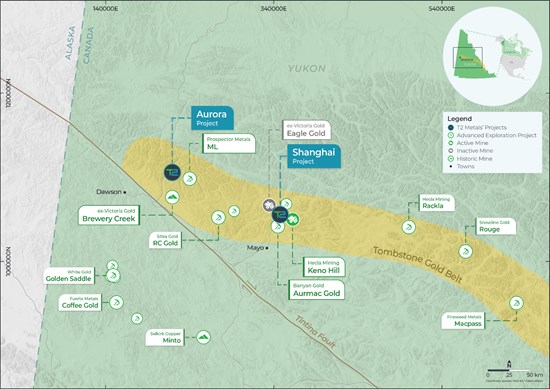
Figure 1: Location of T2 Metals' Shanghai and Aurora projects in the Tombstone Gold Belt, Yukon, Canada.
To view an enhanced version of this graphic, please visit:
https://images.newsfilecorp.com/files/7326/312502_b7b8290ee446aa1f_002full.jpg
Two New Exploration Targets Identified at Aurora
To date, assays from 1,619 auger/soil samples have been received from Aurora (Figure 3), taken during the 2026 program from areas with very limited previous sampling. Multiple spatially coherent soil anomalies have been identified, with elevated gold and the pathfinder elements such as arsenic, bismuth, tungsten, molybdenum and antimony (Table 1, Figure 4 and Figure 6). These continuous surface results are significant as they utilise a well-tested technique to validate the Project's exploration model across previously untested ground, providing a clearer framework to identify a large-scale gold system.
Target Area 1
Two soil anomalies are of particular note. Target Area 1 (Figure 4), centred 850 m west-southwest of the JC prospect, is defined by a cluster of high gold samples across a 500 m x 200 m area, including the highest gold grade of the assay set (10,078 ppb Au) plus enriched As, Bi and Sb. Base metal and silver values are subdued (approximately 250 ppm Cu & 2 ppm Ag average), a typical gold dominant plus a pathfinder signature of an RIRGS. This distinct geochemical footprint matches characteristics associated with intrusion-hosted gold systems in the region. See Table 1 for comprehensive sampling statistics.
Importantly, samples which comprise the anomaly sit on both sides of a prominent ridge line with a strong colour anomaly (Figure 5). Mapping in this area identified metasediment and quartzite, while the major element soil geochemistry at Target Area 1 shows a felsic rock-affinity supporting interpretation of a subcropping or soil/scree covered intrusion. Target Area 1 remains open in multiple directions, highlighting the potential for a larger underlying mineralized system, as this anomaly has not been closed off by sampling.
Target Area 1 combines strong gold results, a surface colour anomaly and geochemistry that is suggestive of a felsic intrusion, defining a priority drill target. The anomaly remains open, highlighting the potential to expand this footprint with future sampling.
Target Area 2
Target Area 2 (Figure 6) lies 900 m north-northwest of the AJ prospect where past drilling intersected high-grade gold. This untested area is at least 400 m x 200 m in size and shows gold in soil up to 5,892 ppb and is the most arsenic-rich area within the sample set with one soil sample exceeding 10,000 ppm. The area has a stronger copper and silver response with respect to Target Area 1 (Cu up to 7,395 ppm and Ag up to 38.4 ppm) which may suggest skarn-style copper-gold mineralization in addition to an RIRGS signature in this area. This signature introduces multi-commodity potential, combining high copper and silver values alongside the primary gold target. See Table 1 for comprehensive sampling statistics.
Mapping in this area identified metasediment, gossan and monzonite intrusions. Prior rock chip sampling has given gold values of 68.9 g/t and 15.0 g/t Au, demonstrating that exceptional high-grade gold exists within the surface mineralised system.
Target Area 2 combines strong gold, copper and silver values with elevated arsenic within a distinct geological setting that includes gossan and monzonite intrusions. This geochemical profile helps define a second, untested discovery opportunity separate from Target Area 1.
These targets and other anomalous areas have not previously been drill-tested. Assay results from other areas of the Project are pending and may define additional targets.
Mr. Shawn Ryan, Advisory Board Member of T2 Metals, commented: "Aurora is well known for its large footprint of gold enrichment. The gold values we are seeing in this soil sampling program are some of the highest I've encountered after more than two decades of work in the Yukon. We are certainly keen to see what lies beneath these impressive anomalies."
| n=1619 | Cu
(ppm) | Pb
(ppm) | Zn
(ppm) | Ag
(ppm) | As
(ppm) | Au
(ppb) | Sb
(ppm) | Bi
(ppm) | Se
(ppm) | Te
(ppm) |
| MAX | 7395.3 | >10000 | 2405.0 | 85.60 | >10000 | 10,078.1 | 2000.0 | 977.70 | 41.5 | 12.6 |
| MIN | 10.8 | 6.1 | 14.0 | 0.05 | 3.7 | 0.7 | 0.5 | 0.05 | 0.2 | 0.1 |
| AVG | 107.5 | 141.5 | 132.9 | 0.92 | 468.7 | 61.4 | 21.4 | 7.01 | 1.1 | 0.3 |
Table 1: Assay Statistics for First Set of Auger/Soil Samples, Aurora Project, Yukon
Tombstone Gold Belt
The Tombstone Gold Belt is one of North America's most prolific gold regions, known for hosting large, intrusion-related gold systems. The belt forms a core part of the broader Tintina Gold Province of the Yukon, Canada, and Alaska, USA. It features a series of mid-Cretaceous, weakly to moderately reduced felsic intrusions genetically associated with RIRGS-style gold mineralization.
This unique geological setting creates two major opportunities: high-grade gold in structurally-controlled vein systems and lower-grade, large-scale, bulk-tonnage deposits. Gold-bearing fluids exsolved from cooling intrusions and preferentially deposited gold in brittle, structurally controlled environments. Exploration efforts have identified that gold is often hosted in sheeted quartz veins and as disseminated mineralization within both the intrusive bodies and the hornfelsed country rocks.
The region hosts numerous significant deposits and is the site of recent discoveries by companies such as Snowline Gold (Rogue Project), Banyan Gold (AurMac Project) and Sitka Gold (RC Gold Project). Aurora shares the same geological signature as these multi-million-ounce gold discoveries, offering potential for both high-grade and large-scale, bulk-tonnage deposits.
RIRGS Geological Signature
RIRGS deposits are typically characterized by a gold-dominant, low-sulphide (generally less than 3% sulphide) mineral assemblage with a distinctive arsenic-bismuth-tungsten-molybdenum-antimony pathfinder-element association and comparatively weak wall-rock alteration — the same elements used to define Aurora's soil targets.
At Aurora, pathfinder-element enrichment appears consistent with a reduced, gold-dominant system, typical of the Tombstone Gold Belt. Target Area 1, lying 850 metres west-southwest of the JC prospect, demonstrates the highest gold grades associated with major element soil geochemistry suggestive of a felsic intrusion — a combination the Company interprets as a proximal intrusive source. Target Area 2, lying 900 metres north of the AJ prospect is the most arsenic-rich of the newly defined prospective areas with higher silver and copper values and gossan in float, and will be evaluated for possible skarn-style mineralization alongside an RIRGS signature.
Project Location
Aurora is a large, district-scale land package of 76 km² in the heart of the Tombstone Gold Belt. It is located in the Dawson Mining District, one of the world's most active and historic exploration regions, known for district-scale, high-grade gold-silver systems, significant discoveries and ongoing exploration success. The district is attracting renewed interest in hard-rock exploration, including multiple examples of strategic investment from senior gold producers.
The Project lies eight kilometres west of Prospector Metals' flagship ML Project (Figure 2) where drilling returned high grades of copper and gold, including 44 m averaging 13.79 g/t gold and 1.84% copper in hole ML25-31 (see Prospector Metals' news release dated October 1, 2025). Aurora shares significant geological similarities with the ML Project, providing a compelling comparison for exploration and discovery potential.
Aurora is also 30 km north of Brewery Creek (Figure 1), a past-producing open-pit gold mine that was one of the most northerly operations of its kind in the world. Gold mineralization at the Brewery Creek Mine is hosted in intrusions of the mid-Cretaceous Tombstone Plutonic Suite (Figure 2), the same intrusive suite that hosts the Antimony Mountain Stock at Aurora.
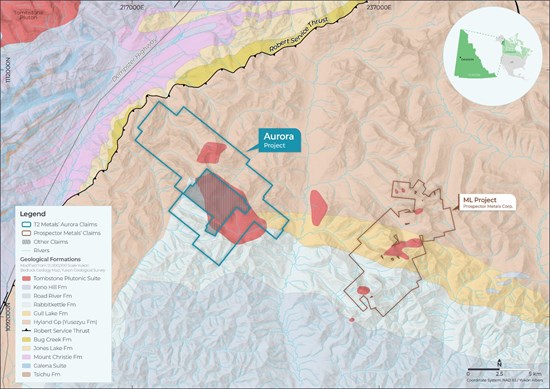
Figure 2: Location of T2 Metals' Aurora Project in relation to Prospector Metals' ML Project, Yukon.
To view an enhanced version of this graphic, please visit:
https://images.newsfilecorp.com/files/7326/312502_b7b8290ee446aa1f_003full.jpg
Project History
Aurora, at the time known as Antimony Mountain, was first staked by Yukon prospectors and explorers Shawn Ryan and Cathy Wood in 2004.
The area takes its name from the discovery of antimony mineralization in 1916. Modern exploration since then was carried out by Conwest Exploration, Anaconda Canada, Total Energold, Kennecott, Logan Resources and Golden Predator, among others.
Surface sampling and mapping has been intermittent over the past two decades, while drilling has totalled less than 3,000 metres. Exploration by Ryan and Wood helped unlock the area's scale and potential through systematic sampling and integration of fragmented historical datasets.
Historical highlights include 4.9 m of 12.45 g/t Au, 3.4 m of 24.45 g/t Au and 3.2 m of 25.06 g/t Au at the AJ prospect (2009 drilling), and up to 61 g/t Au in outcrop grab samples and 2 m of 3.2 g/t Au in drilling at the Golden Wall prospect. In total, six historically identified gold-bearing prospects were mapped across a 10 km trend at Aurora.
Although results have returned high-grade gold, only a small portion of the Project has been tested, leaving much of Aurora underexplored. T2 Metals acquired the Project in February 2026.
Summer Exploration Program
T2 Metals commenced its first summer exploration program at Aurora in June 2026 (see news release dated June 30, 2026) which included LiDAR surveying, soil and rock sampling, geological mapping and RAB drilling.
The Company reported new outcropping semi-massive stibnite mineralization approximately 300 metres from the Antimony Mountain prospect and new semi-massive chalcopyrite mineralization was also identified in rock float 300 metres northeast of the Rainbow prospect. These results are significant as they physically extend known mineralized zones, providing surface evidence of both copper and antimony.
T2 Metals commenced a RAB drill program in July (see news release dated July 30, 2026) at the TK, JC and Rainbow targets (collectively, the Anaconda prospect) marking the first drill program at Aurora in over 15 years. The RAB drilling program is now complete, and results from this and other summer exploration programs at Aurora shall be released during Q3/Q4 2026.
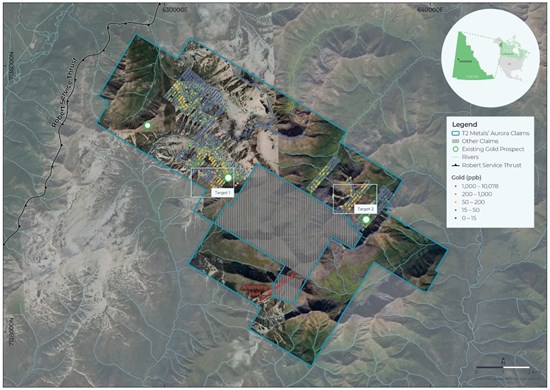
Figure 3: Sampled Area of the Aurora Project, Yukon.
To view an enhanced version of this graphic, please visit:
https://images.newsfilecorp.com/files/7326/312502_t2fig32026.jpg
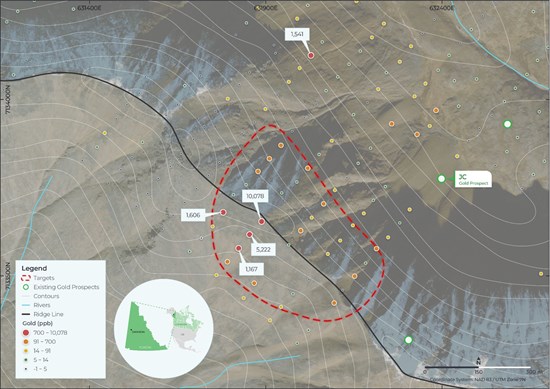
Figure 4: Target 1 Au-As-Bi Anomaly in 2026 Auger/Soil Sampling, Aurora Project, Yukon. Peak Gold Value of 10.1 g/t Au.
To view an enhanced version of this graphic, please visit:
https://images.newsfilecorp.com/files/7326/312502_b7b8290ee446aa1f_005full.jpg
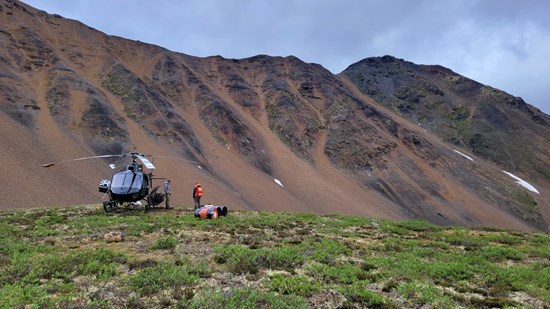
Figure 5: Target 1 Colour Anomaly at the Aurora Project, Yukon. Gold anomaly extends over ridge.
To view an enhanced version of this graphic, please visit:
https://images.newsfilecorp.com/files/7326/312502_b7b8290ee446aa1f_006full.jpg
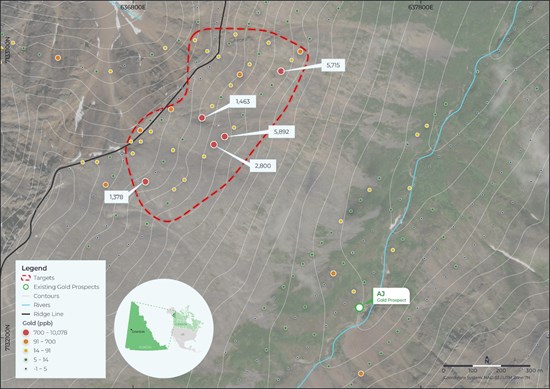
Figure 6: Target 2 Au-Cu-Ag-As Anomaly in 2026 Auger/Soil Sampling, Aurora Project, Yukon.
Peak Gold Value of 0.59 g/t Au
To view an enhanced version of this graphic, please visit:
https://images.newsfilecorp.com/files/7326/312502_b7b8290ee446aa1f_007full.jpg
2026 Soil Geochemistry Program
Since June 2026, T2 Metals' field team has collected approximately 3,000 soil samples across a 10 km by 5 km grid at Aurora. Results from 1,619 samples are reported in this news release. Sampling protocols reflect those applied by Shawn Ryan across the Yukon to discover multiple gold deposits.
Samples were submitted to Bureau Veritas Commodities Canada Ltd. (1265 Powell St, Vancouver, BC V6A 1J5, Canada) and analyzed using a 37-element aqua regia digestion with ICP-MS/ICP-ES finish (method AQ201), with gold reported to a 0.5 ppb detection limit. Field duplicates were inserted at a rate of approximately 3%, in addition to certified reference materials and blanks submitted with each shipment, consistent with the Company's standard QA/QC protocol.
Aurora Project Midpoint: Google Earth Link
Qualified Person
The Qualified Person (as defined under National Instrument 43-101 - Standards of Disclosure for Mineral Projects) for the Company's projects, Mr. Mark Saxon, the Company's President & CEO, a Fellow of the Australasian Institute of Mining and Metallurgy and a Member of the Australian Institute of Geoscientists, has reviewed and approved the contents of this news release.
About T2 Metals Corp. (TSXV: TWO) (OTCQB: TWOSF) (FSE: WJ6)
T2 Metals Corp. is an emerging precious and critical strategic metals company enhancing shareholder value through exploration and discovery. T2 Metals is committed to engaging with rights holders and stakeholders with the highest level of respect, ensuring that our exploration activities contribute positively to the communities in which we operate.
Neither the TSX Venture Exchange nor its Regulation Services Provider (as that term is defined in the policies of the TSX Venture Exchange) accepts responsibility for the adequacy or accuracy of this news release.
Cautionary Note Regarding Forward-Looking Statements
Certain information set out in this news release constitutes forward-looking information. Forward-looking statements are often, but not always, identified by the use of words such as "seek", "anticipate", "plan", "continue", "estimate", "expect", "may", "will", "intend", "could", "might", "should", "believe" and similar expressions. Forward-looking statements are based upon the opinions and expectations of management of the Company as at the effective date of such statements and, in certain cases, information provided or disseminated by third parties. Although the Company believes that the expectations reflected in forward-looking statements are based upon reasonable assumptions, and that information obtained from third party sources is reliable, they can give no assurance that those expectations will prove to have been correct. Readers are cautioned not to place undue reliance on forward-looking statements.
These forward-looking statements are subject to a number of risks and uncertainties. Actual results may differ materially from results contemplated by the forward-looking statements. Accordingly, the actual events may differ materially from those projected in the forward-looking statements. Such risks include uncertainties relating to exploration activities. When relying on forward-looking statements to make decisions, investors and others should carefully consider the foregoing factors and other uncertainties and should not place undue reliance on such forward-looking statements. The Company does not undertake to update any forward-looking statements, except as may be required by applicable securities laws.
To view the source version of this press release, please visit https://www.newsfilecorp.com/release/312502

© 2026 Canjex Publishing Ltd. All rights reserved.