VANCOUVER, British Columbia, July 28, 2026 (GLOBE NEWSWIRE) -- VR Resources Limited (“VR” or the “Company”, TSX.V: VRR, FSE: 5VR; OTCQB: VRRCF) is pleased to announce that it has received final data from the state-of-the-art 3D-array DCIP geophysical survey completed last month over the Copper Queen target on the Company’s Bonita porphyry copper-gold project located in northwestern Nevada. Key results are positive, including:
- Conductivity anomaly adjacent to the Iron Chief specularite syenite breccia body on the east flank of the Copper Queen hill and lithocap, and;
- IP chargeability anomaly on south flank of Copper Queen hill, and adjacent to the Whiskey Bottle hydrothermal-magmatic breccia center.
Dr. Michael Gunning, Chief Executive Officer of the Company, commented: “While our current focus is on the drill program at our New Boston porphyry project in Nevada, we are also excited to advance our long-standing and extensive porphyry exploration at Bonita with these new results from the 3D-array DCIP survey.
We see these new IP and conductivity anomalies as the strongest exploration vectors established to-date towards the potential for a buried copper-gold stock or breccia body at Copper Queen and/or Iron Chief. They are central to the alteration, vein, porphyry dyke and breccia system that we have mapped and sampled on surface across the entire hilltop and lithocap during some four years of continuous exploration.
The conductivity anomaly at Iron Chief is unique to the entire survey block. As shown in Figure 2, it extends from surface to depth. It is flanked to the east by the syenite breccia phase cemented by specularite at Iron Chief (Photo 2), and to the west by the historic workings at the 1936 mine on the east flank of the Copper Queen hill where copper veins are exposed on surface.
The IP anomaly located to the south of the Iron Chief conductor may provide a vector for the porphyry-style copper-sulfide veining intersected in our initial drilling in 2017, for which there is a clear association in anomalous copper-gold geochemistry.
We have only just started to dig into the robust data set and 3D models derived from the survey. We will provide further insights as we fully interpret the data and integrate the new DCIP model into our extensive project data base. Our intent is to evaluate the new Iron Chief conductor and Copper Queen IP anomaly for follow-up drilling.”
Photo 1: The DCIP survey completed in February covered the Copper Queen hill and adjacent flats at Iron Chief. The hill is an alteration lithocap dominated by secondary albite and hematite alteration in a quartz diorite stock, with sheeted crack-seal veins of quartz and hematite after sulfide. The corresponding DCIP survey grid map in Figure 1 shows the numerous historic workings on copper showings at surface across the ridgeline and hill, with up to 2.5% Cu in VR grab samples from veins at surface at the historic workings at 1936 mine.
There are two CEO on-site field video’s available on the Bonita Project Page on the Company’s website. They illustrate the two key messages for Bonita with regard to application of modern exploration technologies to push discoveries in historic districts with proven metal potential, and the strength of local infrastructure as a key advantage for mineral exploration and project development alike. The access roads and showings shown in Figure 1 illustrate the message.
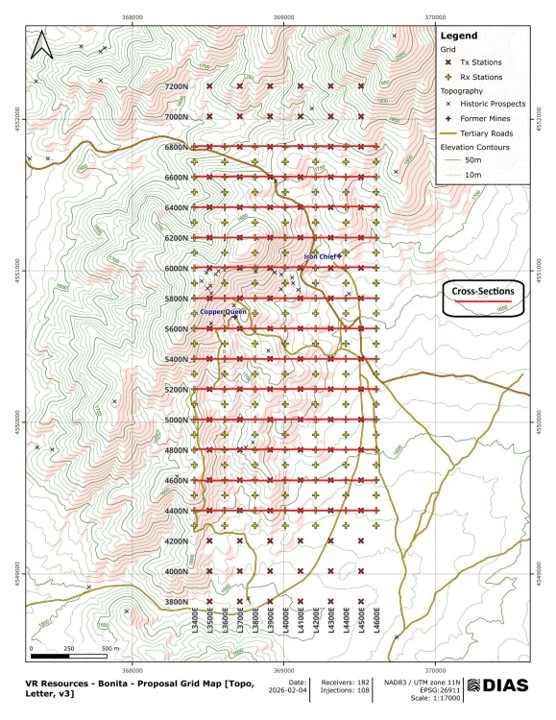
Figure 1. Grid map for 3D-array DCIP survey completed at Bonita property in February, 2026, showing road access, and the clusters of historic iron and copper workings at Iron Chief, 1936, Copper Queen and Whiskey Bottle.
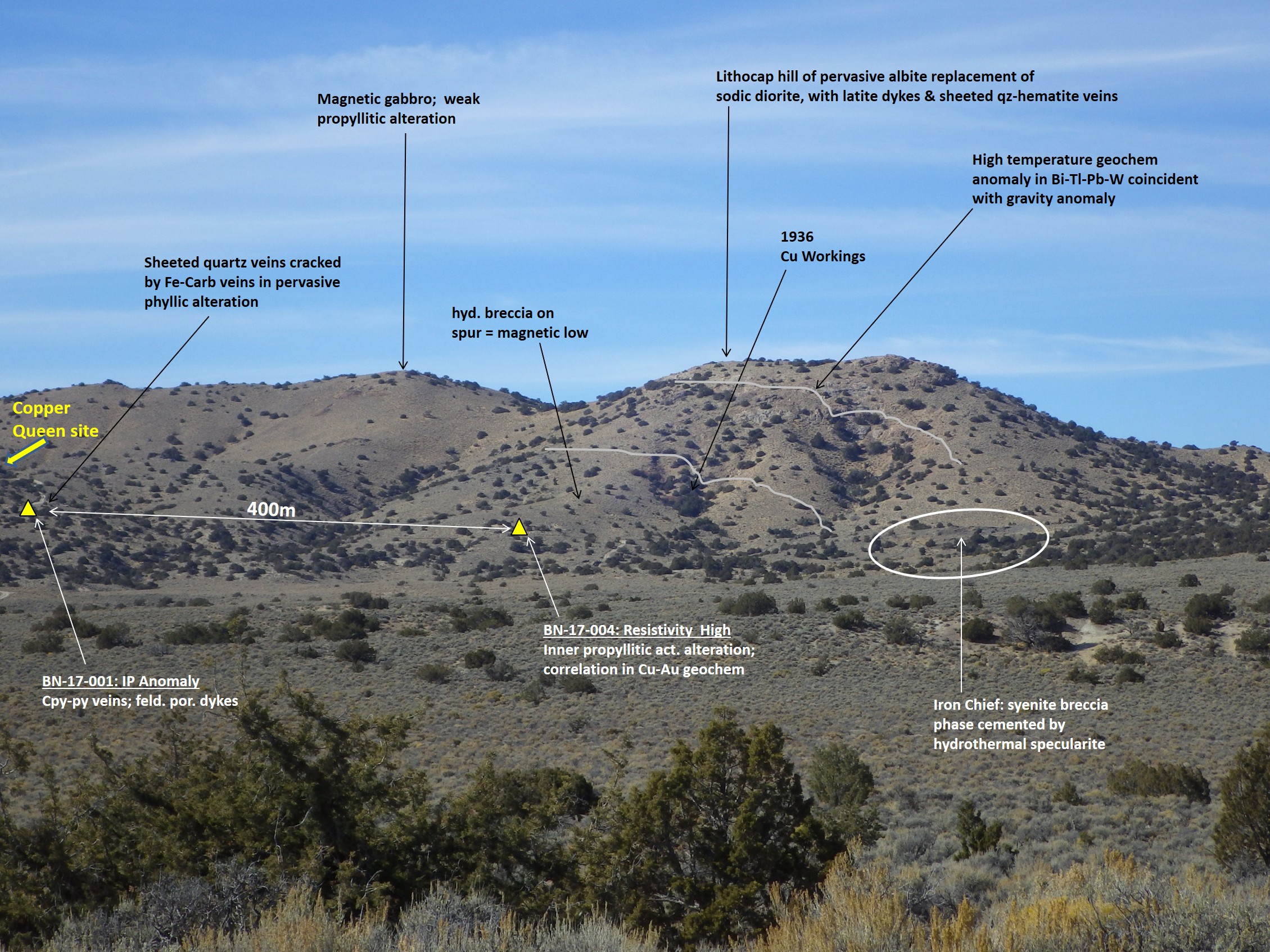
Photo 1. Annotated field photo of the hill at Copper Queen covered by the 1.5 x 3.5 km, 3D-array DCIP survey completed in February, 2026. View is to the northwest, from the main access roads in the southeast part of the grid, as shown in Figure 1. The hill is interpreted to be an alteration lithocap developed in a quartz diorite stock. It is dominated by albite and specularite alteration, with sheeted crack-seal veins of quartz and iron oxide after sulfide. The specularite-cemented syenite breccia at Iron Chief is on the eastern flank.
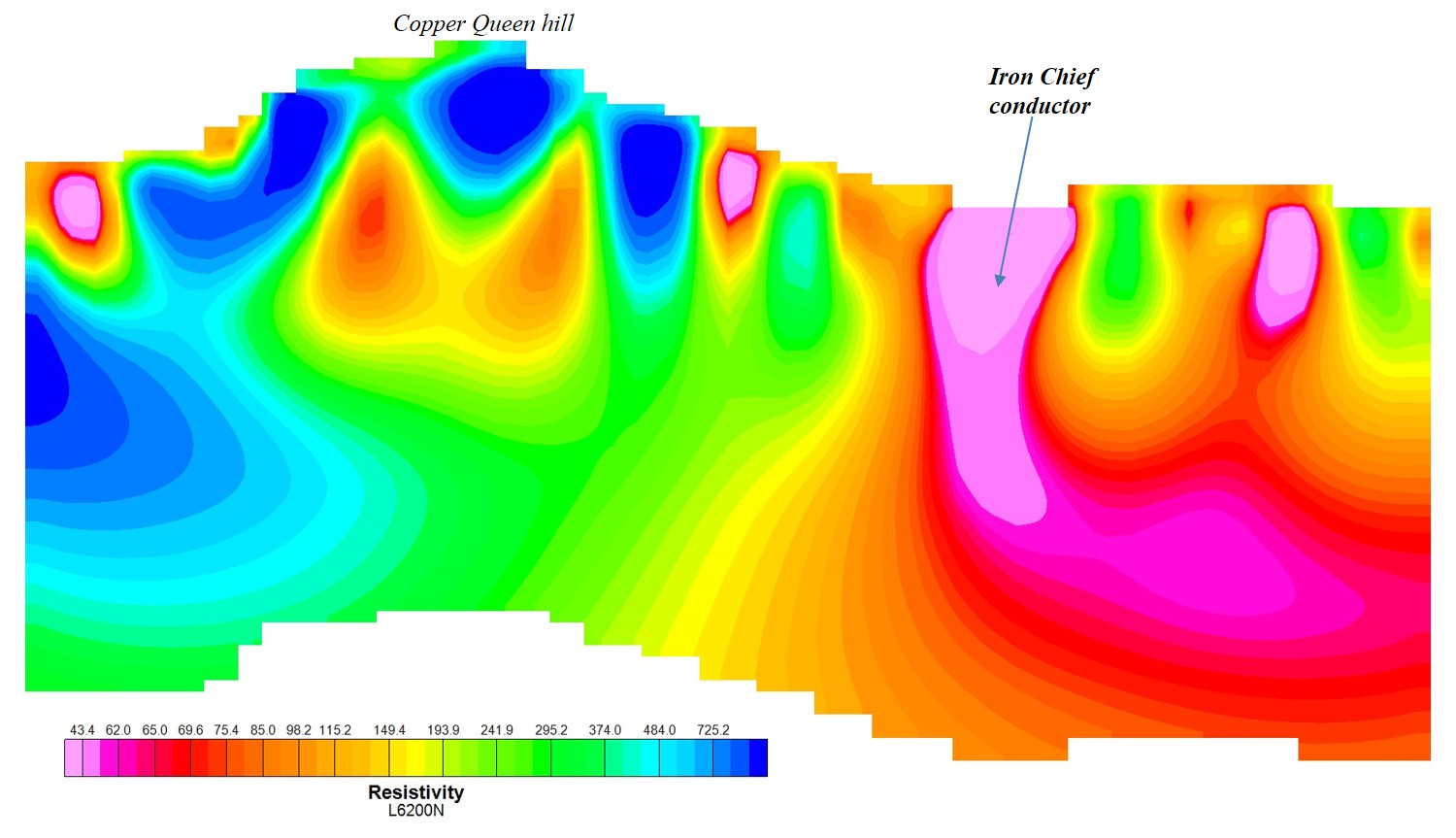
Figure 2: Iron Chief conductor. Resistivity profile extracted from the 3D block model for Line 6200 (location in Figure 1). The east-west profile spans 1.2 km. The syenite breccia phase cemented by specularite at Iron Chief (see Photo 2 below) is immediately to the east of the conductor. Workings at the historic 1936 mine on the east flank of the Copper Queen hill and located immediately to the west of the conductor follow qz veins with copper sulfide associated with latite porphyry dykes in sodic diorite with pervasive secondary albite and hematite alteration.
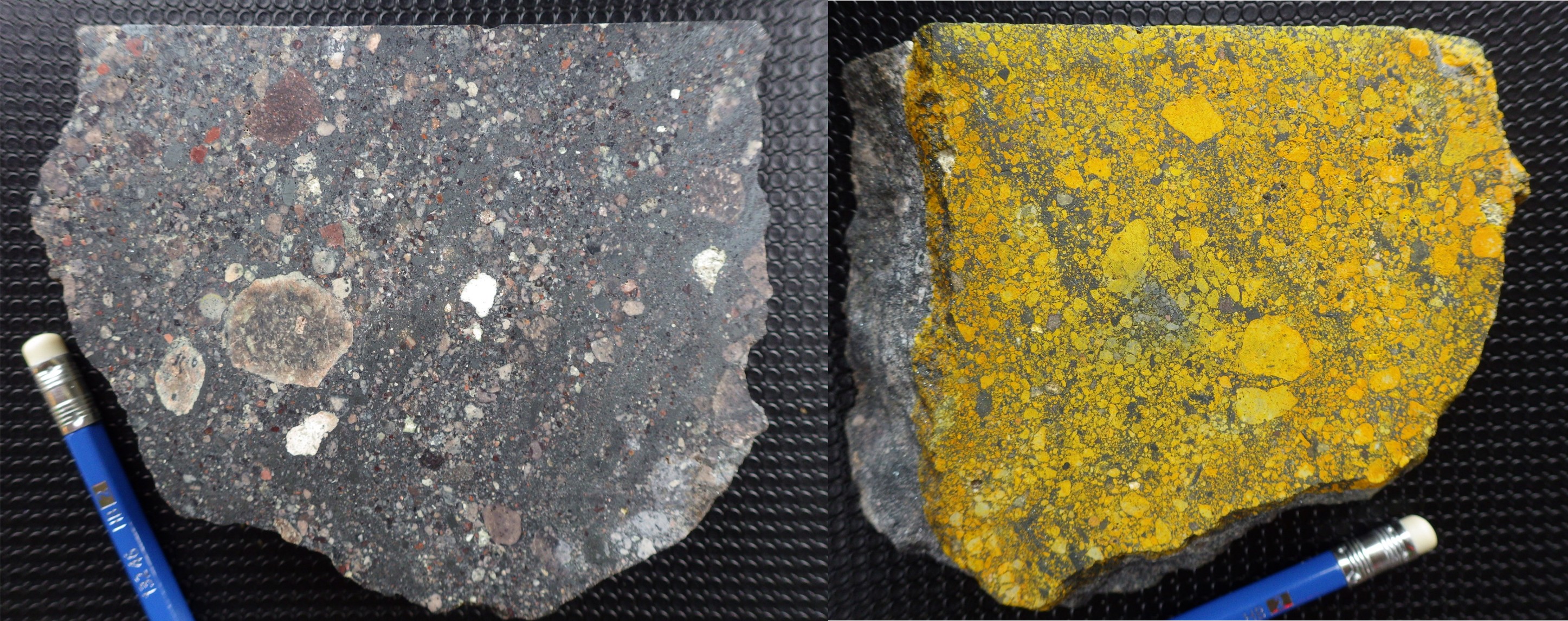
Photo 2: Iron Chief syenite breccia. Hydrothermal streaming of iron in a magmatic syenite breccia phase cemented by specularite at the Iron Chief working. The yellow on the cut face on the right is a positive stain for potassium feldspar using cobaltinitrite.
Context for DCIP Survey
The geophysical proposal and agreement for the survey at Bonita was scoped last Fall, in August 2025, in follow-up to the Company’s previous and extensive exploration on the property, including reconnaissance-level drilling. For Best Practice, the survey design was reviewed again, refined and finalized in-person with the team at Dias Geophysical, a leading provider of geophysical services, during the AME Mineral Exploration Conference held in Vancouver in January. The goal was to optimize survey design in order to map narrow copper veins are present at surface, but also to be able to image a large volume porphyry stock, or breccia body potentially at depth as the source to the surface veins.
The target at Copper Queen has scale, and the DCIP survey was large, with a grid block of approximately 1.5 x 3.5 km covering the entire hilltop and surrounding lowlands shown in Photo 1. To optimize both resolution and depth penetration for a large-scale porphyry target, the survey was designed on 200 m line spacing with 150 m station spacing. The survey was completed over a three week period in February, 2026.
As described and illustrated in the previous News Release dated March 12, 2026, the DIAS32 survey technology used at Bonita is state-of-the-art, and the resultant data set is robust; the 3D resistivity model contains approximately 187,000 source data points, and 135,500 source data points for the IP model. Depth penetration for the 3-D modeling is approximately 400 m.
TECHNICAL INFORMATION
Technical information disclosed by the Company has been prepared in accordance with the Canadian regulatory requirements set out in National Instrument 43-101. Technical information contained in this document, and on the Company’s website, has been reviewed and approved on behalf of the Company by the President & CEO, Dr. Michael Gunning, PhD, P.Geo., a non-independent Qualified Person.
ABOUTVR RESOURCES LTD.
VR is an established junior exploration company based in Vancouver. VR evaluates, explores and advances opportunities in copper, gold and critical metals in Nevada, USA, and Ontario, Canada. VR applies modern exploration technologies, in-house experience and expertise in greenfields exploration to large-footprint mineral systems in underexplored areas/districts. The foundation of VR is the proven track record of its Board in early-stage exploration, discovery and M&A. VR owns its projects outright and evaluates new opportunities on an ongoing basis, whether by staking or acquisition.
The reader is referred to the Company’s website at www.vrr.ca for current information on the Company, and up-to-date project overviews illustrated with maps, photos and recent CEO site-visit video’s from the field.
ON BEHALF OF THE BOARD OF DIRECTORS
Dr. Michael H. Gunning
President & CEO
For general information please use the following:
| Website: | www.vrr.ca |
| Email: | info@vrr.ca |
| Phone: | 778-731-9292 |
CAUTIONARYNOTEREGARDINGFORWARD-LOOKINGSTATEMENTS:
This news release contains statements that constitute "forward-looking statements". Such forward looking statements involve known and unknown risks, uncertainties and other factors that may cause the Company’s actual results, performance or achievements, or developments in the industry to differ materially from the anticipated results, performance or achievements expressed or implied by such forward-looking statements. Forward-looking statements are statements that are not historical facts and are generally, but not always, identified by the words "expects," "plans," "anticipates," "believes," "intends," "estimates," "projects," "potential" and similar expressions, or that events or conditions "will," "would," "may," "could" or "should" occur. Forward-looking statements in this document include statements concerning the results of the recent DCIP geophysical survey at the Company’s Bonita property, and all other statements that are not statements of historical fact.
Although the Company believes the forward-looking information contained in this news release is reasonable based on information available on the date hereof, by their nature, forward-looking statements involve assumptions, known and unknown risks, uncertainties and other factors which may cause our actual results, performance or achievements, or other future events, to be materially different from any future results, performance or achievements expressed or implied by such forward- looking statements. Examples of such assumptions, risks and uncertainties include, without limitation, assumptions, risks and uncertainties associated with: general economic conditions; adverse industry events; future legislative and regulatory developments in the mining sector; the Company’s ability to access sufficient capital from internal and external sources, and/or inability to access sufficient capital on favorable terms; mining industry and markets in Canada; the ability of the Company to implement its business strategies; competition; and other assumptions, risks and uncertainties.
The forward-looking information contained in this news release represents the expectations of the Company as of the date of this news release and, accordingly, is subject to change after such date. Readers should not place undue importance on forward-looking information and should not rely upon this information as of any other date. While the company may elect to, it does not undertake to update this information at any particular time except as required in accordance with applicable laws.
Trading in the securities of the Company should be considered highly speculative. All of the Company’s public disclosure filings may be accessed via www.sedarplus.ca and readers are urged to review them.
Neither the TSX Venture Exchange nor its Regulation Services Provider (as that term is defined in Policies of the TSX Venture Exchange) accepts responsibility for the adequacy or accuracy of this release.
Photos accompanying this announcement are available at
https://www.globenewswire.com/NewsRoom/AttachmentNg/22892b99-ce75-4ceb-b3ef-d4b83791bf6c
https://www.globenewswire.com/NewsRoom/AttachmentNg/fb2a0ca3-1551-41a5-b5b0-6035a21a00a5
https://www.globenewswire.com/NewsRoom/AttachmentNg/52420765-f283-4b5f-912f-aca79ea06f80
https://www.globenewswire.com/NewsRoom/AttachmentNg/ac967d6c-39e4-4acd-a5e0-8486f283d8ad



Photo 1.
Annotated field photo of the hill at Copper Queen covered by the 1.5 x 3.5 km, 3D-array DCIP survey completed in February, 2026. View is to the northwest, from the main access roads in the southeast part of the grid, as shown in Figure 1. The hill is interpreted to be an alteration lithocap developed in a quartz diorite stock. It is dominated by albite and specularite alteration, with sheeted crack-seal veins of quartz and iron oxide after sulfide. The specularite-cemented syenite breccia at Iron Chief is on the eastern flank.
Figure 1.
Grid map for 3D-array DCIP survey completed at Bonita property in February, 2026, showing road access, and the clusters of historic iron and copper workings at Iron Chief, 1936, Copper Queen and Whiskey Bottle.
Photo 2: Iron Chief syenite breccia.
Hydrothermal streaming of iron in a magmatic syenite breccia phase cemented by specularite at the Iron Chief working. The yellow on the cut face on the right is a positive stain for potassium feldspar using cobaltinitrite.
Figure 2: Iron Chief conductor.
Resistivity profile extracted from the 3D block model for Line 6200 (location in Figure 1). The east-west profile spans 1.2 km. The syenite breccia phase cemented by specularite at Iron Chief (see Photo 2 below) is immediately to the east of the conductor. Workings at the historic 1936 mine on the east flank of the Copper Queen hill and located immediately to the west of the conductor follow qz veins with copper sulfide associated with latite porphyry dykes in sodic diorite with pervasive secondary albite and hematite alteration.
© 2026 Canjex Publishing Ltd. All rights reserved.