(via TheNewswire)
July 6, 2026 – TheNewswire - Beauce Gold Fields Inc. (Champs d’Or en Beauce) (TSX Venture: BGF) ("BGF" or the "Company") is pleased to announce assay results from Phase 1 of its 2026 diamond drill program at the Grondin Zone, located within the Company’s Beauce Gold Project in Beauceville, Quebec.
The 2026 Grondin drilling confirms continued gold mineralization within the Saddle Reef antiform system previously identified in BGF’s 2023 and 2025 drill programs. Hole GR-26-03 returned a broad mineralized interval of 27.0 m grading 0.60 g/t Au from 21.0 m to 48.0 m, including 10.0 m grading 1.30 g/t Au from 21.0 m to 31.0 m and 1.0 m grading 6.59 g/t Au from 22.0 m to 23.0 m. The result supports the continuity of the Grondin Zone and reinforces the Company’s interpretation of an open, structurally controlled gold system associated with the Beauce paleoplacer district.
The 2026 drill campaign is being advanced in two phases. Phase 1 consisted of six diamond drill holes totaling approximately 600 metres and was designed to test the down-dip continuity of known mineralized zones and evaluate induced polarization ("IP") geophysical targets.
Patrick Levasseur, President and CEO of Beauce Gold Fields, commented: "We are very pleased with the Phase 1 results, which continue to validate the Grondin Zone as a shallow, gold-bearing Saddle Reef antiform system. Hole GR-26-03 is an important step forward: it delivered a broad mineralized interval, including higher-grade subintervals, and was still in the target area when drilling was stopped at 48 metres due to a fault and casing issue. Just as importantly, GR-26-05 intersected gold mineralization southwest of the Grondin Zone, supporting our view that the system remains open along strike and that IP-guided drilling can continue to expand the mineralized corridor. These results give us a clearer roadmap for Phase 2: refine the structural model, continue or redrill GR-26-03 beyond the fault zone, and test additional targets along the interpreted antiform corridor."
Table 1. Selected 2026 Phase 1 Drill Intercepts – Grondin Zone
Hole | From (m) | To (m) | Length (m) | Au (g/t) | Comment |
GR-26-03 | 21.0 | 48.0 | 27.0 | 0.60 | Main mineralized interval |
GR-26-03 | 21.0 | 31.0 | 10.0 | 1.30 | Including |
GR-26-03 | 22.0 | 29.0 | 7.0 | 1.70 | Including |
GR-26-03 | 21.0 | 26.0 | 5.0 | 1.90 | Including |
GR-26-03 | 22.0 | 23.0 | 1.0 | 6.59 | Including |
GR-26-05 | 57.0 | 66.5 | 9.5 | 0.24 | Main mineralized interval |
GR-26-05 | 60.5 | 64.5 | 4.0 | 0.39 | Including |
GR-26-05 | 61.0 | 62.0 | 1.0 | 0.95 | Including |
Note: Intervals are length-weighted averages calculated from individual assay intervals. Reported intervals are core lengths and true widths have not yet been determined.
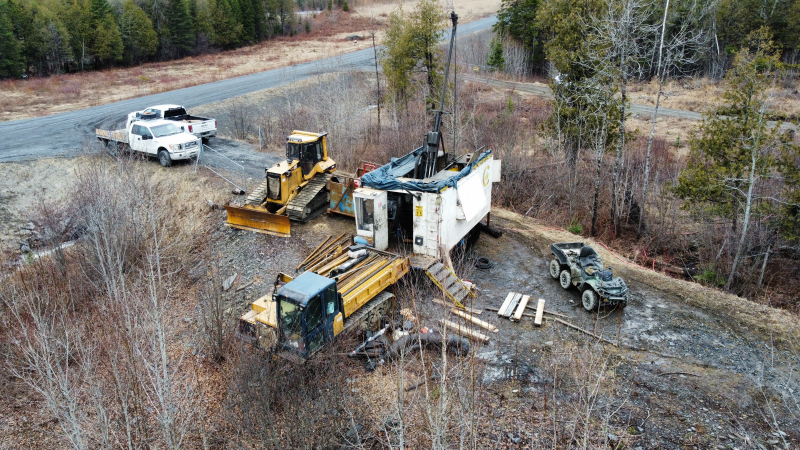
Click Image To View Full Size
Image 1: 2026 Phase 1 Drilling Grondin Zone
Phase 1 Drill Hole Discussion
Drill hole GR-26-03 is particularly important because it intersected a broad mineralized interval in a down-dip position; however, drilling was stopped at 48.0 metres after encountering a fault and casing issue. Drill hole GR-26-05 also identified gold mineralization southwest of the Grondin Zone. Drilling completed since 2023 continues to support the extension of the Grondin Zone and indicates that further drilling, supported by additional IP surveying along the mineralized structure, is warranted.
Drill Holes GR-26-01, GR-26-02 and GR-26-06
Drill holes GR-26-01 and GR-26-02 were designed to test the PP-1 induced polarization anomaly, located approximately 100 metres southwest of drill hole GR-25-08 and at a greater vertical depth (approximately 60 metres, compared to approximately 30 metres for GR-25-08). These drill holes did not intersect the interpreted structure and did not return significant gold grades. Drill hole GR-26-06 was then drilled approximately 20 metres farther back in an attempt to intersect the structure known in drill hole GR-25-08; however, it also did not intersect the target zone. The Company interprets these results as indicating that the zone may be folded farther to the southwest. Additional IP surveys will be required to better locate the southwestward extension.
Drill Holes GR-26-03 and GR-26-04
Drill holes GR-26-03 and GR-26-04 were designed as step-back holes from earlier Grondin drill holes GR-25-05 and GR-25-06 to test the zone at depth and assess the potential for down-dip continuity. Drill hole GR-26-03 intersected mineralization at 21.0 metres and was stopped at 48.0 metres due to a fault. Drill hole GR-26-04 did not intersect the targeted structure.
Drill Hole GR-26-05
Drill hole GR-26-05 tested the PP-1 IP anomaly southwest of the Grondin Zone and intersected gold mineralization from 57.0 m to 66.5 m. The result supports continued IP-guided follow-up along the interpreted Grondin structure.
Table 2. Phase 1 Drill Hole Information - Grondin Zone
Hole No. | Azimuth (°) | Dip (°) | HQ (m) | NQ (m) | Length (m) | UTM E | UTM N |
GR-26-01 | N141 | -54 | 6 | 104.4 | 110.4 | 366545 | 5120305 |
GR-26-02 | N141 | -72 | 4 | 71 | 75 | 366545 | 5120305 |
GR-26-03 | N097 | -50 | 21 | 27 | 48 | 366665 | 5120404 |
GR-26-04 | N314 | -85 | 1 | 131 | 132 | 366825 | 5120476 |
GR-26-05 | N215 | -70 | 18 | 99 | 117 | 366705 | 5120415 |
GR-26-06 | N320 | -84 | 9 | 81 | 90 | 366609 | 5120195 |
TOTAL | | | 59 | 513.4 | 572.4 | | |
Mineralized Zone
The mineralized zone consists of grey to black argillite with alternating fine and coarser lapilli textures. Several white quartz veins of varying widths and orientations occur as stockwork. The matrix contains variable amounts of sulphides, including large pyrite clusters and sulphide stringers, estimated at approximately 5% to 10%.
The mineralized zones are strongly affected by significant structural deformation. The gold zone may be dislocated and offset by shear faults. The highest gold grades are associated with sulphides and free gold, particularly in semi-massive pyrite. The Company notes that variability observed in certain assay results is consistent with coarse-gold heterogeneity, a characteristic commonly associated with nuggety gold systems. Additional follow-up sampling, assaying and drilling will be used to further evaluate grade variability within the Grondin mineralized system. Arsenopyrite is not interpreted to be the primary gold source at the Grondin Showing.
The two drill holes at the extremities of the known zone, spaced more than 600 metres apart (GR-23-08 and GR-25-08), indicate that the area remains open laterally, including at depth, and that gold mineralization extends beyond the known limits. Based on all drilling campaigns completed since 2023, the Company now interprets the gold corridor crossing the property to be on the order of kilometres.
QA/QC: The drill program followed strict QA/QC protocols. The drill program recovered HQ and NQ drill core. Drill cores were split in half using a diamond saw. Half of the core was sampled and sealed in clean plastic bags before being shipped for assay. Standards and blanks were inserted on site. The remaining half of the core was replaced in core boxes and is stored at the Company’s core shack in Saint-Simon-les-Mines, Quebec. Samples were sent to MSALABS in Val-d’Or, Quebec. Samples were dried and crushed up to 1 kg to 70% passing 2 mm, then split into 500 g subsamples. Each sample underwent gold analysis by photon assay.
Assay certificates are YVO2610875 and YVO2610961. MSALABS, Val-d’Or, Quebec, is ISO/IEC 17025 accredited for photon assay.
Phase 2 - Follow-Up and Target Expansion
Phase 2 follow-up will be planned based on the Phase 1 results and updated geological interpretation. The work is expected to include:
continuing or redrilling GR-26-03 to test beyond the fault zone and toward the planned deeper target depth;
testing induced polarization ("IP") anomaly PP-2;
carrying out additional geophysical surveys laterally along the structure toward the northeast to better localize the interpreted extension and the structure missed by holes GR-26-01, GR-26-02 and GR-26-06; and
refining the structural model to improve targeting of potential higher-grade Saddle Reef-style mineralization.
This follow-up phase is expected to refine drill targeting and test newly identified zones while further evaluating the scale and continuity of the Grondin mineralized system.
Grondin Zone - Exploration Background
The Grondin Zone has been the focus of systematic exploration by Beauce Gold Fields since 2023, including diamond drilling, geophysical surveys, geological mapping and limited bulk sampling.
Drilling completed in 2023 and 2025 confirmed structurally controlled gold mineralization associated with a Saddle Reef antiform geometry, with mineralization traced over several hundred metres and remaining open both along strike and at depth.
The Grondin Zone forms part of the Company’s broader exploration strategy aimed at identifying potential bedrock sources of the historic Beauce placer gold deposits. Drilling to date has confirmed gold-bearing mineralization along the Saddle Reef structure, and subsequent IP surveys and integrated geological interpretation have outlined an approximately 8-kilometre antiform structural corridor, providing a large-scale framework for ongoing exploration.
Based on geological, structural and geochemical observations, the Company interprets this antiform-hosted structure as one of the likely bedrock sources that may have contributed to the historical placer gold deposits within the Saint-Simon-les-Mines paleoplacer channel.
Qualified Person
Jean Bernard, B.Sc., Geo., an independent qualified person as defined by National Instrument 43-101, has reviewed and approved the technical content of this news release.
About Beauce Gold Fields
Beauce Gold Fields is focused on exploring and developing the largest placer gold district in eastern North America. The Company’s objective is to trace historical placer gold workings back to a bedrock source to uncover economic lode gold deposits. The Company’s flagship property is the Saint-Simon-les-Mines gold project, site of Canada’s first gold rush, which pre-dates the Yukon Klondike. The Beauce region hosted some of the largest historical placer gold mines in eastern North America, active from the 1860s to the 1960s. It produced some of the largest gold nuggets in Canadian mining history (50 oz+). (Source: SEDAR, NI 43-101 Technical Report - Beauce, July 4, 2018, author B. Violette.)
Beauce Gold Fields is currently drilling recently discovered antiform systems that are interpreted by the Company as having contributed to the development of extensive auriferous placer deposits in Beauce. The Company’s geological model suggests that placer gold within the Beauce Gold paleochannel, including the renowned large nuggets from the 19th century, formed in stressed quartz pockets within layered domed axes of antiforms, exemplified by Saddle Reef formations. For geological context, notable Saddle Reef-style systems include the Bendigo gold fields in Australia and the high-grade Dufferin deposit in Nova Scotia.
Beauce Gold Fields website www.beaucegold.com
Disclaimers:
This press release contains certain forward-looking statements, including, without limitation, statements containing the words "may", "plan", "will", "estimate", "continue", "anticipate", "intend", "expect", "in the process" and other similar expressions which constitute "forward-looking information" within the meaning of applicable securities laws. Forward-looking statements reflect the Company’s current expectations and assumptions and are subject to a number of risks and uncertainties that could cause actual results to differ materially from those anticipated. These forward-looking statements involve risks and uncertainties including, but not limited to, the Company’s expectations regarding mineral exploration. Such statements reflect the current views of the Company with respect to future events and are subject to certain risks and uncertainties and other risks detailed from time to time in the Company’s ongoing filings with securities regulatory authorities, which filings can be found at www.sedarplus.ca. Actual results, events and performance may differ materially. Readers are cautioned not to place undue reliance on these forward-looking statements. The Company undertakes no obligation to publicly update or revise any forward-looking statements, either as a result of new information, future events or otherwise, except as required by applicable securities laws.
Neither the TSX Venture Exchange nor its Regulation Services Provider (as that term is defined in the policies of the TSX Venture Exchange) accepts responsibility for the adequacy or accuracy of this release.
For further information contact
Patrick Levasseur, President and CEO Tel: (514) 262-9239
www.beaucegold.com
Copyright (c) 2026 TheNewswire - All rights reserved.
© 2026 Canjex Publishing Ltd. All rights reserved.