(via TheNewswire)
Melbourne, Australia and Vancouver, Canada – TheNewswire - June 10, 2026 - Mithril Silver and Gold Limited ("Mithril” or the "Company") (TSXV: MSG) (ASX: MTH) (OTCQB: MTIRF) is pleased to provide details of continued drilling progress at Mithril’s district scale Copalquin property, Durango State, Mexico.
Update Highlights
Mithril completes final six holes in the in the western expansion area of the El Refugio area, and final two holes in La Soledad southeast expansion area, in advance of the updated Mineral Resource Estimate planned for late June 2026
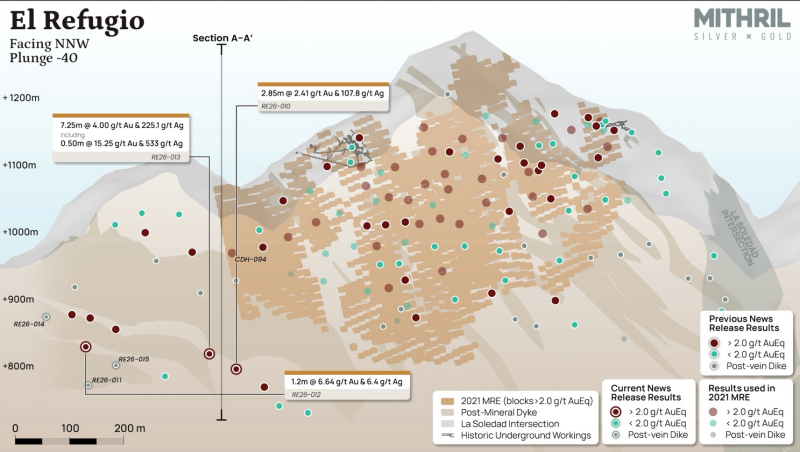
Three of six drill holes completed at El Refugio intercepted high grade silver and gold, including drill hole RE26-013 which intercepted 7.25 m grading 4.01 g/t Au and 225.1 g/t Ag, or 7.22 g/t AuEq, at distance of approximately 190 m from previously announced drill hole RE26-009 which intercepted 9.65 m grading 7.00 g/t Au and 370.3 g/t Ag, or 12.29 g/t AuEq 0F 1
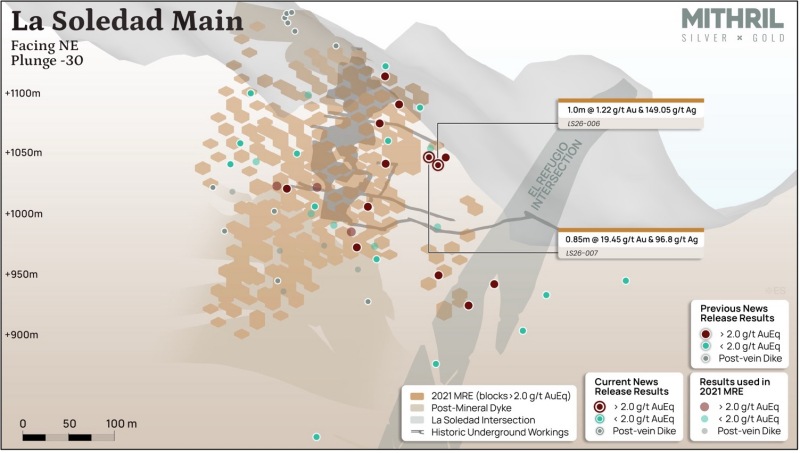
Drilling in the La Soledad vein continues to intercept elevated gold values in drilling, as extension of the 2021 MRE footprint seen in hole LS26-007
Target 1 resource upgrade drilling highlights include:
0.95 m @ 2.83 g/t gold, and 188.0 g/t silver from 396.95 m
1.20 m @ 6.64 g/t gold, and 6.4 g/t silver from 304.20 m (RE26-012) , and
1.65 m @ 3.79 g/t gold, and 8.3 g/t silver from 316.75 m, including
0.75 m @ 5.55 g/t gold, and 11.9 g/t silver from 317.65,
3.30 m @ 7.11 g/t gold, and 368.2 g/t silver from 376.80 m, including
0.50 m @ 15.25 g/t gold, and 533.0 g/t silver from 378.00 m, and including
0.85 m @ 19.45 g/t gold, and 96.8 g/t silver from 94.4 m
The final drillholes of the 2026 Target 1 upgrade drilling program that were directed to further test the western mineralized limit of the El Refugio structure returned encouraging results including high grade silver and gold mineralization within wide intervals of quartz breccia and wider intervals of milled and/or phreatic breccia textures. Drill hole RE26-013, which intercepted 7.25 m of mineralized quartz breccia within a wider 12.6 m interval of quartz filled polymictic breccia, shows as evidence of a large, high energy mineralized system. The overall success of the upgrade drilling campaign is underscored by the increased footprint of the mineralization at El Refugio, and the increased confidence in the grade and geology model which remains open to depth.
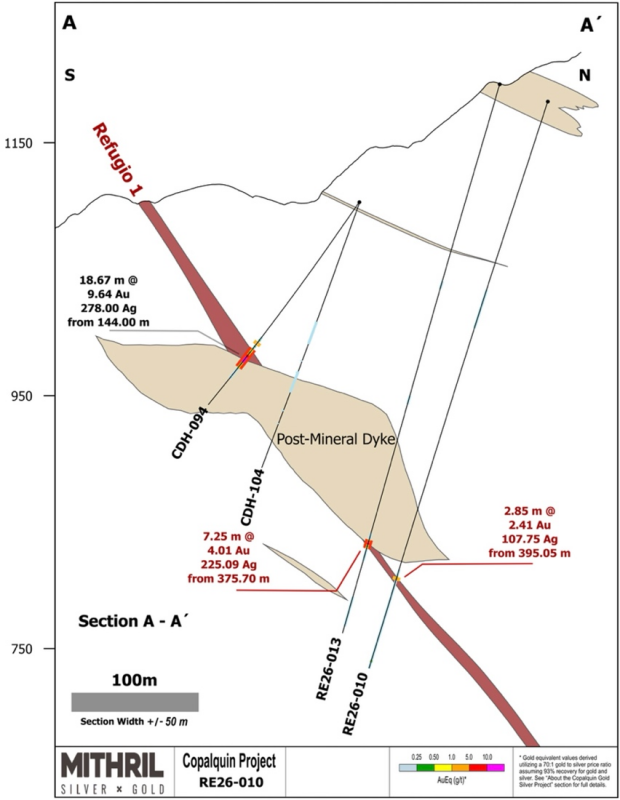
“The continued success at the western expansion area of El Refugio has defined continuity of the structure with a plunge of mineralization directed to the northwest that remains open for further drill testing in the future,” stated James Barr, Mithril’s VP Exploration. “With our immediate objectives in the Target 1 resource area being substantially complete, our focus shifts to completing an update of the Target 1 mineral resource estimate with an emphasis on upgrading confidence in the geological and grade distribution, targeting substantial conversion from the Inferred resource classification. For the first time, detailed modelling of a post-mineral dyke system will be included. Previously, the model recognized this unit as part of the pre-mineral volcanic rock package which masked the continuity of the mineralized structure. The recent drilling has confirmed the continuation of the mineralization at similar grade and thickness across the dyke which has split and offset the mineralization.
Our look-ahead into H2 of 2026 includes expanding ground-based mapping activities to the District North Section, target development at locations not previously drill tested, and extensional drilling to follow-up previous drilling campaign successes in the Target 5 area.”
Copalquin District - 2026
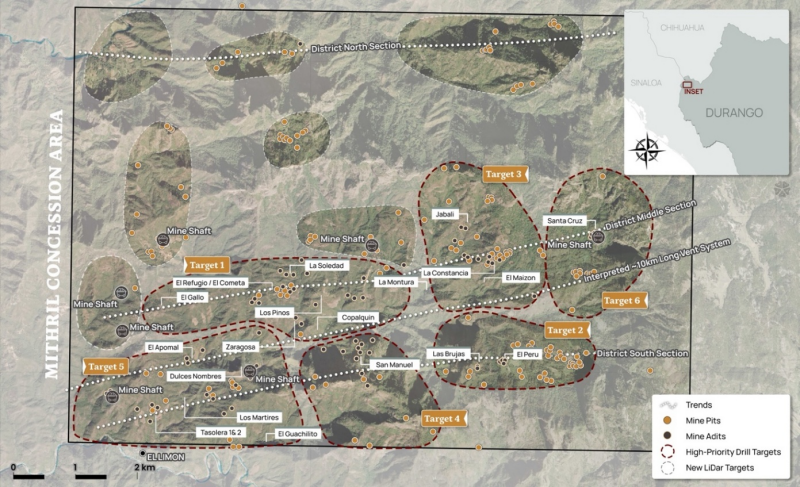
Mithril is undertaking an aggressive exploration programme in 2026, with 11, 238 metres now complete of a up to 25,000 metres of drilling planned during the first 6 - 8 months of the year across the Copalquin District. Upcoming work is focussing on expanding known mineralised zones, testing new high-priority targets, integrating district-wide geophysical data, and continuing to advance the Company’s district-scale exploration thesis. The district features over 100 historic underground workings (c.1850 – 1910) including several multi-level mines and 200 small surface workings. Mapping and sampling across the lower half of the 70 km 2 mining concession area demonstrates and a large epithermal silver-gold system with multiple target areas for potential resource growth plus the underlying conduit system responsible for the widespread gold and silver mineralisation.
The northern half of the Copalquin concession area features large areas of alteration. The LiDAR image shows evidence of historic mining activity and indicates some key structures. Along with historic sampling data, the northern section of the property presents as an additional, potentially significant and large exploration area within Mithril’s Copalquin mining concessions.
The nearby 20 km 2 La Dura property has recently been added to the portfolio providing a brown field property with a database of mapping, sampling and drilling 1F 2 . The recent LiDAR survey 2F 3 has revealed multiple historic workings within the concession area, including the 4-level high-grade La Dura mine. An initial 1.5 km long mineralisation corridor has been identified as a future drill target. An aerial magnetic survey has been complete with interpretation work currently progressing.
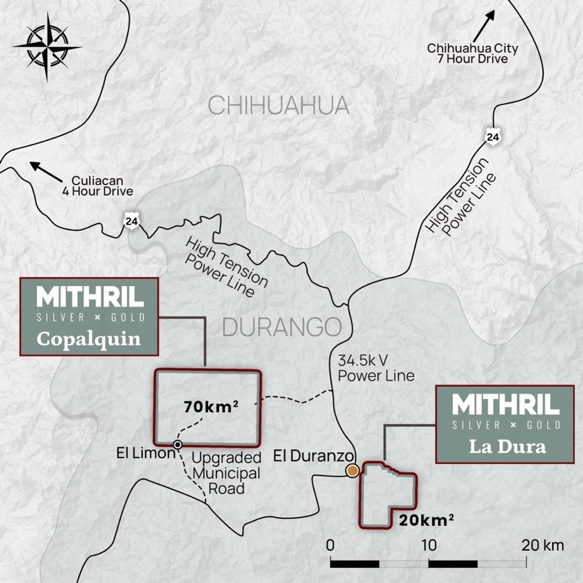
Figure 1 : Mithril’s Copalquin and La Dura property locations in Durango State, Mexico
Click Image To View Full Size
Figure 2 : LiDAR identified historic workings across the 70km 2 district. Current drilling locations at Target 1, Target 3 and Target 5 with ongoing mapping and sampling plus recently completed aerial magnetic survey (report pending)
Click Image To View Full Size
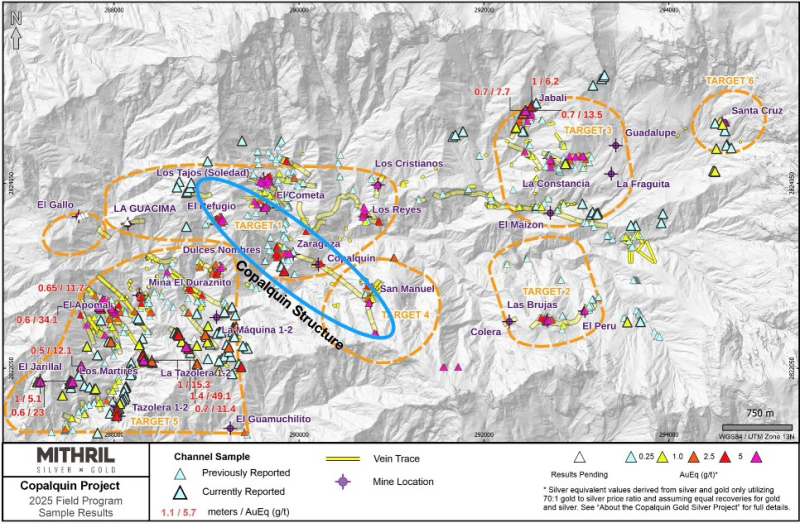
Figure 3 : Property-wide channel sampling results for the middle and south district sections within ~50% of the 70 km 2 mining concession area covering the Copalquin District. An aerial magnetic survey and a desktop structural study have been completed over the area and are being interpreted to support drill planning for district defining targets such as the Copalquin Structure.
Target 1 Drilling Program Discussion
Initial drilling at the Target 1 Resource area started in July 2020, culminating in seventy-seven drill holes (totalling 17,706.20 m) being completed in the area that were used as the basis of the initial Mineral Resource Estimate. Since then, 127 additional drill holes (totalling 42,861.35 m) have been completed in the Target 1 resource area, for a total of 204 drill holes (totalling 60,567.55 m).
A priority objective of the drilling campaign has been to de-risk the mineral resource model by completing infill drilling within areas defined as Inferred Resources to increase local confidence in the geology and grade continuity. In early 2026 Mithril directed drilling activities to address some remaining gaps that were recognized between wide spaced drilling in the El Refugio vein system that were untested or that were classified as Inferred resources. Eight (8) holes (totalling 2,814.0 m) were completed to fill these gaps. These holes further developed understanding of the main El Refugio body, including the addition of two new veins. The system now comprises four veins on the footwall and hangingwall side of El Refugio main.
Along the western extension of El Refugio main, the vein system consolidates into one main structure. The final seven holes (totalling 2,868.0 m) of the 2026 campaign at El Refugio were drilled to test continuity of the mineralized system and successfully intersected mineralization beyond the post-mineral dyke system. Recent age dating confirms the approximate age of mineralization around 27 Ma, relative to the post mineral dyke system with an age of 22 Ma, based on K-Ar age dating methods. Mineralization within the structure remains open to depth.
Drilling at La Soledad since the 2021 Mineral Resource Estimate focused on drill testing mineralized extensions projected from the historical workings, which were surveyed with underground LiDAR in May 2025, in addition to the successful extension of the mineralized structure to the southeast. Drilling in 2026, which included seven (7) drill holes at La Soledad (totalling 2,316 m) continued testing the extension of the mineralization along the southeast trend. Together, the campaigns have culminated in identifying six subparallel mineralized structures located in the footwall to La Soledad main near the intersection with Refugio main vein.
Table 1 : Recent significant results received for Target 1 resource upgrade drilling
Hole ID | From (m) | To (m) | Interval (m) | Au g/t | Ag g/t | AuEq g/t3F4 |
El Refugio |
RE26-010* | 395.05 | 397.90 | 2.85 | 2.41 | 107.8 | 3.94 |
including | 396.95 | 397.90 | 0.95 | 2.83 | 188.0 | 5.52 |
RE26-012 | 304.20 | 305.40 | 1.20 | 6.64 | 6.4 | 6.73 |
RE26-012 | 316.75 | 318.40 | 1.65 | 3.79 | 8.3 | 3.91 |
including | 317.65 | 318.40 | 0.75 | 5.55 | 11.9 | 5.72 |
RE26-013* | 375.70 | 382.95 | 7.25 | 4.01 | 225.1 | 7.22 |
including | 376.80 | 380.10 | 3.30 | 7.11 | 368.2 | 12.37 |
and* | 378.00 | 378.50 | 0.50 | 15.25 | 533.0 | 22.86 |
La Soledad |
LS26-006* | 66.00 | 67.00 | 1.00 | 1.22 | 149.1 | 3.34 |
LS26-006 | 117.55 | 118.30 | 0.75 | 1.49 | 50.7 | 2.21 |
LS26-007 | 58.20 | 58.75 | 0.55 | 0.95 | 53.7 | 1.71 |
LS26-007 | 81.90 | 88.65 | 6.75 | 0.65 | 23.4 | 0.98 |
LS26-007 | 92.00 | 95.25 | 3.25 | 5.23 | 30.5 | 5.66 |
Including* | 94.40 | 95.25 | 0.85 | 19.45 | 96.8 | 20.83 |
LS26-007 | 99.75 | 100.25 | 0.50 | 1.70 | 10.8 | 1.85 |
LS26-007 | 293.15 | 294.00 | 0.85 | 2.04 | 5.8 | 2.12 |
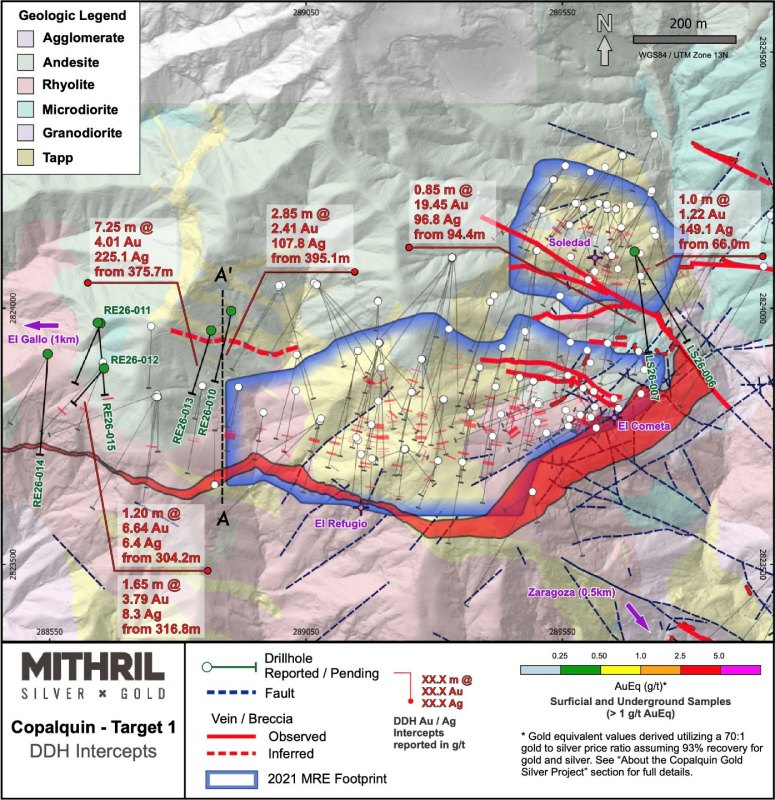
* Intercepts shown on attached maps and sections
Click Image To View Full Size
Figure 4 : Target 1 plan map showing drill hole trace locations, highlight intercepts in this announcement and resource footprint area
Click Image To View Full Size
Figure 5: Long section view of the El Refugio vein looking perpendicular to the vein to the northwest
Click Image To View Full Size
Figure 6: Cross section +/- 50 metres for drilling on the western extension of the Target 1 resource area, centred on drill hole RE26-013; drill hole RE26-010 and CDH-094 are located approximately 50 metres east.
Click Image To View Full Size
Figure 7: Long section view of the El Refugio vein looking perpendicular to vein to the northeast
Table 2 : Drill hole collar details included in this announcement
Hole ID | Easting | Northing | Elevation | Azimuth | Inclination | Depth (m) |
(m) | (m) | (m) | (degrees) | (degrees) |
RE26-010 | 288904 | 2823995 | 1186.00 | 190 | -72 | 471 |
RE26-011 | 288649 | 2823971 | 1182.00 | 200 | -70 | 402 |
RE26-012 | 288656 | 2823883 | 1177.00 | 220 | -75 | 369 |
RE26-013 | 288865 | 2823957 | 1202.48 | 195 | -74 | 453 |
RE26-014 | 288546 | 2823911 | 1133.8 | 182.5 | -58.1 | 384 |
RE26-015 | 288644 | 2823972 | 1182 | 170 | -69 | 417 |
LS26-006 | 289691 | 2824111 | 1121 | 150 | -58 | 366 |
LS26-007 | 289691 | 2824111 | 1121 | 173 | -58 | 381 |
Note: Some collar locations may be reported with approximate handheld GPS coordinates, while surveying with differential GPS is pending completion
Table 3: All drill results reported greater than or equal to 0.1 g/t AuEq
Hole ID | Sample ID | From (m) | To (m) | Interval (m) | Au (g/t) | Ag (g/t) | AuEq (g/t)* |
RE26-010 | 210152 | 394.50 | 395.05 | 0.55 | 0.20 | 3.6 | 0.25 |
RE26-010 | 210153 | 395.05 | 395.70 | 0.65 | 3.38 | 14.6 | 3.59 |
RE26-010 | 210154 | 395.70 | 396.45 | 0.75 | 2.42 | 146.0 | 4.51 |
RE26-010 | 210155 | 396.45 | 396.95 | 0.50 | 0.31 | 19.0 | 0.58 |
RE26-010 | 210156 | 396.95 | 397.90 | 0.95 | 2.83 | 188.0 | 5.52 |
RE26-010 | 210184 | 415.45 | 416.00 | 0.55 | 0.03 | 5.1 | 0.10 |
RE26-010 | 210234 | 464.00 | 466.00 | 2.00 | 0.10 | 4.9 | 0.17 |
RE26-011 | 207553 | 347.70 | 348.55 | 0.85 | 0.08 | 2.5 | 0.11 |
RE26-011 | 207554 | 348.55 | 349.50 | 0.95 | 0.04 | 9.3 | 0.17 |
RE26-011 | 207556 | 350.00 | 350.65 | 0.65 | 0.08 | 4.4 | 0.14 |
RE26-011 | 207557 | 350.65 | 351.15 | 0.50 | 0.17 | 3.8 | 0.23 |
RE26-011 | 207566 | 390.90 | 391.95 | 1.05 | 0.25 | 2.8 | 0.29 |
RE26-011 | 207569 | 393.35 | 394.10 | 0.75 | 0.27 | 1.7 | 0.30 |
RE26-012 | 207610 | 300.40 | 301.65 | 1.25 | 0.08 | 2.0 | 0.11 |
RE26-012 | 207613 | 304.20 | 305.40 | 1.20 | 6.64 | 6.4 | 6.73 |
RE26-012 | 207623 | 316.75 | 317.65 | 0.90 | 2.33 | 5.3 | 2.41 |
RE26-012 | 207624 | 317.65 | 318.40 | 0.75 | 5.55 | 11.9 | 5.72 |
RE26-012 | 207626 | 318.40 | 318.90 | 0.50 | 0.25 | 7.7 | 0.36 |
RE26-012 | 207627 | 318.90 | 319.40 | 0.50 | 0.35 | 5.6 | 0.43 |
RE26-012 | 207628 | 319.40 | 320.15 | 0.75 | 0.11 | 3.9 | 0.16 |
RE26-012 | 207629 | 320.15 | 320.90 | 0.75 | 0.05 | 3.8 | 0.11 |
RE26-012 | 207634 | 322.60 | 323.10 | 0.50 | 0.22 | 2.7 | 0.26 |
RE26-012 | 207636 | 323.80 | 324.30 | 0.50 | 0.44 | 5.4 | 0.51 |
RE26-012 | 207637 | 324.30 | 324.90 | 0.60 | 0.08 | 4.9 | 0.15 |
RE26-012 | 207638 | 324.90 | 325.80 | 0.90 | 0.09 | 4.4 | 0.16 |
RE26-012 | 207639 | 325.80 | 326.30 | 0.50 | 0.32 | 12.2 | 0.50 |
RE26-012 | 207640 | 326.30 | 326.95 | 0.65 | 0.70 | 18.5 | 0.96 |
RE26-012 | 207642 | 327.45 | 327.95 | 0.50 | 0.16 | 2.4 | 0.19 |
RE26-012 | 207643 | 327.95 | 328.45 | 0.50 | 0.17 | 3.9 | 0.22 |
RE26-012 | 207644 | 328.45 | 329.40 | 0.95 | 0.75 | 11.6 | 0.91 |
RE26-013 | 210255 | 375.70 | 376.20 | 0.50 | 2.29 | 242.0 | 5.75 |
RE26-013 | 210256 | 376.20 | 376.80 | 0.60 | 2.93 | 99.2 | 4.35 |
RE26-013 | 210257 | 376.80 | 377.35 | 0.55 | 8.84 | 335.0 | 13.63 |
RE26-013 | 210258 | 377.35 | 378.00 | 0.65 | 2.00 | 110.0 | 3.57 |
RE26-013 | 210259 | 378.00 | 378.50 | 0.50 | 15.25 | 533.0 | 22.86 |
RE26-013 | 210261 | 378.50 | 379.05 | 0.55 | 9.08 | 461.0 | 15.67 |
RE26-013 | 210262 | 379.05 | 379.60 | 0.55 | 6.01 | 348.0 | 10.98 |
RE26-013 | 210263 | 379.60 | 380.10 | 0.50 | 2.73 | 496.0 | 9.82 |
RE26-013 | 210264 | 380.10 | 380.60 | 0.50 | 1.64 | 111.0 | 3.22 |
RE26-013 | 210265 | 380.60 | 381.20 | 0.60 | 0.41 | 71.5 | 1.43 |
RE26-013 | 210266 | 381.20 | 381.80 | 0.60 | 0.12 | 11.4 | 0.28 |
RE26-013 | 210267 | 381.80 | 382.40 | 0.60 | 0.87 | 111.0 | 2.46 |
RE26-013 | 210268 | 382.40 | 382.95 | 0.55 | 1.86 | 117.0 | 3.53 |
RE26-013 | 210274 | 386.90 | 387.60 | 0.70 | 0.03 | 4.9 | 0.10 |
RE26-013 | 210276 | 387.60 | 388.30 | 0.70 | 0.05 | 8.0 | 0.17 |
RE26-013 | 210285 | 425.30 | 425.90 | 0.60 | 0.02 | 5.1 | 0.10 |
RE26-014 | 207687 | 358.80 | 359.35 | 0.55 | 0.02 | 7.9 | 0.13 |
RE26-014 | 207688 | 359.35 | 360.00 | 0.65 | 0.03 | 8.2 | 0.15 |
RE26-014 | 207689 | 360.00 | 362.00 | 2.00 | 0.01 | 6.7 | 0.11 |
RE26-015 | 207711 | 324.00 | 325.25 | 1.25 | 0.08 | 10.7 | 0.23 |
LS26-006 | 210322 | 66.00 | 66.50 | 0.50 | 0.95 | 95.1 | 2.31 |
LS26-006 | 210323 | 66.50 | 67.00 | 0.50 | 1.48 | 203.0 | 4.38 |
LS26-006 | 210326 | 67.50 | 68.00 | 0.50 | 0.06 | 4.8 | 0.13 |
LS26-006 | 210334 | 105.50 | 106.00 | 0.50 | 0.08 | 6.3 | 0.17 |
LS26-006 | 210335 | 106.00 | 106.50 | 0.50 | 0.14 | 3.3 | 0.18 |
LS26-006 | 210337 | 107.10 | 107.75 | 0.65 | 0.06 | 7.0 | 0.16 |
LS26-006 | 210344 | 112.30 | 113.35 | 1.05 | 0.10 | 17.4 | 0.35 |
LS26-006 | 210349 | 115.60 | 116.25 | 0.65 | 0.24 | 12.6 | 0.42 |
LS26-006 | 210351 | 116.25 | 117.55 | 1.30 | 0.06 | 6.4 | 0.15 |
LS26-006 | 210352 | 117.55 | 118.30 | 0.75 | 1.49 | 50.7 | 2.21 |
LS26-006 | 210363 | 127.45 | 128.45 | 1.00 | 0.04 | 4.2 | 0.10 |
LS26-006 | 210367 | 134.40 | 135.40 | 1.00 | 0.05 | 5.9 | 0.14 |
LS26-006 | 210387 | 159.80 | 160.30 | 0.50 | 0.08 | 1.3 | 0.10 |
LS26-006 | 210388 | 160.30 | 160.80 | 0.50 | 0.18 | 3.5 | 0.23 |
LS26-006 | 210389 | 160.80 | 161.30 | 0.50 | 0.10 | 0.5 | 0.10 |
LS26-006 | 210390 | 161.30 | 161.80 | 0.50 | 0.09 | 2.6 | 0.13 |
LS26-006 | 210394 | 165.35 | 166.35 | 1.00 | 0.18 | 5.0 | 0.25 |
LS26-006 | 210401 | 172.35 | 173.85 | 1.50 | 0.09 | 5.7 | 0.17 |
LS26-006 | 210409 | 207.40 | 207.90 | 0.50 | 0.11 | 0.5 | 0.12 |
LS26-006 | 210419 | 259.35 | 260.00 | 0.65 | 0.12 | 0.5 | 0.13 |
LS26-006 | 210432 | 272.60 | 273.60 | 1.00 | 0.32 | 22.8 | 0.64 |
LS26-007 | 210478 | 54.60 | 55.40 | 0.80 | 0.75 | 1.1 | 0.77 |
LS26-007 | 210479 | 55.40 | 56.20 | 0.80 | 0.30 | 2.2 | 0.33 |
LS26-007 | 210483 | 58.20 | 58.75 | 0.55 | 0.95 | 53.7 | 1.71 |
LS26-007 | 210484 | 58.75 | 59.75 | 1.00 | 0.05 | 3.1 | 0.10 |
LS26-007 | 210501 | 81.90 | 83.00 | 1.10 | 0.68 | 21.5 | 0.99 |
LS26-007 | 210502 | 83.00 | 84.00 | 1.00 | 0.87 | 28.3 | 1.28 |
LS26-007 | 210503 | 84.00 | 85.10 | 1.10 | 1.30 | 36.0 | 1.81 |
LS26-007 | 210504 | 85.10 | 85.75 | 0.65 | 0.32 | 14.1 | 0.52 |
LS26-007 | 210505 | 85.75 | 86.35 | 0.60 | 0.56 | 43.7 | 1.18 |
LS26-007 | 210506 | 86.35 | 87.00 | 0.65 | 0.28 | 23.9 | 0.62 |
LS26-007 | 210508 | 88.00 | 88.65 | 0.65 | 0.85 | 19.1 | 1.12 |
LS26-007 | 210509 | 88.65 | 89.45 | 0.80 | 0.15 | 6.5 | 0.24 |
LS26-007 | 210512 | 92.00 | 93.00 | 1.00 | 0.21 | 12.0 | 0.38 |
LS26-007 | 210513 | 93.00 | 93.75 | 0.75 | 0.28 | 2.9 | 0.32 |
LS26-007 | 210514 | 93.75 | 94.40 | 0.65 | 0.05 | 4.1 | 0.11 |
LS26-007 | 210515 | 94.40 | 95.25 | 0.85 | 19.45 | 96.8 | 20.83 |
LS26-007 | 210518 | 98.00 | 99.00 | 1.00 | 0.15 | 1.5 | 0.17 |
LS26-007 | 210521 | 99.75 | 100.25 | 0.50 | 1.70 | 10.8 | 1.85 |
LS26-007 | 210528 | 110.00 | 111.00 | 1.00 | 0.06 | 3.4 | 0.11 |
LS26-007 | 210531 | 112.00 | 113.00 | 1.00 | 0.18 | 8.0 | 0.29 |
LS26-007 | 210536 | 118.00 | 120.00 | 2.00 | 0.28 | 0.5 | 0.29 |
LS26-007 | 210548 | 135.00 | 135.50 | 0.50 | 0.84 | 6.1 | 0.93 |
LS26-007 | 210549 | 135.50 | 136.10 | 0.60 | 0.05 | 4.0 | 0.11 |
LS26-007 | 210551 | 136.10 | 136.80 | 0.70 | 0.07 | 1.8 | 0.10 |
LS26-007 | 210556 | 140.40 | 141.05 | 0.65 | 0.09 | 6.5 | 0.18 |
LS26-007 | 210567 | 150.40 | 151.15 | 0.75 | 0.11 | 3.0 | 0.15 |
LS26-007 | 210599 | 221.90 | 222.55 | 0.65 | 0.12 | 2.0 | 0.15 |
LS26-007 | 210644 | 290.75 | 291.25 | 0.50 | 0.05 | 4.0 | 0.11 |
LS26-007 | 210647 | 293.15 | 294.00 | 0.85 | 2.04 | 5.8 | 2.12 |
LS26-007 | 210660 | 302.75 | 303.25 | 0.50 | 0.09 | 4.7 | 0.16 |
LS26-007 | 210662 | 304.70 | 305.55 | 0.85 | 0.11 | 1.8 | 0.13 |
*See gold equivalent (AuEq) formula in the ABOUT THE COPALQUIN SILVER GOLD PROJECT section
LA DURA PROJECT UPDATE
In December 2025, Mithril secured an exclusive option to acquire 100% of the 2,052-hectare La Dura gold-silver property in Durango, Mexico, approximately 20 km from the Copalquin Project.
The property hosts several historic workings, including the past-producing La Dura Mine. Initial work has included LiDAR and aerial magnetic surveys to advance targeting.
Accordingly, along with the initial payment of US$25K, 50,000 ordinary Mithril shares at A$0.51 per share will be issued to the vendor as part of the initial acquisition consideration and are subject to a four-month hold period.
ABOUT THE COPALQUIN SILVER GOLD PROJECT
The Copalquin mining district is located in Durango State, Mexico and covers an entire mining district of 70km 2 containing several dozen historic silver and gold mines and workings, ten of which had notable production. The district is within the Sierra Madre Gold Silver Trend which extends north-south along the western side of Mexico and hosts many gold and silver districts.
Multiple mineralisation events, young intrusives thought to be system-driving heat sources, widespread alteration together with extensive surface vein exposures and dozens of historic mine workings, identify the Copalquin mining district as a major epithermal centre for Gold and Silver.
Within 15 months of drilling in the Copalquin District, Mithril delivered a maiden JORC mineral resource estimate at the first of several target areas (Target 1), demonstrating the high-grade gold and silver resource potential for the district. This maiden resource is detailed below (see ASX release 17 November 2021 ) ^ and a NI 43-101 Technical Report filed on SEDAR+
Target 1 Maiden Resource:
Indicated 691 kt @ 5.43 g/t gold, 114 g/t silver for 121 ,000 oz gold plus 2,538,000 oz silver
Inferred 1,725 kt @ 4.55 g/t gold, 152 g/t silver for 252 ,000 oz gold plus 8,414,000 oz silver
(using a cut-off grade of 2.0 g/t AuEq*)
Table 4 Mineral resource estimate at Target 1 El Refugio – La Soledad using a cut-off grade of 2.0 g/t AuEq*
| | Tonnes (kt) | Tonnes (kt) | Gold (g/t) | Silver (g/t) | Gold Eq.* (g/t) | Gold (koz) | Silver (koz) | Gold Eq.* (koz) |
El Refugio | Indicated | 691 | 5.43 | 114.2 | 7.06 | 121 | 2,538 | 157 |
| | Inferred | 1,447 | 4.63 | 137.1 | 6.59 | 215 | 6,377 | 307 |
La Soledad | Indicated | - | - | - | - | - | - | - |
| | Inferred | 278 | 4.12 | 228.2 | 7.38 | 37 | 2,037 | 66 |
Total | Indicated | 691 | 5.43 | 114.2 | 7.06 | 121 | 2,538 | 157 |
| | Inferred | 1,725 | 4.55 | 151.7 | 6.72 | 252 | 8,414 | 372 |
* In determining the gold equivalent (AuEq.) grade for reporting, a gold:silver price ratio of 70:1 was determined, using the formula: AuEq grade = Au grade + ((Ag grade/70) x (Ag recovery/Au recovery)). The metal prices used to determine the 70:1 ratio are the cumulative average prices for 2021: gold USD1,798.34 and silver: USD25.32 (actual is 71:1) from kitco.com .
For silver equivalent (AgEq.) grade reporting, the same factors as above are used with the formula AgEq grade = Ag grade + ((Au grade x 70) x (Au recovery/Ag recovery))
At this early stage, the metallurgical recoveries were assumed to be equal (93%). Subsequent preliminary metallurgical test work produced recoveries of 91% for silver and 96% for gold (ASX Announcement 25 February 2022) and these will be used when the resource is updated in the future. In the Company’s opinion there is reasonable potential for both gold and silver to be extracted and sold.
^ The information in this report that relates to Mineral Resources or Ore Reserves is based on information provided in the following ASX announcement: 17 Nov 2021 - MAIDEN JORC RESOURCE 529,000 OUNCES @ 6.81G/T (AuEq * ), which includes the full JORC MRE report, also available on the Mithril Resources Limited Website.
The Company confirms that it is not aware of any new information or data that materially affects the information included in the original market announcement and that all material assumptions and technical parameters underpinning the estimates in the relevant market announcement continue to apply and have not materially changed. The company confirms that the form and context in which the Competent Person’s findings are presented have not been materially modified from the original market announcement.
Mining study (conceptual) and metallurgical test work supports the development of the El Refugio-La Soledad resource with conventional underground mining methods indicated as being appropriate and with high silver-gold recovery to produce metal on-site with conventional processing. The average vein width is approximately 4.5 metres.
Mithril is currently exploring in the Copalquin District to expand the resource footprint, demonstrating its multi-million-ounce gold and silver potential. Mithril has an exclusive option to purchase 100% interest in the Copalquin mining concessions by paying US$10M on or any time before 7 August 2028.
-ENDS-
Released with the authority of the Board.
For further information contact:
The Australian Securities Exchange has not reviewed and does not accept responsibility for the accuracy or adequacy of this release.
Neither TSX Venture Exchange nor its Regulation Services Provider (as that term is defined in policies of the TSX Venture Exchange) accepts responsibility for the adequacy or accuracy of this release.
Competent Persons Statement - JORC
The information in this announcement that relates to metallurgical test results, mineral processing and project development and study work has been compiled by Mr John Skeet who is Mithril’s CEO and Managing Director. Mr Skeet is a Fellow of the Australasian Institute of Mining and Metallurgy. This is a Recognised Professional Organisation (RPO) under the Joint Ore Reserves Committee (JORC) Code.
Mr Skeet has sufficient experience of relevance to the styles of mineralisation and the types of deposits under consideration, and to the activities undertaken, to qualify as a Competent Person as defined in the 2012 Edition of the Joint Ore Reserves Committee (JORC) Australasian Code for Reporting of Exploration Results, Mineral Resources and Ore Reserves. Mr Skeet consents to the inclusion in this report of the matters based on information in the form and context in which it appears. The Australian Securities Exchange has not reviewed and does not accept responsibility for the accuracy or adequacy of this release.
The information in this announcement that relates to sampling techniques and data, exploration results and geological interpretation for Mithril’s Mexican project, has been compiled by Mr James Barr who is Mithril’s Vice President - Exploration. Mr Barr is a member of the Engineers and Geoscientists of British Columbia and a Certified Professional Geologist (P.Geo). This is a Recognised Professional Organisation (RPO) under the Joint Ore Reserves Committee (JORC) Code.
Mr Barr has sufficient experience of relevance to the styles of mineralisation and the types of deposits under consideration, and to the activities undertaken, to qualify as a Competent Person as defined in the 2012 Edition of the Joint Ore Reserves Committee (JORC) Australasian Code for Reporting of Exploration Results, Mineral Resources and Ore Reserves. Mr Barr consents to the inclusion in this report of the matters based on information in the form and context in which it appears.
The information in this announcement that relates to Mineral Resources is reported by Mr Rodney Webster, former Principal Geologist at AMC Consultants Pty Ltd (AMC), who is a Member of the Australian Institute of Geoscientists. The report was peer reviewed by Andrew Proudman, Principal Consultant at AMC. Mr Webster is acting as the Competent Person, as defined in the 2012 Edition of the Joint Ore Reserves Committee (JORC) Australasian Code for Reporting of Exploration Results, Mineral Resources and Ore Reserves, for the reporting of the Mineral Resource estimate. A site visit was carried out by Jose Olmedo a geological consultant with AMC, in September 2021 to observe the drilling, logging, sampling and assay database. Mr Webster consents to the inclusion in this report of the matters based on information in the form and context in which it appears
Qualified Persons – NI 43-101
Scientific and technical information in this Report has been reviewed and approved by Mr John Skeet (FAUSIMM, CP) Mithril’s Managing Director and Chief Executive Officer. Mr John Skeet is a qualified person within the meaning of NI 43-101.
Samples are sent to ALS Global with sample preparation performed in Chihuahua City, Mexico and assaying of sample pulps performed in North Vancouver, BC, Canada.
JORC Code, 2012 Edition – Table 1
Section 1 Sampling Techniques and Data
Criteria | JORC Code explanation | Commentary |
Sampling techniques | Nature and quality of sampling (e.g. cut channels, random chips, or specific specialised industry standard measurement tools appropriate to the minerals under investigation, such as down hole gamma sondes, or handheld XRF instruments, etc). These examples should not be taken as limiting the broad meaning of sampling.
Include reference to measures taken to ensure sample representativity and the appropriate calibration of any measurement tools or systems used.
Aspects of the determination of mineralisation that are Material to the Public Report.
In cases where ‘industry standard’ work has been done this would be relatively simple (e.g. ‘reverse circulation drilling was used to obtain 1 m samples from which 3 kg was pulverised to produce a 30 g charge for fire assay’). In other cases more explanation may be required, such as where there is coarse gold that has inherent sampling problems. Unusual commodities or mineralisation types (e.g. submarine nodules) may warrant disclosure of detailed information.
| Drill core samples are cut lengthwise with a diamond saw. Intervals are nominally 1 m but may vary between 0.5 m to 1.5 m based on geologic criteria.
The same side of the core is always sent to sample (left side of saw).
Reported intercepts are calculated as either potentially underground mineable (100m down hole) or as potentially open-pit mineable (near surface).
Potentially underground mineable intercepts are calculated as length weighted averages of material greater than or equal to 1 g/t AuEQ_70 allowing up to 2m of internal dilution.
Potentially open-pit mineable intercepts are calculated as length weighted averages of material greater than or equal to 0.25 g/t AuEQ_70 allowing for up to 2m of internal dilution.
Rock Sawn Channel samples underground and surface are collected with the assistance of a handheld portable saw. The channels are 2.5 to 3cm deep and 6-8 cm wide along continuous lines oriented perpendicular to the mineralized structure. The samples are as representative as possible
Rock Sawn Channel surface samples were surveyed with a Handheld GPS then permanently mark with an aluminium tag and red colour spray across the strike of the outcrop over 1 metre. Samples are as representative as possible
Rock Sawn Channel underground samples were located after a compass and tape with the mine working having a surveyed control point at the portal, then permanently marked with an aluminium tag and red colour spray oriented perpendicular to the mineralized structure. Samples are as representative as possible
Soil sampling has been carried out by locating pre-planned points by handheld GPS and digging to below the first colour-change in the soil (or a maximum of 50 cm). In the arid environment there is a 1 – 10 cm organic horizon and a 10 – 30 cm B horizon above the regolith. Samples are sieved to -80 mesh in the field. Samples are collected on a 20 m x 50 m grid or every 20 m on N–S lines 50 m apart. These samples are considered representative of the medium being sampled and lines are appropriately oriented to the nearly E–W structural trend.
|
Drilling techniques | Drill type (e.g. core, reverse circulation, open-hole hammer, rotary air blast, auger, Bangka, sonic, etc) and details (e.g. core diameter, triple or standard tube, depth of diamond tails, face-sampling bit or other type, whether core is oriented and if so, by what method, etc).
| |
Drill sample recovery | Method of recording and assessing core and chip sample recoveries and results assessed.
Measures taken to maximise sample recovery and ensure representative nature of the samples.
Whether a relationship exists between sample recovery and grade and whether sample bias may have occurred due to preferential loss/gain of fine/coarse material.
| Drill recovery is measured based on measured length of core divided by length of drill run.
Recovery in holes CDH-001 through CDH-025 and holes CDH-032 through CDH-077 was always above 90% in the mineralized zones. Detailed core recovery data are maintained in the project database.
Holes CDH-026 through CDH-031 had problems with core recovery in highly fractured, clay rich breccia zones.
There is no adverse relationship between recovery and grade identified to date.
|
Logging | Whether core and chip samples have been geologically and geotechnically logged to a level of detail to support appropriate Mineral Resource estimation, mining studies and metallurgical studies.
Whether logging is qualitative or quantitative in nature. Core (or costean, channel, etc) photography.
The total length and percentage of the relevant intersections logged.
| Geotechnical and geological logging of the drill core takes place on racks in the company core shed.
Core samples have been geologically and geotechnically logged to a level of detail to support appropriate Mineral Resource estimation, mining studies and metallurgical studies.
Core logging is both qualitative or quantitative in nature. Photos are taken of each box of core before samples are cut. Photos of cut core intervals are taken after sampling. Core is wetted to improve visibility of features in the photos.
All core has been logged and photographed.
Rock sawn channel samples are marked, measured and photographed at location
Soil samples are recorded at location, logged and described
|
Sub-sampling techniques and sample preparation | If core, whether cut or sawn and whether quarter, half or all core taken.
If non-core, whether riffled, tube sampled, rotary split, etc and whether sampled wet or dry.
For all sample types, the nature, quality and appropriateness of the sample preparation technique.
Quality control procedures adopted for all sub-sampling stages to maximise representativity of samples.
Measures taken to ensure that the sampling is representative of the in situ material collected, including for instance results for field duplicate/second-half sampling.
Whether sample sizes are appropriate to the grain size of the material being sampled.
|
Crushed core duplicates are split/collected by the laboratory and submitted for assay (1 in 30 samples)
Sample sizes are appropriate to the grain size of the material being sampled.
Rock sawn channel samples and soil samples are prepared using ALS Minerals Prep-31 crushing, splitting and pulverizing. This is appropriate for the type of deposit being explored.
|
Quality of assay data and laboratory tests | The nature, quality and appropriateness of the assaying and laboratory procedures used and whether the technique is considered partial or total.
For geophysical tools, spectrometers, handheld XRF instruments, etc, the parameters used in determining the analysis including instrument make and model, reading times, calibrations factors applied and their derivation, etc.
Nature of quality control procedures adopted (e.g. standards, blanks, duplicates, external laboratory checks) and whether acceptable levels of accuracy (i.e. lack of bias) and precision have been established.
|
Samples are assayed for silver using ALS Minerals ME-ICP61 method. Over limits are assayed by silverOG63 and silverGRAV21. These are considered a total assay technique.
Standards and blanks are inserted at a rate of one per every 25 samples and one per every 40 samples, respectively. Pulp duplicate sampling is undertaken for 3% of all samples (see above). External laboratory checks will be conducted as sufficient samples are collected. Levels of accuracy (i.e. lack of bias) and precision have not yet been established.
Certified Reference Materials – Rock Labs and CDN CRMs have been used throughout the project including, low (~2 g/t Au), medium (~9 g/t Au) and high (~18g/t Au and ~40 g/t Au). Results are automatically checked on data import into the BEDROCK database to fall within 2 standard deviations of the expected value.
Samples with significant amounts of observed visible gold are also assayed by AuSCR21, a screen assay that analyses gold in both the milled pulp and in the residual oversize from pulverization. This has been done for holes CDH-075 and CDH-077.
|
Verification of sampling and assaying | The verification of significant intersections by either independent or alternative company personnel.
The use of twinned holes.
Documentation of primary data, data entry procedures, data verification, data storage (physical and electronic) protocols.
Discuss any adjustment to assay data.
| The verification of significant intersections by either independent or alternative company personnel has not been conducted. A re-assay programme of pulp duplicates is currently in progress.
MTH has drilled one twin hole. Hole CDH-072, reported in the 15/6/2021 announcement, is a twin of holes EC-002 and UC-03. Results are comparable.
Documentation of primary data, data entry procedures, data verification, data storage (physical and electronic) protocols are maintained in the company’s core facility.
Assay data have not been adjusted other than applying length weighted averages to reported intercepts.
|
Location of data points | Accuracy and quality of surveys used to locate drill holes (collar and down-hole surveys), trenches, mine workings and other locations used in Mineral Resource estimation.
Specification of the grid system used.
Quality and adequacy of topographic control.
| Drill collar coordinates are currently located by handheld GPS. Precise survey of hole locations is planned. Downhole surveys of hole deviation are recorded using a Reflex Multishot tool for all holes. A survey measurement is first collected at 15 meters downhole, and then every 50 meters until the end of the hole. Locations for holes have been surveyed with differential GPS to a sub 10 cm precision.
UTM/UPS WGS 84 zone 13 N
High quality topographic control from LiDAR imagery and orthophotos covers the entire project area.
|
Data spacing and distribution | Data spacing for reporting of Exploration Results.
Whether the data spacing and distribution is sufficient to establish the degree of geological and grade continuity appropriate for the Mineral Resource and Ore Reserve estimation procedure(s) and classifications applied.
Whether sample compositing has been applied.
| Data spacing is appropriate for the reporting of Exploration Results.
The Resource estimation re-printed in this announcement was originally released on 17 Nov 2021
No sample compositing has been applied.
|
Orientation of data in relation to geological structure | Whether the orientation of sampling achieves unbiased sampling of possible structures and the extent to which this is known, considering the deposit type.
If the relationship between the drilling orientation and the orientation of key mineralised structures is considered to have introduced a sampling bias, this should be assessed and reported if material.
| Cut lines are marked on the core by the geologists to assure that the orientation of sampling achieves unbiased sampling of possible structures. This is reasonably well observed in the core and is appropriate to the deposit type.
The relationship between the drilling orientation and the orientation of key mineralised structures is not considered to have introduced a sampling bias.
Rock sawn channel samples are cut perpendicular to the observed vein orientation wherever possible
|
Sample security | | Samples are stored in a secure core storage facility until they are shipped off site by small aircraft and delivered directly to ALS Global sample preparation facility in Chihuahua, Mexico. ALS airfreights the sample pulps to their assaying facility in North Vancouver, BC, Canada
|
Audits or reviews | | |
Section 2 Reporting of Exploration Results
Criteria | JORC Code explanation | Commentary |
Mineral tenement and land tenure status | Type, reference name/number, location and ownership including agreements or material issues with third parties such as joint ventures, partnerships, overriding royalties, native title interests, historical sites, wilderness or national park and environmental settings.
The security of the tenure held at the time of reporting along with any known impediments to obtaining a licence to operate in the area.
|
No. | Concession | Concession Title number | Area (Ha) | Location | 1 | LA SOLEDAD | 52033 | 6 | Tamazula, Durango, Mexico | 2 | EL COMETA | 164869 | 36 | Tamazula, Durango, Mexico | 3 | SAN MANUEL | 165451 | 36 | Tamazula, Durango, Mexico | 4 | COPALQUIN | 178014 | 20 | Tamazula, Durango, Mexico | 5 | EL SOL | 236130 | 6,000 | Tamazula, Durango and Badiraguato, Sinaloa, México | 6 | EL CORRAL | 236131 | 907.3243 | Tamazula, Durango and Badiraguato, Sinaloa, México |
|
Exploration done by other parties | | Previous exploration by Bell Coast Capital Corp. and UC Resources was done in the late 1990’s and in 2005 – 2007. Work done by these companies is historic and non-JORC compliant. Mithril uses these historic data only as a general guide and will not incorporate work done by these companies in resource modelling.
Work done by the Mexican government and by IMMSA and will be used for modelling of historic mine workings which are now inaccessible (void model)
|
Geology | | Copalquin is a low sulfidation epithermal silver-gold deposit hosted in andesite. This deposit type is common in the Sierra Madre Occidental of Mexico and is characterized by quartz veins and stockworks surrounded by haloes of argillic (illite/smectite) alteration. Veins have formed as both low-angle semi-continuous lenses parallel to the contact between granodiorite and andesite and as tabular veins in high-angle normal faults. Vein and breccia thickness has been observed up to 30 meters wide with average widths on the order of 3 to 5 meters. The overall strike length of the semi-continuous mineralized zone from El Gallo to Refugio, Cometa, Los Pinos, Los Reyes, La Montura to Constancia and Santa Cruz is almost 7 kilometres. The southern area from south west of Apomal to San Manuel and to Las Brujas-El Peru provides additional exploration potential up to 6km.
|
Drill hole Information | A summary of all information material to the understanding of the exploration results including a tabulation of the following information for all Material drill holes:
easting and northing of the drill hole collar
• elevation or RL (Reduced Level – elevation above
sea level in metres) of the drill hole collar
dip and azimuth of the hole
down hole length and interception depth
hole length.
If the exclusion of this information is justified on the basis that the information is not Material and this exclusion does not detract from the understanding of the report, the Competent Person should clearly explain why this is the case.
|
See Table 2 and Figures 4 and 5 in the Announcement |
Data aggregation methods | In reporting Exploration Results, weighting averaging techniques, maximum and/or minimum grade truncations (e.g. cutting of high grades) and cut-off grades are usually Material and should be stated.
Where aggregate intercepts incorporate short lengths of high grade results and longer lengths of low grade results, the procedure used for such aggregation should be stated and some typical examples of such aggregations should be shown in detail.
The assumptions used for any reporting of metal equivalent values should be clearly stated.
| Potentially underground mineable intercepts are calculated as length weighted averages of material greater than or equal to 1 g/t AuEQ_70 allowing up to 2m of internal dilution.
Potentially open-pit mineable intercepts are calculated as length weighted averages of material greater than or equal to 0.25c g/t AuEQ_70 allowing for up to 2m of internal dilution.
No upper cut-off is applied to reporting intercepts.
Length weighted averaging is used to report intercepts. The example of CDH-002 is shown. The line of zero assays is a standard which was removed from reporting.
Au Raw | silver raw | Length (m) | Au *length | silver *length | | | | | | 7.51 | 678 | 0.5 | 3.755 | 339 | | | | | | 11.85 | 425 | 0.55 | 6.5175 | 233.75 | | | | | | | 0 | 0 | 0 | 0 | 0 | | | | | | 0.306 | 16 | 1 | 0.306 | 16 | | | | | | 0.364 | 31.7 | 1 | 0.364 | 31.7 | | | | | | 3.15 | 241 | 0.5 | 1.575 | 120.5 | | | | | | 10.7 | 709 | 0.5 | 5.35 | 354.5 | | | | | | 15.6 | 773 | 0.5 | 7.8 | 386.5 | | | | | | | | | | | | From | To | Length | Au g/t | silver g/t | | | | 4.55 | 25.667 | 1481.9 | 91.95 | 96.5 | 4.55 | 5.64 | 325.7 |
In determining the gold equivalent (AuEq.) grade for reporting, a gold:silver price ratio of 70:1 was determined, using the formula: AuEq grade = Au grade + ((silver grade/70) x (silver recovery/Au recovery)). The metal prices used to determine the 70:1 ratio are the cumulative average prices for 2021: gold USD1,798.34 and silver: USD25.32 (actual is 71:1) from kitco.com At this early stage, the metallurgical recoveries are assumed to be equal (93%), Subsequent preliminary metallurgical test work produced recoveries of 91% for silver and 96% for gold (ASX Announcement 25 February 2022).
For Rock Saw Channel Sampling and soil sampling in the Copalquin District, silver equivalent (AgEq) is determined using the formula: AgEq grade = silver grade + ((Au grade x 70) x (Au recovery/silver recovery)). The metal prices used to determine the 70:1 ratio are the cumulative average prices for 2021: gold USD1,798.34 and silver: USD25.32 (actual is 71:1) fromkitco.com At this early stage, the metallurgical recoveries for Au and silver are assumed to be equal (93%) in the absence of metallurgical test work for Targets 2, 3, 4 and 5 material. In the Company’s opinion there is reasonable potential for both gold and silver to be extracted and sold.
|
Relationship between mineralisation widths and intercept lengths | These relationships are particularly important in the reporting of Exploration Results.
If the geometry of the mineralisation with respect to the drill hole angle is known, its nature should be reported.
If it is not known and only the down hole lengths are reported, there should be a clear statement to this effect (e.g. ‘down hole length, true width not known’).
| True widths at Refugio between sections 120 and 1,000 vary according to the hole’s dip. Holes drilled at -50 degrees may be considered to have intercept lengths equal to true-widths, Holes drilled at -70 degrees had true widths approximately 92% of the reported intercept lengths and holes drilled at -90 degrees had true widths of 77% of the reported intercept lengths.
True widths at La Soledad are not fully understood and downhole intercepts to date, are reported.
At Las Brujas in Target 2, true widths are not yet known since we are still in the early stages of target definition.
Rock sawn channel samples are cut perpendicular to the observed vein orientation wherever possible
|
Diagrams | | See figures in announcement |
Balanced reporting | | |
Other substantive exploration data | Other exploration data, if meaningful and material, should be reported including (but not limited to): geological observations; geophysical survey results; geochemical survey results; bulk samples – size and method of treatment; metallurgical test results; bulk density, groundwater, geotechnical and rock characteristics; potential deleterious or contaminating substances.
| No additional exploration data are substantive at this time.
Metallurgical test work on drill core composite made of crushed drill core from the El Refugio drill hole samples has been conducted.
The samples used for the test work are representative of the material that makes up the majority of the Maiden Resource Estimate for El Refugio release on 17th November 2021.
The test work was conducted by SGS laboratory Mexico using standard reagents and test equipment.
|
Further work | The nature and scale of planned further work (e.g. tests for lateral extensions or depth extensions or large-scale step-out drilling).
Diagrams clearly highlighting the areas of possible extensions, including the main geological interpretations and future drilling areas, provided this information is not commercially sensitive.
| The Company drilled 148 diamond core holes from July 2020 to July 2022 for 32,712 m. The Company has stated its target to drill up to 45,000m from July 2025 until the second half of 2026.
Diagrams are included in the announcements and presentations showing the drill target areas within the Copalquin District
|
1 See Announcement dated 12 May 2026, MTH Drills 7.00 G/T Gold, 370 G/T Silver Over 9.65 M at T1
2 See Announcement 5 December 2025, MITHRIL TO ACQUIRE THE LA DURA GOLD-SILVER PROPERTY
3 See Announcement 25 February 2026, MITHRIL LIDAR STUDY REVEALS 1.5 KM TREND & HISTORIC MINES
4 See gold equivalent (AuEq) formula in the ABOUT THE COPALQUIN SILVER GOLD PROJECT section
Copyright (c) 2026 TheNewswire - All rights reserved.
© 2026 Canjex Publishing Ltd. All rights reserved.