WILD DOG PROJECT, PNG - DRILL PROGRAM RESULTS
Vancouver, British Columbia--(Newsfile Corp. - September 1, 2026) - Great Pacific Gold Corp. (TSXV: GPAC) (OTCQX: GPGCF) (FSE: 0B3) ("Great Pacific Gold", "GPAC", or the "Company") is pleased to provide the results of the Company's completed maiden diamond drill program at the Kavasuki target ("Kavasuki") at its flagship Wild Dog Project (the "Project") in East New Britain Province, Papua New Guinea ("PNG").
The Kavasuki program comprised 12 diamond drill holes (KVH-01-KVH-12) for a total of 1,844.8 metres and formed part of the Main Zone drilling program for 2026. Located approximately 1.5 km northeast of the historically mined Wild Dog (Sinivit) deposit, the program was designed to confirm historical mineralization, test the geometry and continuity of the Kavasuki vein system, and evaluate its relationship with historical 3D induced polarization ("3DIP") chargeability anomalies.
HIGHLIGHTS - KAVASUKI DRILL PROGRAM RESULTS
- Drilling returned multiple broad, shallow gold intercepts, including 58.90 m @ 2.43 g/t Au (2.50 g/t AuEq) and 18.10 m @ 2.08 g/t Au (2.15 g/t AuEq) in KVH-01; 38.40 m @ 2.07 g/t Au (2.14 g/t AuEq) in KVH-03; and 59.90 m @ 1.38 g/t Au (1.47 g/t AuEq) in KVH-04. Higher-grade intervals include 1.20 m @ 17.93 g/t Au and 2.20 m @ 15.78 g/t Au.
- New results include 5.20 m @ 1.02 g/t Au from 22.40 m in KVH-06 and 11.50 m @ 0.73 g/t Au (0.76 g/t AuEq) in KVH-12, including 2.05 m @ 2.45 g/t Au (2.53 g/t AuEq).
- The strongest gold mineralization identified to date is concentrated from surface to approximately 70 metres vertical depth, while the principal Kavasuki vein structure continues below this horizon.
- Drilling refined the 3DIP interpretation indicating the principal chargeability response reflects disseminated pyrite rather than gold mineralization. This, together with the shallow mineralized window, provides a new targeting framework for Kavasuki and the broader Wild Dog corridor. Both rigs are now drilling at Magiabe and Mengmut.
"Our maiden program at Kavasuki delivered broad zones of shallow gold mineralization, including 58.9 metres at 2.43 g/t gold, and achieved its core technical objectives by confirming historical mineralization, demonstrating continuity of the vein system at depth and resolving the principal source of the historical chargeability response. Importantly, we now have a much clearer understanding of where the better grades are developed and how to target the system going forward. That knowledge is already improving how we rank targets not only at Kavasuki, but across the broader Wild Dog corridor. With the Kavasuki program complete, both rigs are now drilling at Magiabe and Mengmut as we systematically advance the highest-priority targets across the Main Zone" commented Callum Spink, Chief Operating Officer and Vice President Exploration.
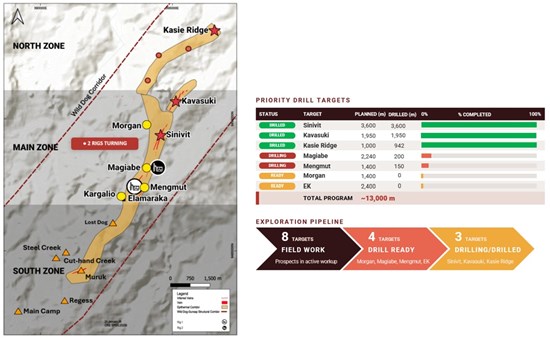
Figure 1: Simplified plan view of the 15 km Wild Dog Structural Corridor, showing the key epithermal target areas, current drilling locations, priority drill targets and the broader exploration pipeline from active field work through to drill-ready and drilling-stage prospects.
To view an enhanced version of this graphic, please visit:
https://images.newsfilecorp.com/files/11018/312333_figure1.jpg
KAVASUKI - MAIN ZONE - TARGET OVERVIEW AND DRILL PROGRAM RESULTS
The Kavasuki target is a structurally controlled epithermal quartz vein system within the 15 km Wild Dog structural corridor (Figure 1). The geology at the prospect comprises a sequence of crystal-rich and lithic-crystal-rich tuffs, interbedded mudstone-shale-volcanic units and volcanic conglomerate, intruded by an interpreted rhyodacite-diorite sill and sub-vertical dioritic intrusion. Veining extends to surface and no clay cap is developed at the prospect.
The main Kavasuki vein dips approximately 60-70° to the west, with a broad zone of perpendicular to sub-perpendicular vein stockwork interpreted to branch from the main structure and zones of pinch and swell developed along strike. Veining is dominated by Stage 1 and Stage 2 quartz types, with Stage 3 (high-grade) quartz observed only within highly faulted zones (KVH-03-KVH-04) and thin rims around vein breccia clasts in the upper portions of the veining (Figures 3 and 4). The intensity of broad veining decreases with depth, which is interpreted to be potentially lithologically controlled.
Drilling confirmed the historically reported mineralized intervals and demonstrated continuity of the main vein structure at depth (Figure 2). Better grades (typically 1-2.5 g/t Au, with narrow higher-grade zones of up to approximately 18 g/t Au) are concentrated within a shallow window extending from approximately 740-750 m RL to surface (Figure 4). The base of this window is interpreted to represent the lower boundary of the prospective mineralized horizon at Kavasuki. Below this horizon, the main vein structure continues but is not accompanied by significant gold mineralization at the levels tested (Figure 3).
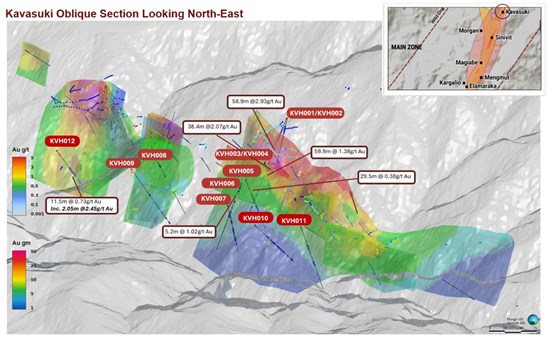
Figure 2: Kavasuki oblique section looking northeast, showing completed and planned drill holes, gold distribution, gram-metre AuEq contours and interpreted >9 ms chargeability anomalies. Inset shows the location of Kavasuki at the northern end of the Wild Dog Main Zone.
To view an enhanced version of this graphic, please visit:
https://images.newsfilecorp.com/files/11018/312333_figure2.jpg
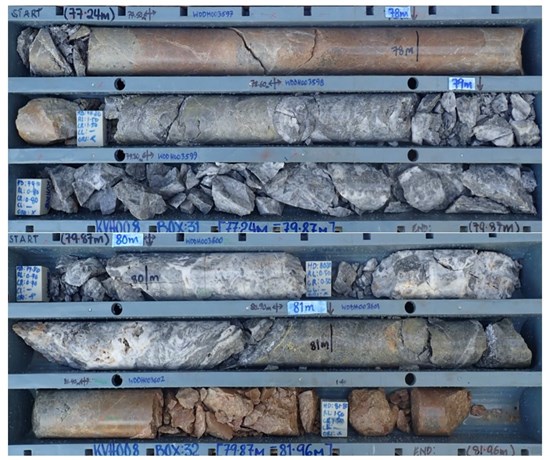
Figure 3: Representative drill core photographs from KVH-08 (77.24-81.96 m) showing Stage 1-2 quartz veining within the deeper vertical extent of the main vein. The adjacent interval (72.30-77.50 m) returned 5.20 m @ 0.17 g/t Au, illustrating the continuation of the vein structure below the mineralized window.
To view an enhanced version of this graphic, please visit:
https://images.newsfilecorp.com/files/11018/312333_figure3.jpg
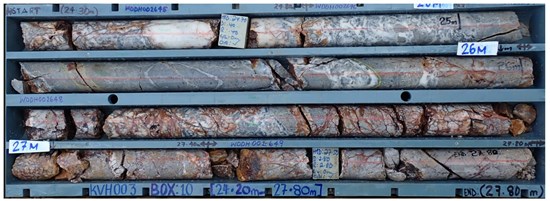
Figure 4: Representative drill core photographs from KVH-03 (24.2-27.8 m) showing oxidized Stage 1-2 quartz veining and thin rims of Stage 3 around clasts within the shallow mineralized window. The pictured interval lies within the reported intercept of 38.40 m @ 2.07 g/t Au from 12.30 m (Table 2).
To view an enhanced version of this graphic, please visit:
https://images.newsfilecorp.com/files/11018/312333_figure4.jpg
CHARGEABILITY ANOMALIES AND MULTI-ELEMENT INTERPRETATION
Several holes were designed to test the historical 3DIP chargeability anomalies at Kavasuki and determine their relationship with mineralization. Drilling has materially refined the Company's interpretation of the historical 3DIP dataset: the principal chargeability response at Kavasuki is now interpreted to be associated with disseminated pyrite within a specific lithological unit - the interbedded volcanic-siltstone sequence - rather than directly with gold mineralization. This distinction provides an important new filter for the reinterpretation and ranking of geophysical targets elsewhere along the Wild Dog corridor.
Review of the multi-element dataset shows that the deeper holes (KVH-07-KVH-11) returned low concentrations of both metals and pathfinder elements. The low metal and pathfinder tenor of the deeper holes indicates that drilling likely tested beneath the more favourable mineralized window identified at Kavasuki. The deeper Kavasuki results (650-710 m RL) are similar in character to the deeper intervals intersected at Sinivit (approximately 680-750 m RL), supporting the interpretation of an elevation-controlled window of prospective mineralization within the corridor (Figure 5). The elevation-controlled window for prospective mineralization is now being incorporated into the design of the Main Zone drill programs and has highlighted targets such as Keamgi that may not have been sufficiently tested.
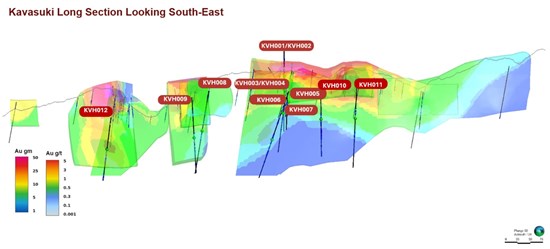
Figure 5: Long section looking SE through the Kavasuki vein showing drill pierce points, the shallow mineralized window (surface to ~70 m vertical) and the interpreted elevation window relative to Sinivit.
To view an enhanced version of this graphic, please visit:
https://images.newsfilecorp.com/files/11018/312333_figure5.jpg
NEXT STEPS AT KAVASUKI
Near-term follow-up at Kavasuki will focus on low-cost surface work designed to refine the next generation of drill targets:
- Priority trenching south of the drilled area, where increasing topographic elevation may preserve the interpreted prospective mineralization window.
- Trenching and detailed mapping north toward Kavasuki Creek, including follow-up of the known 3-4 m wide vein approximately 600 m NNE of the drilled area that returned 4.4 g/t Au, to test vein continuity and potential grade enhancement associated with cross-structures.
- A future drill test of the ridge between Sinivit and Kavasuki, integrating the reinterpreted 3DIP dataset with the newly defined prospective elevation window.
With the maiden program at Kavasuki complete, the Company's two diamond drill rigs remain active on the Main Zone drilling program, with one rig drilling at Magiabe and the second at Mengmut, ahead of the Morgan and EK targets.
UPDATED PREVIOUSLY REPORTED RESULTS
During final database validation ahead of this news release, data-entry errors affecting previously reported Kavasuki intervals were identified and corrected, and all results have been restated using the assay-reporting conventions described in the Notes. The KVH-03 interval of 38.40 m from 12.30 m is now reported at 2.07 g/t Au (previously 2.17 g/t Au), including 2.23 m at 8.56 g/t Au (previously 10.26 g/t Au), following correction of superseded certificate entries. The KVH-04 interval of 59.90 m from 8.70 m is now reported at 1.38 g/t Au (previously 1.33 g/t Au), including 14.00 m at 2.70 g/t Au (previously 2.61 g/t Au), incorporating final assays and a confirmed re-assay value. Silver, copper and gold equivalent values for previously reported intervals have been updated to the current conventions (silver by GA03 with below-detection values assigned half the detection limit; copper by four-acid ICP-MS on a per-sample basis where assayed), the largest effect being the KVH-03 interval of 2.20 m from 48.50 m, now reported at 0.26% Cu and 16.34 g/t AuEq (previously 0.20% Cu and 16.24 g/t AuEq). Gold grades of all other previously reported intervals are unchanged and no change is material to the interpretation of results. The results in this news release supersede those in the Company's news releases dated March 3, March 25, April 9 and April 30, 2026.
Table 1: Kavasuki Drill Hole Details (PNG94 UTM Zone 56 coordinates).
| Drillhole | Easting | Northing | Elevation
(m) | Dip
(°) | Azimuth
(°) | Depth
(m) |
| KVH-01 | 395247 | 9490673 | 842 | -55 | 304 | 159 |
| KVH-02 | 395248 | 9490672 | 842 | -71 | 304 | 165.4 |
| KVH-03 | 395178 | 9490701 | 803 | -53 | 100 | 113.7 |
| KVH-04 | 395179.5 | 9490701 | 803 | -72 | 106 | 91.9 |
| KVH-05 | 395155 | 9490728 | 785 | -63 | 109 | 158 |
| KVH-06 | 395144.9 | 9490734 | 785 | -58 | 307 | 112.7 |
| KVH-07 | 395114 | 9490753 | 763 | -55 | 95 | 201.9 |
| KVH-08 | 395217 | 9490872 | 764 | -58 | 109 | 190.2 |
| KVH-09 | 395214 | 9490914 | 751.7 | -60 | 130 | 170 |
| KVH-10 | 395071 | 9490706 | 759 | -52 | 125 | 155.8 |
| KVH-11 | 395055 | 9490632 | 772 | -68 | 118 | 172.9 |
| KVH-12 | 395309 | 9491041 | 712 | -55 | 114 | 153.3 |
Table 2: Kavasuki Significant Drill Intercepts (drill intercepts represent core lengths).
| Hole ID | From
(m) | To
(m) | Interval
(m) | Gold
(g/t) | Silver
(g/t) | Copper
(%) | Gold
Eq (g/t) |
| KVH-01 | 38.60 | 97.50 | 58.90 | 2.43 | 2.85 | 0.02 | 2.50 |
| Including | 49.00 | 53.60 | 4.60 | 8.24 | 10.19 | 0.13 | 8.56 |
| Including | 85.50 | 88.00 | 2.50 | 4.08 | 1.64 | 0.02 | 4.13 |
| KVH-01 | 100.60 | 118.70 | 18.10 | 2.08 | 1.82 | 0.03 | 2.15 |
| Including | 105.30 | 110.90 | 5.60 | 4.83 | 4.02 | 0.07 | 4.99 |
| and including | 106.60 | 107.80 | 1.20 | 17.93 | 12.00 | 0.24 | 18.45 |
| KVH-03 | 12.30 | 50.70 | 38.40 | 2.07 | 2.50 | 0.02 | 2.14 |
| Including | 12.30 | 27.40 | 15.10 | 2.24 | 1.36 | 0.01 | 2.26 |
| Including | 14.27 | 16.50 | 2.23 | 8.56 | 1.33 | 0.01 | 8.59 |
| Including | 40.33 | 43.30 | 2.97 | 1.88 | 2.84 | 0.02 | 1.94 |
| Including | 48.50 | 50.70 | 2.20 | 15.78 | 12.59 | 0.26 | 16.34 |
| KVH-04 | 8.70 | 68.60 | 59.90 | 1.38 | 1.24 | 0.05 | 1.47 |
| Including | 35.00 | 49.00 | 14.00 | 2.70 | 2.18 | 0.03 | 2.78 |
| Including | 61.10 | 68.60 | 7.50 | 2.39 | 1.99 | 0.26 | 2.81 |
| KVH-05 | 15.20 | 44.70 | 29.50 | 0.38 | 3.42 | 0.02 | 0.46 |
| KVH-06 | 22.40 | 27.60 | 5.20 | 1.02 | 0.57 | 0.01 | 1.03 |
| KVH-12 | 12.00 | 15.50 | 3.50 | 1.00 | 0.19 | 0.01 | 1.02 |
| Including | 12.00 | 12.50 | 0.50 | 2.48 | 1.0 | 0.01 | 2.51 |
| Including | 13.35 | 14.20 | 0.85 | 1.26 | 0.05 | 0.01 | 1.28 |
| KVH-12 | 74.95 | 86.45 | 11.50 | 0.73 | 1.26 | 0.01 | 0.76 |
| Including | 74.95 | 77.00 | 2.05 | 2.45 | 6.02 | 0.00 | 2.53 |
KVH-02,
KVH-07 —
KVH-11 | No significant intercepts (see Notes) |
NOTES:
- Drill intercepts reported in this news release represent core lengths; true widths are not known.
- Historical exploration results have not been independently verified by the Company and should not be relied upon as an indication of current or future mineral resources, mineral reserves or mineralization at the Project.
- Gold equivalent (AuEq) exploration results are calculated using longer-term commodity prices with a copper price of US$4.50/lb, a silver price of US$27.50/oz and a gold price of US$2,000/oz. No metallurgical testing has been carried out on Wild Dog mineralized samples. For AuEq calculations, recovery assumptions of Au 92.6%, Ag 78.0%, and Cu 94.0% were used based on K92 Mining's stated recovery results in an Updated Definitive Feasibility Study for the Kainantu mine.
- Significant intercepts are calculated using a 0.3 g/t AuEq lower cut-off over a minimum 2.0 m core length with a maximum of 2.0 m of internal dilution, and are reported where the product of grade and length exceeds 3 AuEq gram-metres. "Including" intervals are reported at a 1.0 g/t AuEq cut-off. Holes KVH-02 and KVH-07 to KVH-11 did not return intervals meeting these criteria.
- Silver values are reported from aqua-regia digest analyses (Intertek GA03); copper values are reported from four-acid ICP-MS where final multi-element results are available and otherwise from GA03. Final multi-element results remain pending for portions of the Kavasuki dataset and reported copper grades may be subject to minor revision. Assay results for KVH-11 and KVH-12 are reported from preliminary certificates and remain subject to final certification. Assay values below detection limit are assigned half the detection limit in interval calculations.
- Intervals for KVH-01 to KVH-05 supersede those previously reported (see "Updated Previously Reported Results").
- Rock chip samples are selective in nature and may not represent mineralization present near the samples.
- Geological interpretations described in this news release, including interpretations relating to chargeability sources and elevation-controlled mineralization, are based on current drilling and geophysical data and may be revised as additional data become available.
On behalf of Great Pacific Gold:
Alex Heath
Chief Executive Officer and Director
QUALIFIED PERSON
The technical content of this news release has been reviewed, verified and approved by Callum Spink, Chief Operating Officer and Vice President Exploration of Great Pacific Gold Corp., who is a Member of the Australian Institute of Geoscientists (MAIG) and a Qualified Person as defined by National Instrument 43-101 Standards of Disclosure for Mineral Projects. Mr. Spink has verified the Company-generated exploration data disclosed in this release by reviewing original assay certificates, sampling records, drill logs, collar information, QA/QC results and relevant geological and geophysical datasets. Historical exploration results have been reviewed against available historical reports and records but have not been independently verified through resampling or other confirmatory work. Mr. Spink is not independent of the Company.
QUALITY ASSURANCE / QUALITY CONTROL (QAQC)
The Company follows industry-standard quality assurance and quality control ("QA/QC") procedures for the collection, handling, preparation and analysis of exploration samples. Drill core samples reported in this news release were collected by Company personnel from PQ/HQ/NQ diamond drill core, which was logged, photographed and half-cut on site, with sample intervals determined on geological boundaries. Samples were labelled, securely packaged and transported under the supervision of Company personnel to Intertek Minerals' independent sample preparation facility in Lae, PNG, where they were dried, crushed and pulverized, with prepared pulps forwarded to Intertek's laboratory in Perth, Western Australia, for analysis. Gold was analyzed by 50 g fire assay with AAS finish (Intertek FA50), with silver and copper determined by aqua-regia digestion (Intertek GA03) and multi-element data determined by four-acid digestion with ICP-MS finish (Intertek 4A/MS48). Samples returning results above upper analytical limits were reanalyzed using an appropriate overlimit method. Intertek is independent of the Company, and Intertek's Perth laboratory is accredited under ISO/IEC 17025 for the relevant analytical methods.
Great Pacific Gold inserts certified reference materials, blanks and duplicate samples into the sample stream at regular intervals to monitor analytical accuracy, contamination and sampling precision, with blanks routinely inserted following visually mineralized samples. QA/QC results associated with the assays reported in this release were reviewed and considered acceptable for the purposes of this disclosure.
ABOUT GREAT PACIFIC GOLD
Great Pacific Gold's vision is to become the leading gold-copper development company in Papua New Guinea ("PNG") by focusing on its flagship Wild Dog Project.
Wild Dog is located on the island of New Britain in the East New Britain Province of PNG. The Project covers the 15 km Wild Dog structural corridor, a large-scale epithermal system that has yielded numerous high-grade gold-copper drill results, with district-scale porphyry potential at the adjacent Magiabe target. The Company has two diamond drill rigs on the property advancing drill targets toward resource definition, supported by a field exploration crew advancing a pipeline of targets.
In addition, the Company holds a portfolio of other projects in PNG including strategic land positions in the Kesar and Arau Projects, both located in the Eastern Highlands Province of PNG and contiguous with the mine tenements of K92 Mining Inc. ("K92"). The Company also holds the Tinga Valley Project in western PNG.
FORWARD-LOOKING STATEMENTS
Information set forth in this news release contains forward-looking statements that are based on assumptions as of the date of this news release. These statements reflect management's current estimates, beliefs, intentions and expectations. They are not guarantees of future performance. Great Pacific Gold cautions that all forward-looking statements are inherently uncertain and that actual performance may be affected by many material factors, most of which are beyond their respective control. Such factors include, among other things: risks and uncertainties relating to Great Pacific Gold's limited operating history, its exploration and development activities on its mineral properties and the need to comply with environmental and governmental regulations. Accordingly, actual and future events, conditions and results may differ materially from the estimates, beliefs, intentions and expectations expressed or implied in the forward-looking information. Except as required under applicable securities legislation, Great Pacific Gold does not undertake to publicly update or revise forward-looking information.
Mineralization at the properties held by K92 Mining Inc. is not necessarily indicative of mineralization at the Wild Dog Project.
Neither TSX Venture Exchange nor its Regulation Services Provider (as that term is defined in the policies of the TSX Venture Exchange) accepts responsibility for the adequacy or accuracy of this release.

To view the source version of this press release, please visit https://www.newsfilecorp.com/release/312333

© 2026 Canjex Publishing Ltd. All rights reserved.