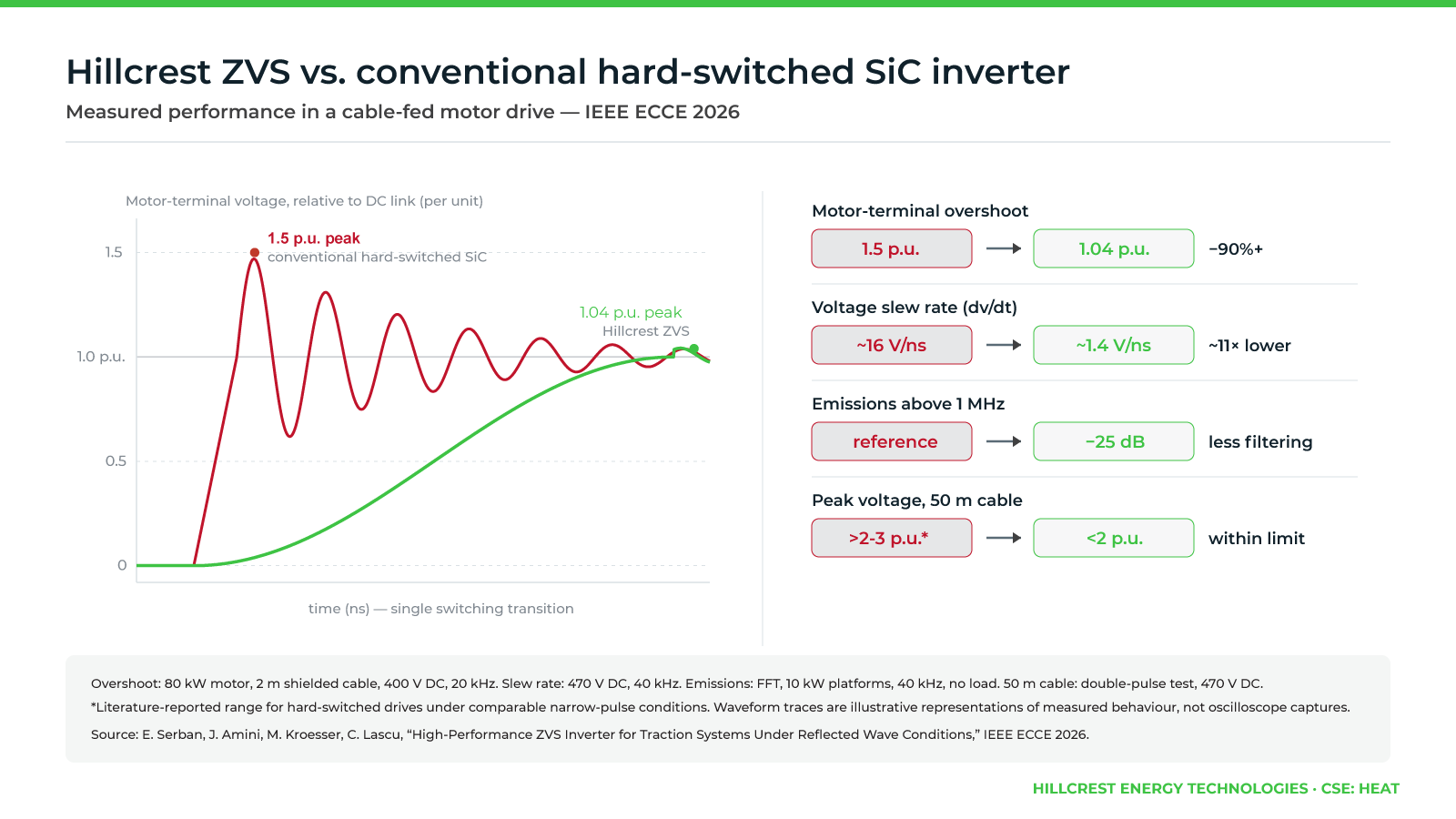
VANCOUVER, BC / ACCESS Newswire / September 29, 2026 / Hillcrest Energy Technologies (CSE:HEAT)(OTCQB:HLRTF)(FSE:7HI) ("Hillcrest" or the "Company") today announced peer-reviewed test results quantifying the performance of its zero-voltage-switching (ZVS) inverter technology against a conventional hard-switched silicon carbide (SiC) inverter. In side-by-side testing, ZVS reduced motor-terminal voltage overshoot by more than 90%, from 1.5 per unit (p.u.) to 1.04 p.u. of DC-link voltage and reduced high-frequency electromagnetic interference (EMI) above 5 MHz by approximately 25 dB.
The results are documented in a peer-reviewed paper accepted for the IEEE Energy Conversion Congress and Expo (ECCE 2026), a leading international conference in power conversion. Dr. Emanuel Serban, Hillcrest's Vice President of Engineering, will present the paper at the event, to be held October 4-8, 2026, in Vancouver, BC.
Commercial Significance
Drive manufacturers are moving from silicon to wide-bandgap semiconductors, principally SiC, to gain efficiency, switching frequency and power density. The paper documents the engineering penalty that accompanies this transition: because SiC devices switch far faster than silicon, impedance mismatch between inverter, cable and motor produces repeated voltage reflections, and motor-terminal voltage can reach twice the DC-link voltage even with cable lengths of only a few meters.
The consequences carry commercial weight. The paper states that these voltage oscillations accelerate insulation aging, promote partial discharge activity and ultimately lead to premature failure of inverter-fed motor windings, which translates into warranty exposure for equipment makers and unplanned downtime for end users. The standard mitigation is passive filtering at the motor terminals or the inverter cabinet. As the paper notes, while such filters are effective, they add cost and size to the drive system and incur extra power losses, which offsets the inherent advantages of wide-bandgap technology.
Hillcrest's ZVS approach addresses the problem at the switching event rather than downstream of it. By commutating each device when the voltage across it is near zero, the platform extends the voltage transition roughly tenfold while preserving high efficiency, whereas conventional slew-rate reduction through snubber circuits increases switching losses and degrades efficiency. For drive OEMs evaluating SiC platforms, these results provide a quantified basis for comparing ZVS against added filtering hardware.
Where the Results Apply
The overvoltage findings apply to cable-fed drive systems, where the inverter is cabinet-mounted and connected to the motor by a cable of meaningful length. The effect scales with cable length, so the benefit is greatest in factory automation and robotics, conveyor and material handling systems, packaging machinery, automated assembly lines, cabinet-driven industrial pumps and fans, and electric vehicle and rail traction systems.
The emissions and slew-rate results are independent of cable length and apply to any SiC inverter platform.
Detailed Findings
Against a conventional hard-switched SiC inverter, the ZVS platform delivered:
- Overshoot reduction of more than 90%. Motor-terminal overshoot fell from 1.5 p.u. to 1.04 p.u. with an 80-kW motor on a 2-meter shielded cable at 400 V DC and 20 kHz. Overshoot is the peak voltage the motor insulation actually sees, expressed relative to DC-link voltage.
- An order-of-magnitude reduction in dv/dt. Slew rate fell from approximately 16 V/ns to 1.4 V/ns at 470 V DC and 40 kHz. Because inverter output voltage rise time has been shown to have a dominant influence on the severity of reflected-wave overvoltage, this is the mechanism behind the overshoot result.
- Up to 25 dB lower high-frequency emissions. Above 5 MHz, emissions were roughly 25 dB below the hard-switched reference. Between 1 and 5 MHz, the ZVS platform's emissions were 5 to 25 dB lower; below 1 MHz the two platforms were comparable. Reduced high-frequency content is where EMI filtering and shielding costs concentrate.
- Controlled voltage on long cable runs. Under worst-case double-pulse conditions with a 50-meter cable at 470 V DC, peak load voltage remained below 2 p.u. at approximately 920 V. The paper notes that published research reports hard-switched inverters exceeding 2-3 p.u. under comparable narrow-pulse conditions.
Slower switching transitions also allow longer cables. Every drive has a critical cable length, beyond which reflected waves can double the voltage at the motor. For the configuration analyzed, ZVS extends that limit to approximately 18 meters, giving machine builders more flexibility in cable routing and cabinet placement.
Results at a Glance
Parameter | Conventional hard-switched SiC | Hillcrest ZVS | Test conditions |
| Motor-terminal overshoot | 1.5 p.u. (+50%) | 1.04 p.u. (+4%) | 80 kW motor, 2 m shielded cable, 400 V DC, 20 kHz |
| Voltage slew rate (dv/dt) | ~16 V/ns | ~1.4 V/ns | 470 V DC, 40 kHz, modulation index 0.4 |
| Switching voltage rise time | ~30 ns | ~335 ns | 470 V DC, 40 kHz, modulation index 0.4 |
| Emissions, 1-5 MHz | Reference | 5-25 dB lower | FFT, 470 V DC, 40 kHz, modulation index 0.4 |
| Emissions above 5 MHz | Reference | ~25 dB lower | FFT, 470 V DC, 40 kHz switching frequency |
| Motor-terminal overshoot using long cables | Literature reports >2-3 p.u. | ~920 V (<2 p.u.) | Double-pulse test, 470 V DC, 50 m cable-fed |
Source: E. Serban, J. Amini, M. Kroesser and C. Lascu, "High-Performance ZVS Inverter for Traction Systems Under Reflected Wave Conditions," Proceedings of IEEE ECCE 2026.
Broader ZVS Platform Results
The reflected-wave findings build on the results Hillcrest has previously reported for its ZVS technology in separate testing and research:
- Efficiency: up to 99.7% peak inverter efficiency, confirmed in testing at the facilities of global automotive OEMs and Tier One suppliers[1]. This indicates that the controlled switching transitions described in the paper are compatible with very high efficiency.
- Electromagnetic interference: chamber testing at a certified external laboratory selected by a European automotive OEM found substantially lower EMI than conventional inverters across all tested operating points[2].
- Passive component reduction: by largely eliminating switching losses, ZVS supports higher switching frequencies, which Hillcrest's published research has shown reduced DC-link capacitor size and ripple-related heating, with benefits for drive cost, volume and component lifetime[3].
Together with the ECCE 2026 results, these findings indicate that ZVS can address efficiency, electromagnetic interference and motor insulation stress within a single architecture. Drive designers often have to trade these attributes off against one another.
Management Commentary
"Reflected-wave overvoltage limits the use of high-efficiency, high-speed power semiconductors in motor drives with long cables. Conventional solutions require additional filters, increasing system cost, size, and complexity. Our solution simplifies the drive design while enabling the use of advanced, high-efficiency semiconductor devices," said Dr. Emanuel Serban, Vice President of Engineering at Hillcrest Energy Technologies. "Controlling dv/dt at the switching event removes the cause instead of treating the symptom. Both theoretical analysis and experimental results demonstrate a significant reduction in EMI and motor-terminal overvoltage in cable-fed systems."
"Peer-reviewed validation is what drive manufacturers require before committing to a new power conversion architecture," said Don Currie, CEO of Hillcrest Energy Technologies. "Presenting these results puts quantified evidence in front of exactly the engineering audience that makes those decisions. Combined with the efficiency and EMI performance already demonstrated in OEM testing, these results strengthen the case for ZVS across a broad range of motor-drive applications."
About the Research
The paper, "High-Performance ZVS Inverter for Traction Systems Under Reflected Wave Conditions," originated in electric vehicle traction work and applies to any cable-fed motor drive. Test setup: three-phase inverter using 1200 V SiC MOSFETs driving an 80 kW motor through a 35 mm² four-conductor shielded cable (0.3 µH/m, 130 pF/m, characteristic impedance approximately 48 Ω, propagation velocity approximately 160 m/µs).
Authors: Dr. Emanuel Serban and Jalal Amini (Hillcrest Energy Technologies Ltd., Canada); Mathias Kroesser (Systematec GmbH, Germany); Prof. Cristian Lascu (Politehnica University of Timișoara, Romania). The paper will be published in the IEEE ECCE 2026 Proceedings and will be available on IEEE Xplore following the conference.
More information on IEEE ECCE 2026: https://www.ieee-ecce.org/2026/
About Hillcrest Energy Technologies
Hillcrest Energy Technologies Ltd. is a Canadian clean technology company developing advanced power conversion technologies and digital control systems for next-generation energy applications, including AI datacenters, energy storage, industrial motor drives, microgrids, and electric-vehicle powertrains. The PCS1000 is Hillcrest's newest product platform, currently in the A-Sample prototype stage. For more information: https://hillcrestenergy.tech/
CONTACT INFORMATION
Investor Relations
Don Currie
info@hillcrestenergy.tech
O: +1 604-609-0006
Toll-free: 1-855-609-0006
Public Relations
Jamie L. Hogue
jhogue@hillcrestenergy.tech
O: +1 602-793-9481
NEITHER THE CANADIAN SECURITIES EXCHANGE NOR ITS REGULATION SERVICES PROVIDER HAS REVIEWED OR ACCEPTS RESPONSIBILITY FOR THE ADEQUACY OR ACCURACY OF THIS RELEASE.
FORWARD-LOOKING INFORMATION
Cautionary Statement Regarding "Forward-Looking" Information
Some of the statements contained in this news release are forward-looking statements and information within the meaning of applicable securities laws. Forward-looking statements and information can be identified by the use of words such as "expects," "intends," "is expected," "potential," "suggests" or variations of such words or phrases, or statements that certain actions, events or results "may," "could," "should," "would," "might" or "will" be taken, occur or be achieved. This forward-looking information is provided as of the date of this news release. The forward-looking information reflects our current expectations and assumptions and is subject to a number of known and unknown risks, uncertainties and other factors, which may cause actual results, performance or achievements to be materially different from any anticipated future results, performance or expectations expressed or implied by the forward-looking information. No assurance can be given that these assumptions will prove correct. Forward-looking statements and information are not historical facts and are subject to a number of risks and uncertainties beyond the Company's control. Investors are advised to consider the risk factors under the heading "Risks and Uncertainties" in the Company's MD&A for the year ended Dec. 31, 2025, available at https://www.sedarplus.ca/ for a discussion of the factors that could cause the Company's actual results, performance and achievements to be materially different from any anticipated future results, performance or achievements expressed or implied by the forward-looking information. Accordingly, readers should not place undue reliance on forward-looking statements. The Company undertakes no obligation to update publicly or otherwise revise any forward-looking statements, except as may be required by law.
[1] As announced by the Company on December 16, 2024.
[2] As announced by the Company on March 4, 2024.
[3] Hillcrest white paper, Benefits of High-Switching Frequency on DC-Link Capacitors, August 17, 2022.
SOURCE: Hillcrest Energy Technologies Ltd.
View the original press release on ACCESS Newswire

© 2026 Canjex Publishing Ltd. All rights reserved.