VANCOUVER, BC, Sept. 22, 2026 /CNW/ -- Copper Giant Resources Corp. ("Copper Giant" or the "Company") (TSXV: CGNT) (OTCQX: CGNRF) (FRA: 29H0) today reports assay results from four drill holes at its flagship Mocoa copper-molybdenum porphyry project in Putumayo, Colombia ("Mocoa" or the "Mocoa Project"). Infill daughter hole MD-073 returned 804 metres of 0.56% CuEq* (0.31% Cu and 0.048% Mo), including 103 metres of 1.07% CuEq* (0.57% Cu and 0.095% Mo) and, within that, 54 metres of 1.20% CuEq* (0.64% Cu and 0.106% Mo), more than twice the average grade of the current Mineral Resource Estimate¹. MD-067 returned 165 metres of 0.67% CuEq* (0.43% Cu and 0.045% Mo) including 13 metres of 1.31% CuEq*(o.92% Cu and 0.073% Mo), and its daughter hole MD-071 returned 184 metres of 0.62% CuEq* (0.33% Cu and 0.054% Mo) including 14 metres of 1.15% CuEq* (0.86% Cu and 0.055% Mo), with mineralization continuing to the bottom of both holes. A fourth drill rig is on site and moving to its first platform on the western flank, where the extent of the porphyry system has not been defined by drilling and where the Company's recently announced predictive targeting study ranked new targets (refer to news release dated September 16, 2026). The Preliminary Economic Assessment ("PEA") remains on plan for delivery in the fourth quarter of 2026.
Highlights
- Tighter-spaced drilling through the higher-grade core returned more than twice the resource average: MD-073 returned 804 metres of 0.56% CuEq* (0.31% Cu and 0.048% Mo) from 150 metres, including 103 metres of 1.07% CuEq* (0.57% Cu and 0.095% Mo) from 346 metres and, within that, 54 metres of 1.20% CuEq* (0.64% Cu and 0.106% Mo) (Table 1), against an average of 0.51% CuEq* for the current resource¹. MD-067 and its daughter hole MD-071 also returned intersections above 1% CuEq*, of 13 metres at 1.31% CuEq* (0.92% Cu and 0.073% Mo) and 14 metres at 1.15% CuEq* (0.86% Cu and 0.055% Mo).
- Broad intervals above the resource average, with mineralization to the bottom of both holes: MD-067 returned 165 metres of 0.67% CuEq* (0.43% Cu and 0.046% Mo) from 191 metres, within 639 metres of 0.31% CuEq* (0.19% Cu and 0.021% Mo) running to the bottom of the hole. MD-071 returned 184 metres of 0.62% CuEq* (0.33% Cu and 0.054% Mo) from 166 metres and ended in mineralization at 708 metres, below the depth at which the historic vertical drilling stopped.
- Kilometre-scale intercepts from a single pad, with no new road: MD-073 is the third directional daughter steered from the MD-064 platform, whose mother hole returned 1,206 metres of 0.42% CuEq* (0.30% Cu and 0.022% Mo) (refer to news release dated June 22, 2026). Mocoa has demonstrated over 1,100 metres of vertical continuity. This drill pad has delivered close to 7,000 metres of drilling, without a new road or a new access.
- A fourth drill rig is on site and being set up on its first platform on the western flank, where the extent of the porphyry system has not been defined by drilling. Drilling is expected to start in October, the first to follow up the Company's predictive targeting study (refer to news release dated September 16, 2026).
"We drilled the higher-grade core at tighter spacing and it came back above the model, the material we most want confidence in before the PEA. Three of the four holes returned intersections over 1% copper equivalent, and the step-out holes ended in mineralization. The fourth rig is on site and starts on the western flank in October. The deposit is better defined every quarter, and we have not found the edge of the system." – Edwin Naranjo Sierra, Vice-President of Exploration.
Hole MD-073
Copper Giant uses directional drilling to steer multiple daughter holes from a single drill pad, testing several targets without building new pads or roads in Mocoa's steep terrain. This delivers more geological information per metre at lower cost and with less surface disturbance and accelerates the conversion of resources from Inferred to Indicated ahead of the PEA. Daughter holes are drilled to a planned length and are typically still in mineralization when completed, by design.
MD-073 was completed as a directional daughter hole from mother hole MD-064 (refer to news release dated June 22, 2026), kicked off at 150 metres and steered west-northwest. It is the third daughter drilled from that platform, after MD-066 (refer to news release dated July 28, 2026) and MD-070 (refer to news release dated August 27, 2026). MD-073 forms part of the Company's infill drilling and resource-conversion strategy within the current Mineral Resource Estimate¹ footprint and was designed to test the grade and continuity of the resource model at tighter drill spacing (Figure 1).
The hole is hosted almost entirely in an Intramineral porphyry, with short intervals of hydrothermal breccia. Alteration through the hole is sericite-rich, with potassic alteration developed locally at depth.
MD-073 returned 804 metres of 0.56% CuEq* (0.31% Cu and 0.048% Mo) from 150 metres downhole, including 373 metres of 0.74% CuEq* (0.38% Cu and 0.068% Mo) from 206 metres, 199 metres of 0.93% CuEq* (0.42% Cu and 0.096% Mo) from 342 metres, and a higher-grade core of 103 metres of 1.07% CuEq* (0.57% Cu and 0.095% Mo) from 346 metres, within which 54 metres returned 1.20% CuEq* (0.64% Cu and 0.106% Mo) from 381 metres (Table 1). The reported interval runs from the kick-off point to the bottom of the hole at 954 metres, and MD-073 ended in mineralization. The copper-to-molybdenum ratio falls from about six to one over the whole hole to about four to one through the 199-metre interval, so that part of the hole is proportionally richer in molybdenum as well as in copper. These grades are consistent with, and locally exceed, the values modelled by the current block model¹, indicating that the resource model continues to predict both grade distribution and mineralized continuity at Mocoa.
Hole | Hole Type | Kick-off
depth (m) | From
(m) | To (m) | Interval
(m) | Cu
(%) | Mo
(%) | CuEq*
(%) | Release date |
MD-067 | Mother | 0.0 | 0.0 | 756 | 756 | 0.17 | 0.019 | 0.27 | September 22, 2026 |
Including |
|
| 0.0 | 145.3 | 145.3 | 0.12 | 0.005 | 0.15 | August 27, 2026 |
and including |
|
| 97 | 145.3 | 48.3 | 0.30 | 0.009 | 0.34 |
and including |
|
| 117 | 145.3 | 28.3 | 0.38 | 0.007 | 0.42 |
and |
|
| 117 | 756 | 639 | 0.19 | 0.021 | 0.31 | September 22, 2026 |
and including |
|
| 117 | 359 | 242 | 0.36 | 0.034 | 0.54 |
and including |
|
| 190 | 355 | 165 | 0.43 | 0.046 | 0.67 |
and including |
|
| 198 | 331 | 133 | 0.47 | 0.052 | 0.74 |
and including |
|
| 201 | 214 | 13 | 0.92 | 0.073 | 1.31 |
and |
|
| 708 | 740 | 32 | 0.12 | 0.028 | 0.27 |
MD-071 | Daughter | 166 | 166 | 708 | 542 | 0.17 | 0.031 | 0.34 |
Including |
|
| 166 | 350 | 184 | 0.33 | 0.054 | 0.62 |
and including |
|
| 192 | 302 | 110 | 0.40 | 0.066 | 0.75 |
and including |
|
| 200 | 214 | 14 | 0.86 | 0.055 | 1.15 |
and |
|
| 630 | 708 | 78 | 0.11 | 0.033 | 0.29 |
MD-064 | Mother |
| 0.0 | 1,206 | 1,206 | 0.30 | 0.022 | 0.42 | June 22, 2026 |
Including |
|
| 155 | 1,206 | 1,052 | 0.34 | 0.024 | 0.46 |
and including |
|
| 155 | 641 | 486 | 0.41 | 0.029 | 0.57 |
and |
|
| 552 | 668 | 115 | 0.34 | 0.058 | 0.65 |
and |
|
| 1,001 | 1,181 | 180 | 0.36 | 0.015 | 0.44 |
and including |
|
| 1,001 | 1,074 | 72 | 0.51 | 0.008 | 0.55 |
MD-073 | Daughter | 150 | 150 | 954 | 804 | 0.31 | 0.048 | 0.56 | September 22, 2026 |
Including |
|
| 206 | 579 | 373 | 0.38 | 0.068 | 0.74 |
and including |
|
| 342 | 541 | 199 | 0.42 | 0.096 | 0.93 |
and including |
|
| 346 | 449 | 103 | 0.57 | 0.095 | 1.07 |
and including |
|
| 381 | 435 | 54 | 0.64 | 0.106 | 1.20 |
MD-069 | Mother |
| 0.0 | 541 | 541 | 0.02 | 0.001 | 0.03 | September 22, 2026 |
Including |
|
| 460 | 472 | 12 | 0.10 | 0.000 | 0.11 |
Table 1 – Assay results for drill holes MD-067, MD-071, MD-073 and MD-069. *Copper equivalent (CuEq) for drill hole interceptions is calculated as: CuEq (%) = Cu (%) + 5.278 × Mo (%), utilizing metal prices of Cu - US$4.00/lb and Mo - US$20.00/lb and metal recoveries of 90% Cu and 95% Mo. Grades are uncut and uncapped. Mineralized zones at Mocoa are bulk porphyry-style zones and drilled widths are interpreted to be very close to true widths. Copper equivalent (CuEq*) values were calculated from unrounded assay values; therefore, reported totals may not reconcile exactly due to rounding. Reported intervals are length-weighted composites of original core samples over the stated depths, expressed as metres downhole; each hole is composited within its own hole identifier and no reported interval spans two holes. Directional daughter hole MD-071 was drilled from mother hole MD-067 and directional daughter hole MD-073 from mother hole MD-064. Collar coordinates for MD-067 and MD-071 are 313,644E, 137,557N and 1,737 m.a.s.l.; with an azimuth of 120° and a dip of -77° for MD-067; an azimuth of 165° and a dip of -60° for MD-071. Collar coordinates for MD-073 are 314,014E, 137,980N and 1,720 m.a.s.l., with an azimuth of 290° and a dip of -60°. Collar coordinates for MD-069 are 314,153E, 137,143N and 1,344 m.a.s.l., with an azimuth of 250° and a dip of -45°. Coordinates are in UTM Zone 18N, WGS84 datum.
Holes MD-067 and MD-071
MD-067 was partially reported (refer to news release dated August 27, 2026), when assays were available only for the first 145 metres of the hole. Those results covered the weathered leach cap and the supergene blanket immediately beneath it. Assays for the remainder of the hole, completed to 756 metres, are reported here.
MD-067 returned 165 metres of 0.67% CuEq* (0.43% Cu and 0.046% Mo) from 191 metres, including 133 metres of 0.74% CuEq* (0.47% Cu and 0.052% Mo) from 198 metres and 13 metres of 1.31% CuEq* (0.92% Cu and 0.073% Mo) from 201 metres (Figure 2, Table 1). That zone sits within a continuous 639 metres of 0.31% CuEq* (0.19% Cu and 0.021% Mo) from 117 metres, running from the top of the supergene blanket to the bottom of the hole. Grade is concentrated in the upper part of that run, the first 242 metres from 117 metres averaging 0.54% CuEq* (0.36% Cu and 0.034% Mo). Between 145 and 179 metres, where the deviation for directional daughter hole MD-068 was built, core was not recovered over 26 metres in three runs, and the core recovered within that span was sampled. The unrecovered 26 metres are included in the 639-metre interval at zero grade, so they lower rather than raise the reported average. The 165-, 133- and 13-metre intervals lie below them and are unaffected. A separate interval of 32 metres of 0.27% CuEq* (0.12% Cu and 0.028% Mo) was returned from 708 metres, in which molybdenum accounts for more than half of the copper-equivalent grade (Table 1).
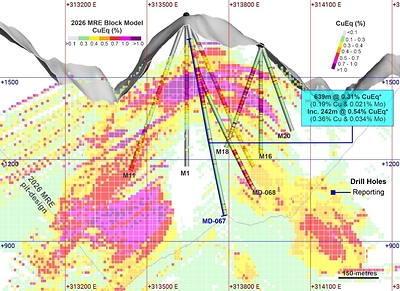
From 301 metres the hole passed into quartz-diorite porphyry of the early intrusive phase and remained in it to the bottom at 756 metres, with hydrothermal and crackle breccia logged locally. Alteration is strongly potassic, with secondary K-feldspar and secondary biotite logged over 386 metres of the hole. Veining is dense throughout, averaging 19% of the rock by volume and carrying the full high-temperature porphyry suite of A-, AK-, B-, BMQ- and K-type veins, placing MD-067 close to the center of the porphyry system rather than on its flank.
MD-071 was completed as a directional daughter hole from the MD-067, kicked off at 166 metres and steered south-southeast, and is the second hole drilled from that pad after MD-068 (refer to news release dated August 27, 2026).
MD-071 returned 184 metres of 0.62% CuEq* (0.33% Cu and 0.054% Mo) from 166 metres, including 110 metres of 0.75% CuEq* (0.40% Cu and 0.066% Mo) from 192 metres and 14 metres of 1.15% CuEq* (0.86% Cu and 0.055% Mo) from 200 metres (Table 1). That zone sits within a continuous 542 metres of 0.34% CuEq* (0.17% Cu and 0.031% Mo) over the full assayed length of the hole. A second and separate interval of 78 metres of 0.29% CuEq* (0.11% Cu and 0.033% Mo) was returned from 630 metres to the bottom of the hole at 708 metres, and the hole ended in mineralization.
The hole cut the same sequence as MD-067: Saldaña Formation volcanics to about 355 metres, then quartz-diorite porphyry of the early intrusive phase, with 98 metres of hydrothermal and crackle breccia, the main body between 549 and 597 metres. Alteration is strongly potassic over 312 metres between 207 and 708 metres, and veining is dense, averaging 21% of the rock by volume and carrying the same A-, AK-, B-, BMQ-, K- and QM-type suite. Together with MD-067 and MD-068, the three holes from this platform have carried mineralization to the east and below the historic drilling, where drill hole MD-077 is now being drilled.
Mineralization reported in MD-067 and MD-071 below and/or beyond the limits of the current Mineral Resource Estimate is not included in the current MRE and is not included in the PEA currently in progress. No mineral resource has been estimated for such mineralization, and there is no assurance that additional drilling will result in its inclusion in a future Mineral Resource Estimate.
Hole MD-069
MD-069 was designed to follow up MD-053, the first hole completed at the La Estrella target (refer to news release dated January 29, 2026), and to test the copper-molybdenum anomaly defined in soils and rocks at surface. That anomaly returned up to 558 ppm copper and 264 ppm molybdenum in soils and up to 1,105 ppm copper and 98.4 ppm molybdenum in rock (refer to news release dated April 8, 2026). MD-069 was collared on the La Estrella platform, the same pad from which MD-065 was drilled (refer to news release dated July 28, 2026), and steered west-southwest toward the southern end of the Mocoa system. The hole was designed to drill from outside a porphyry system inward and expected to cut the margin first, with grade rising toward the core. The hole was completed to 541 metres, and its base lies approximately 225 metres from the nearest historic drilling at Mocoa's southern margin.
The hole intercepted 188 metres of the Mocoa Batholith, the Jurassic intrusive suite into which the Mocoa porphyries were emplaced, beneath a leach cap of 98 metres. Alteration is zoned from that leach cap through phyllic and chlorite-sericite assemblages into a peripheral propylitic assemblage, with potassic alteration of secondary K-feldspar logged between 100 and 286 metres. Veining includes the high-temperature porphyry suite of A-, AK-, B-, BMQ- and K-type veins from 100 metres to the bottom of the hole, averaging 18% of the rock by volume and reaching 72% locally. Copper and molybdenum were returned in all 273 samples assayed over the length of the hole. From 400 metres the hole entered the Rancho Mula fault zone and ended within that structure at 541 metres.
MD-069 defined the position of the Rancho Mula fault on the southern side of the deposit. The hole carries copper, molybdenum and high-temperature veining over its full length, with potassic alteration between 100 and 286 metres, extending the porphyry architecture recognized at La Estrella some 410 metres deeper than MD-053 reached. The Rancho Mula fault zone truncates the section at 400 metres, and the hole was stopped inside that structure. The position of the fault is now constrained by drilling, and the ground beyond it, between MD-069 and the southern margin of the Mocoa deposit, remains untested.
Fourth Drill Rig on Site for the Western Flank
A fourth drill rig is on site at Mocoa and is being set up on its first platform. While the existing rigs continue resource expansion and conversion within and around the current MRE¹ footprint and target testing beyond it, the fourth rig will be dedicated to drill testing the western flank of the porphyry system where the extent of mineralization has not been defined by drilling. Drilling is expected to commence in October.
Qualified Person and Technical Notes
Edwin Naranjo Sierra, Vice-President of Exploration for Copper Giant, is the designated Qualified Person within the meaning of National Instrument 43-101 – Standards of Disclosure for Mineral Projects ("NI 43-101") and has reviewed and approved the technical information in this news release. Mr. Naranjo holds an MSc. in Earth Sciences and is a Fellow of the Australasian Institute of Mining and Metallurgy (FAusIMM). Mr. Naranjo is not independent of the Company.
Copper Giant operates according to a rigorous Quality Assurance and Quality Control (QA/QC) protocol consistent with industry best practices. For surface samples, 2.5kg of material is taken on each outcrop using chip or channel techniques. Samples are taken by well-trained field helpers supervised by the geologist of the company. Core diameter is a mix of HQ and NQ depending on the depth of the drill hole. Diamond drill core boxes were photographed, sawed, sampled and tagged in maximum 2-metre intervals, stopping in geological boundaries. Samples were bagged, tagged and packaged for shipment by truck from Copper Giant's core logging facilities in Mocoa, Colombia to the ActLabs certified sample preparation facility in Medellin, Colombia. ActLabs is an accredited laboratory independent of the Company. Samples are processed in the Medellin facilities where they are analyzed for copper, gold, silver, molybdenum, zinc and lead by 4-Acid digest Atomic Absorption (AA) analysis. Where the copper result exceeded the upper detection limit of that method, the copper grade reported is the over-limit assay by the 8-TD-AA method. The sample pulps are air freighted from Medellin to the ActLabs certified laboratory in Ancaster, Canada where they are analyzed for a suite of 60 elements using ICPOES/ICPMS Total Digestion method. In order to monitor the ongoing quality of assay data and the database, Copper Giant has implemented QA/QC protocols which include standard sampling methodologies, the insertion of certified copper and molybdenum standard materials, blanks, and duplicates (field, preparation and analysis) randomly inserted into the sampling sequence. QA/QC program also includes ongoing monitoring of data entry, QA/QC reporting and data validation. No material QA/QC issues have been identified with respect to sample collection, security and assaying.
Reported intervals are length-weighted composites of original core samples over the stated depths, expressed as metres downhole. Each hole is composited within its own hole identifier; no reported interval spans two holes. No cut-off grade and no internal dilution rule have been applied; every reported interval is a continuous run of samples, and where core was not recovered the missing length is included in the interval at zero grade.
Inferred Mineral Resources are considered too speculative geologically to have economic considerations applied to them that would enable them to be categorized as Mineral Reserves. There is no certainty that all or any part of the Inferred Mineral Resources will be upgraded to an Indicated or Measured category.
*Copper equivalent (CuEq) for drill hole interceptions is calculated as: CuEq (%) = Cu (%) + 5.278 × Mo (%), utilizing metal prices of Cu - US$4.00/lb and Mo - US$20.00/lb and metal recoveries of 90% Cu and 95% Mo.
1 Notes on the MRE of the Mocoa Project
- The MRE was completed by Kevin Hon, B.Sc., P.Geo., Senior Resource Geologist, and Warren Black, M.Sc., P.Geo., Senior Consultant: Mineral Resources and Geostatistics, both of APEX. Mr. Hon and Mr. Black are independent Qualified Persons, as defined by NI 43-101, and are responsible for the completion of the Mineral Resource Estimate, with an effective date of November 18, 2025. Michael Dufresne, M.Sc., P.Geo., President & CEO of APEX, completed a peer review of the estimate.
- Mineral Resources that are not Mineral Reserves do not have demonstrated economic viability.
- The estimate of Mineral Resources may be materially affected by environmental, permitting, legal, title, taxation, socio-political, marketing, or other relevant issues.
- The Inferred Mineral Resource in this estimate has a lower level of confidence than that applied to an Indicated Mineral Resource and must not be converted to a Mineral Reserve. It is reasonably expected that the majority of the Inferred Mineral Resource could potentially be upgraded to an Indicated Mineral Resource with continued exploration.
- The Mineral Resources were estimated in accordance with the Canadian Institute of Mining, Metallurgy and Petroleum (CIM), CIM Standards on Mineral Resources and Reserves, Definitions (2014) and Best Practices Guidelines (2019) prepared by the CIM Standing Committee on Reserve Definitions and adopted by the CIM Council.
- Economic assumptions used include US$4.00/lb Cu, US$20.00/lb Mo, process recoveries of 90% for Cu and 95% for Mo, a US$10/t processing cost, G&A costs of US$1.00/t, and a 3% NSR royalty.
- CuEq* values are calculated using a Cu-to-Mo value ratio of 1:5.278, incorporating both metal prices and metallurgical recoveries.
- The constraining pit optimization parameters include a US$2.5/t mining cost for both mineralized and waste material and 45° slopes. Pit-constrained Mineral Resources are reported at a cutoff of 0.25% CuEq*.
About the Mocoa Porphyry System
The Mocoa Project is located in Colombia's Department of Putumayo, approximately 10 kilometres from the town of Mocoa in the country's south. Copper Giant controls more than 128,300 Ha of district-scale tenure through granted titles and applications, covering a significant portion of the Jurassic porphyry belt—an underexplored and highly prospective metallogenic corridor within the northern Andes.
Mocoa was first identified in 1973 through a regional geochemical survey conducted by the United Nations and the Colombian government. Follow-up programs between 1978 and 1983 included geological mapping, IP and magnetic geophysics, surface sampling, drilling, and metallurgical testing. Subsequent drilling by B2Gold in 2008 and 2012 refined the geological interpretation and confirmed the large scale of the system.
The deposit is hosted in Middle Jurassic dacite and quartz-diorite porphyries intruding andesitic to dacitic volcanics of the Central Cordillera in Colombia, a 30-kilometre-wide tectonic belt that extends into Ecuador and also contains major porphyry systems such as Mirador, Warintza, San Carlos, and Panantza. Mocoa exhibits classic porphyry-style zonation with a potassic core surrounded by sericite and propylitic alteration. Mineralization consists principally of disseminated chalcopyrite and molybdenite, accompanied locally by bornite and chalcocite, and is associated with stockwork veining and hydrothermal breccias.
A distinguishing geological feature of Mocoa is the presence of a fertile magmatic window spanning roughly ten million years, a prolonged and unusually productive interval of magma generation and evolution that is not commonly observed in other Jurassic porphyry systems within the same belt. This extended fertile period provides a compelling explanation for the system's large metal endowment, broad alteration footprint, and overlapping intrusive and hydrothermal events.
The deposit demonstrates more than 1,100 metres of vertical continuity, with multiple intrusive phases, brecciation episodes, and vein generations reflecting a dynamic and long-lived magmatic–hydrothermal evolution, likely influenced by more than one porphyry center. Mocoa remains open along several directions and several satellite targets across the broader land package support the interpretation of a district-scale mineralized system.
Mocoa's Mineral Resource Estimate¹ comprises Inferred resources of 12.7 billion pounds (Blbs) copper-equivalent (CuEq*) at an average grade of 0.51% CuEq*, including 7.7 Blbs of copper at 0.31% Cu and 1.0 Blbs of molybdenum at 0.039% Mo, within 1,120 million tonnes (Mt).
1 For further information refer to the NI 43-101 Technical Report, entitled "Technical Report and Updated Mineral Resource Estimate for The Mocoa Project, Putumayo Department, Colombia", dated January 8, 2026, prepared by Michael Dufresne (P.Geo, P.Geol, MSc), Warren Black (MSc, P.Geo), Kevin Hon (BSc, P.Geo) and Chester de Leon (P.Eng), with an effective date of December 23, 2025. The Mineral Resource Estimate contained in that report has an effective date of November 18, 2025.
About Copper Giant
Copper Giant Resources Corp. is part of the Fiore Group, a private and well-established Canadian organization known for building successful, high-impact companies across the natural resource sector. Copper Giant was formed with a singular focus: to advance high-quality copper projects beyond resource definition—responsibly, efficiently, and with long-term positive impact.
The Company is led by a team with uncommon experience, having successfully taken some of the few major copper mines developed in the past two decades from discovery through to construction.
Copper Giant's current focus is the Mocoa copper-molybdenum deposit in southern Colombia, one of the largest undeveloped resources of its kind in the Americas. Recent exploration success has revealed potential well beyond its original footprint, highlighting Mocoa as a broader district-scale opportunity—and the catalyst for the Company's name and evolution.
Guided by the values of respect and responsibility, and grounded in its Good Neighbor philosophy, Copper Giant is committed to creating enduring values for all stakeholders and playing a meaningful role in the global energy transition.
Neither the TSX Venture Exchange nor its Regulation Services Provider (as that term is defined in the policies of the TSX Venture Exchange) accepts responsibility for the adequacy or accuracy of this release.
Forward-Looking Statements
This news release includes forward-looking statements that are subject to risks and uncertainties. All statements within, other than statements of historical fact, including statements regarding: the timing and outcome of drilling by the fourth drill rig, the benefits of the Company's directional drilling program; the anticipated effects of completed assay results of drill holes MD-067, MD-069, MD-071 and MD-073; the potential for mineralization below the historic drilling in the southeast of the Mocoa deposit to support resource growth or to be evaluated in a future update of the mineral resource estimate; the Company's intention to carry out further drilling in that sector and the timing of that drilling; the outcome of the Company's current resource expansion strategy; the timing, completion and results of the planned updated mineral resource estimate, metallurgical studies and Preliminary Economic Assessment (PEA); the results of ongoing drilling; and other activities and achievements of the Company, including, but not limited to, the timing and success of the advancement of the Mocoa Project and the expansion of the Mocoa resource base, are to be considered forward-looking statements. Copper Giant believes the expectations expressed in such forward-looking statements are based on reasonable assumptions, including assumptions regarding the accuracy and reliability of assay, geological and technical information; the interpretation of drilling results and geological continuity; the availability of personnel, equipment, contractors, funding and other resources required to advance exploration and technical studies, the timely completion of drilling and assaying; and general economic, market, political and regulatory conditions. Such statements are not guarantees of future performance and actual results or developments may differ materially from those in forward-looking statements. Factors that could cause actual results to differ materially from those in forward-looking statements include market prices and volatility in the market price of the Company's common shares, exploitation and exploration successes, uncertainty of reserve and resource estimates, risks of not achieving production, continued availability of capital and financing, processes, permits and filing requirements, risks related to operations in foreign and developing countries and compliance with foreign laws, including risks related to changes in foreign laws and changing policies related to mining and local ownership requirements in Colombia, and general economic, market, political or business conditions and regulatory and administrative approvals. There can be no assurances that such statements will prove accurate and, therefore, readers are advised to rely on their own evaluation of such uncertainties. Copper Giant does not assume any obligation to update any forward-looking statements.

SOURCE COPPER GIANT RESOURCES CORP.

 View original content to download multimedia: http://www.newswire.ca/en/releases/archive/September2026/22/c3978.html
Additional Information: Ian Harris, President and Chief Executive Officer, harris@coppergiant.co, +1 303 956 2944; Tetiana Konstantynivska, Vice President Investor Relations, tk@coppergiant.co, +1 778 829 8455