Highlights:
- Two drill rigs mobilized for the inaugural drilling campaign at the newly discovered Nguni Prospect, a high-grade gold-in-soil anomaly with a strike length in excess of 6km.
- One diamond drill rig will focus on the highest-grade portions of the soil anomaly with an initial drill plan comprising 18 holes for 3,500m.
- A second reverse circulation drill rig will focus on testing the strike extension of the soil anomaly with 13 holes planned for 1,500m.
- A step-out diamond drill program comprising 5 holes for 1,000m has been finalised to test the eastern extension of the Manga Gold Prospect, a promising gold-in-soil and gold-in-bedrock anomaly located 17km west of Nguni.
VANCOUVER, British Columbia, Sept. 15, 2026 (GLOBE NEWSWIRE) -- Ongwe Minerals Inc. (TSXV: OGW) (NSX:ONG) (“Ongwe” or “the Company”) is pleased to announce the commencement of drilling at its newly discovered Nguni gold prospect, situated 17 km east of the Manga Gold discovery, at the Omatjete Gold Project.
Nguni is a large, high-grade, gold-in-soil anomaly discovered by Ongwe in May 2026 during a regional soil sampling program. The sampling program targeted the regionally significant Okondeka Fault Zone (OFZ), which hosts both WIA Gold’s Kokoseb Gold Deposit and Ongwe’s Manga Gold Discovery – see Figure 1. Situated 55 km east of Kokoseb and 17 km east of Manga, Nguni is being rapidly advanced through detailed surface work and drilling, with the aim of converting the target into a large-scale economic discovery.
Dave Underwood, Ongwe’s CEO commented: "The central portion of the Nguni gold anomaly has now been closely defined by infill soil sampling, with 50 soil samples above 300ppb Au, peaking at 1,310ppb Au. This represents a 6km long, high-grade soil anomaly similar in scale and tenor to the anomaly at the neighbouring Kokoseb gold deposit, before it was drilled. We are now embarking on the maiden, fully funded drill program at this exciting target. A diamond drill rig has been mobilized to test the highest-grade portion of the anomaly so that we can collect detailed geological, structural and mineralogical information upfront, in order to better guide the follow-on drill program. The lower grade (central) portions of the anomaly will be scout drilled using an RC rig, which provides a quick and relatively cheap method of establishing grade potential and allows for ranking of targets.
We are also planning a diamond step-out drill program at Manga over the highest grade and width portion of the bedrock anomaly defined earlier in the year. The priority bedrock anomaly starts east of the previous RC drilling at Manga, stretches for at least a 1000m and is still open to the east".
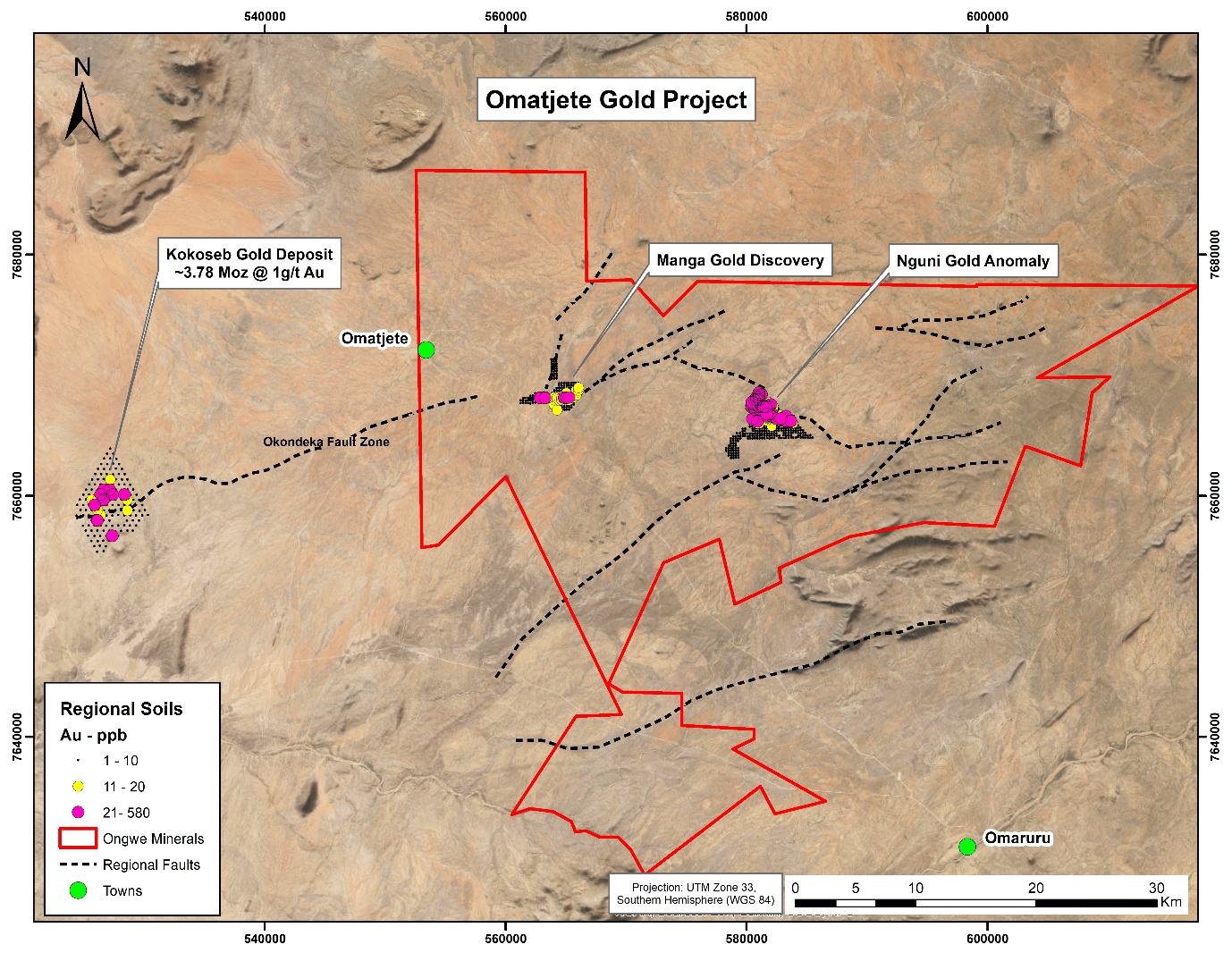
Figure 1: Regional map illustrating the Nguni Gold Anomaly in relation to the Manga Gold Discovery and the initial soil sampling results at the Kokoseb Gold Deposit (54.2Mt at 1.04 g/t Indicated, 35Mt at 0.99 g/t Inferred, released 16 July 2026, ASX, WIA Gold). The image highlights the primary structural control of the Okondeka Fault Zone and the scale of initial gold-in-soil results across the three discoveries.
Nguni Prospect
The Nguni gold anomaly was discovered by Ongwe during regional soil sampling along the Okondeka Fault System in May 2026. The initial regional sampling was carried out on a 200 x 200m square grid and later infilled to 50 x 50m spacing over the anomalous areas. The Nguni area is flat lying and there is very little outcrop visible. The gold anomaly lies along narrow zones of metasediments between late to post orogenic granites and appears to be in-situ within residual soils.
The Nguni anomaly extends over 6 km of strike and includes targets with varying orientations, width and intensity. A two-pronged drill program has been planned as follows:
- A diamond drill program of approximately 18 holes for 3,500m initially, starting in the northwest corner of the anomaly and covering the higher-grade soils in the northwestern and southeastern portions.
- A scout drill program of approximately 1,500m using an RC rig. This program is aimed at first pass testing of the lower priority targets to establish economic potential and priority.
- Either or both programs will be expanded or modified as indicated by the logging and assay results.
Geological mapping of the limited outcrop indicates that the targeted metasedimentary units predominantly dip toward the south-southeast and the initial holes will therefore be drilled toward the north, except for one RC line positioned on the nose of the fold closure. Detailed logging of the initial core will be used to refine the drill parameters. See Figure 2.
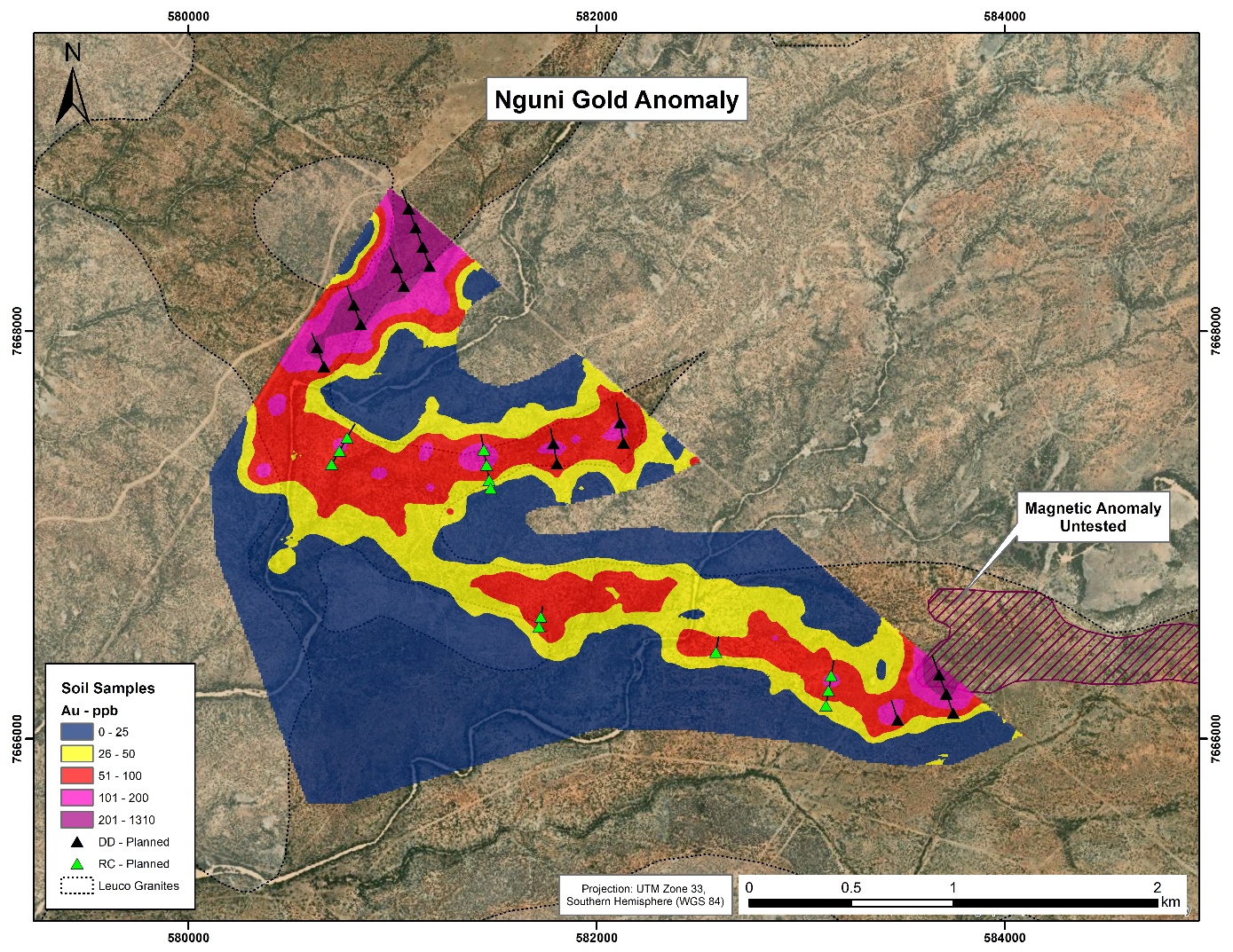
Figure 2: Heat Map showing Nguni soil sample results with the planned DD and RC drill collars plotted.
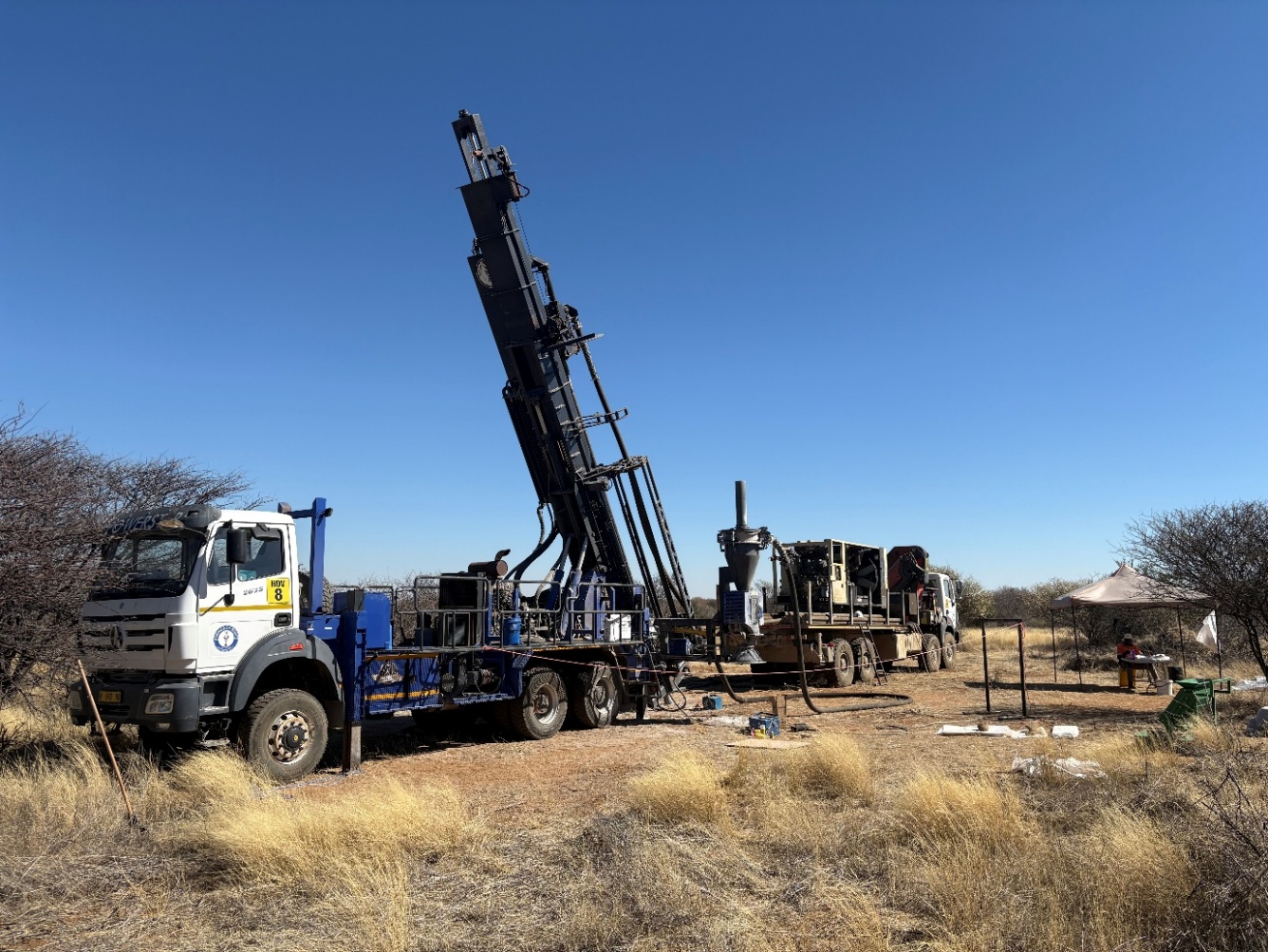
Figure 3: RC drilling underway at the Nguni gold anomaly.
Manga Prospect
The Manga prospect was discovered during the initial regional Omatjete soil sampling program carried out in Q4 2024. The 200 x 200m regional soil grid outlined an arsenic and gold anomaly approximately 4.5km long and 1km wide at the widest point. Infill sampling to 100 x 25m tightened up the surface anomaly and provided follow-up targets. The soil sampling was followed up with two trenches and eleven RC scout holes. Ten of the eleven RC holes returned anomalous gold values, several with wide low-grade intercepts including 138m @ 0.22g/t Au in hole MRC006. As the Manga area is covered by calcrete and alluvial sediment cover, a decision was taken in early 2026 to drill vertical holes through the calcrete cover and sample the top of bedrock beneath. This exploration technique was pioneered by Osino Resources at Twin Hills and has proved effective in defining mineralised footprints in hard rock below calcrete cover. The results from this program indicate that the Manga prospect becomes wider and higher grade towards the east and it is now clear that the calcrete cover gets thicker towards the east, masking the gold mineralization in the bedrock beneath.
Manga Drilling
A diamond drilling program of 5 holes for 1,000 m is planned for the Manga east extension, with an average planned depth of 200 m. The initial holes will be oriented and drilled toward the northwest, but drill parameters may be modified by the detailed logging.
The Company also plans to undertake a calcrete sampling program to trace gold mineralization beneath the calcrete cover east of the current bedrock sampling extent. If the calcrete results confirm that the mineralized trend continues, the Company will use follow-up bedrock sampling to refine the target before testing it with diamond drilling.
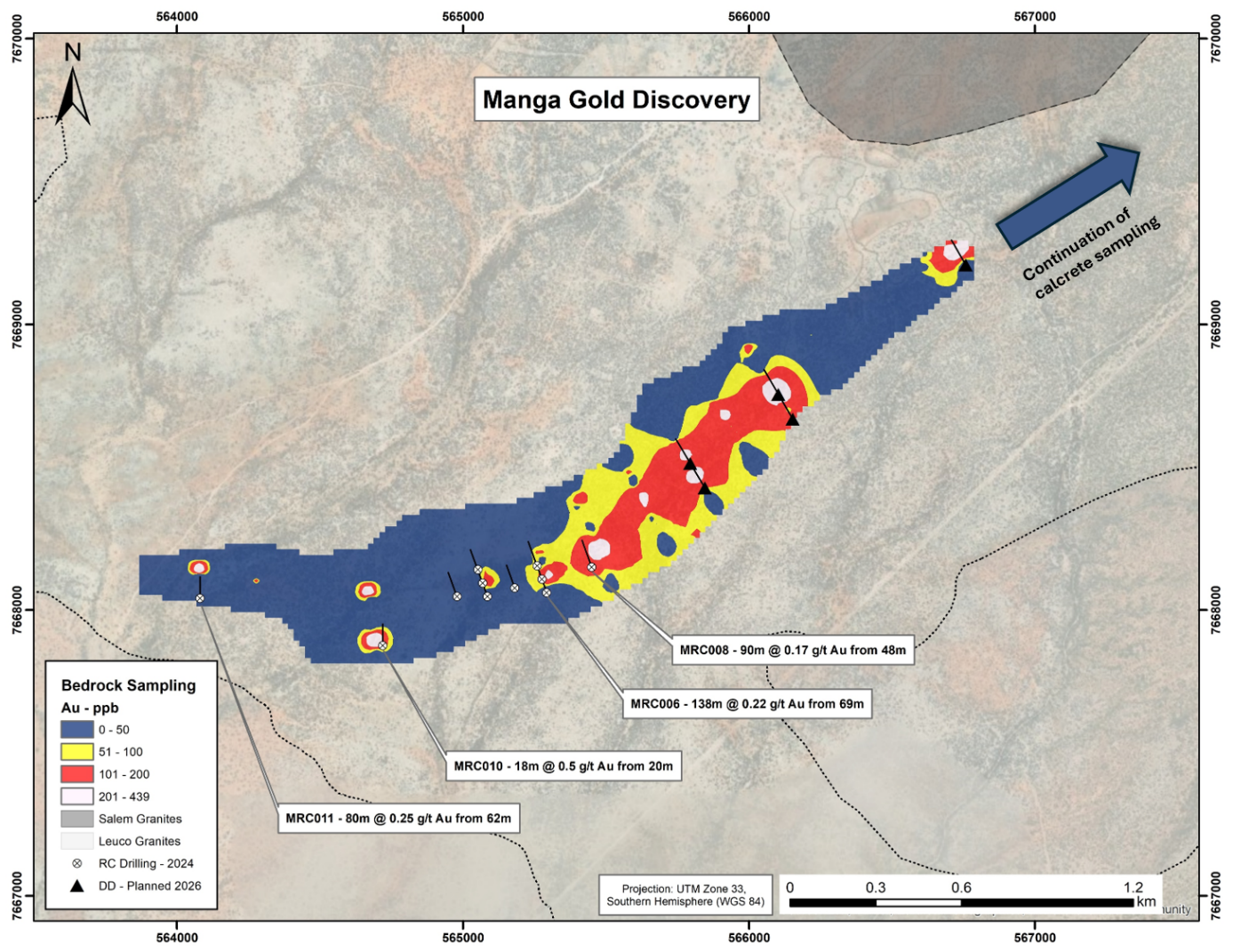
Figure 4: Heat map showing the bedrock assay results improving east of the 2024 RC drill collars. Black triangles indicate the planned DD drill collars to be drilled in Q4 2026.
Assay Method
During the soil sampling programs, the Company initially utilized the detectORE™ analytical technique, designed to enable the measurement of trace gold concentrations in geological samples using a portable X-Ray Fluorescence (pXRF) instrument. This process overcomes the traditional limitations of gold analysis by pXRF including low gold concentrations and metal peak interference. The method involves leaching 250g of sieved material in a sealed pouch with 500ml of GLIX-20™ lixiviant and a Collector Device (CD). Following a 16-hour tumble in a Maxi Mixer barrel to dissolve the gold, the CD is removed, rinsed, and analyzed for 150 seconds using detectORE™ mode firmware. This partial analysis technique is managed through pLIMS™ software with strict QA/QC protocols to identify relative gold anomalism. An extensive orientation program was carried out before putting the detectORE™ methodology into production by comparing soil, calcrete and rock chip sample assays with Aqua Regia and FireICP. The detectORE™ system performed extremely well and identified the same anomalies as the laboratory techniques in all conditions. The detectORE™ gold technique is designed for rapid on-site assessment and is not used for the formal quantification of gold content or the estimation of Mineral Resources.
As part of the current exploration program, all soil samples undergo initial multi-element analysis utilizing the Company’s in-house pXRF. All trace element anomalies, including base metal and arsenic anomalies are then analyzed through the Company’s detectORE™ system. Any area returning a value equal to or greater than 10 detectable Units (dU) are prioritized for follow-up soil sampling. All follow-up soil samples are analyzed via Fire Assay at the MSALAB facility in Omaruru, Namibia. The fire assay procedure starts by drying the <212u and +-250g soil sample. The sample is then pulverized to 85% passing 75 microns, from which a final 50g aliquot is taken for fire assay with an Atomic Absorption (AA) finish.
QA/QC
All of Ongwe’s sample assay results have been independently monitored through a quality assurance and quality control ("QA/QC") program including the insertion of blind standards, blanks, and field duplicate samples. The Company maintains rigorous monitoring for both in-house and laboratory analyses to ensure data reliability. For the detectORE™ process, which provides rapid on-site assessment of gold anomalism, a Certified Reference Material (CRM) sample is inserted every 15 samples to monitor the performance of the pXRF instrument and the leaching efficiency. For the formal fire assay verification conducted at MSALABS, a CRM is inserted every 30 samples. This laboratory procedure involves precise pulverization and a 50g fire assay with an Atomic Absorption (AA) finish to provide formal quantification for prioritized bedrock samples.
Data Verification
Carl Joone, BSc. (Hons), the President and Co-Founder of Ongwe Minerals Inc., and a Qualified Person for the purposes of National Instrument 43-101, has verified all the data disclosed, including a review of the sampling procedures, chain of custody, and assay results underlying the disclosure, by plotting and verifying against raw data received. Mr. Joone noted no errors or omissions during the data verification process.
Qualified Person
Carl Joone, BSc. (Hons) is the President and Co-Founder of Ongwe Minerals Inc. and is a registered Professional Natural Scientist with the South African Council for Natural Scientific Professions (Pr. Sci. Nat. No. 172695) and a Qualified Person for the purposes of National Instrument 43-101. Mr. Joone has reviewed and approved the scientific and technical information in this news release.
About Ongwe Minerals Inc.
Ongwe Minerals Inc. is a Canadian listed gold exploration company focused on the discovery and advancement of new gold systems in Namibia. The Ongwe team, previously with Osino Resources (sold to Shanjin International), has a history of making and advancing gold discoveries in Namibia, including Osino’s Twin Hills (currently in construction) and Eureka deposits, and the advancement and sale of Auryx Gold’s Otjikoto gold deposit (in production, sold to B2Gold).
The Company’s current focus is on three promising gold projects in the emerging Northwest Damara gold belt in Namibia, with a focus on the Omatjete and Khorixas Gold Projects.
The Omatjete Gold Project is strategically located along the regional Okondeka Fault Zone, which also hosts the Kokoseb gold deposit (WIA Gold). Early surface work by Ongwe led to the discovery of the Manga Gold Prospect which has a 4.5km x 1km footprint of gold in soil and early scout drilling indicating gold in bedrock. Recent regional sampling in 2026 has led to the discovery of the large scale, high tenor Nguni anomaly 17km east of Manga. Nguni currently has a strike length of 6km and is open to the west, north and east. The Omatjete Project still has significant growth potential and work is ongoing to define further anomalies along the Okondeka Fault system.
The Khorixas Gold Project is situated just 60km west of Osino's Eureka gold project, adjacent to the northern margin of the Damara Orogenic Belt. Khorixas hosts two large-scale surface discoveries called Belmont and K17. The Belmont prospect has a surface gold footprint of approximately 12 × 6km and lies between the regional scale, basin margin, Khorixas Fault and the Belmont Thrust Zone. Calcrete and grab sampling to date have indicated eighteen target areas.
ON BEHALF OF THE BOARD OF DIRECTORS
“Dave Underwood”
Chief Executive Officer
CONTACT INFORMATION
|
Ongwe Minerals Inc.
Dave Underwood, Chief Executive Officer
Email: dave@ongweminerals.com
| Ongwe Minerals Inc.
Carl Joone, President & Co-Founder
Email: carl@ongweminerals.com |
Neither the TSX Venture Exchange nor its Regulation Services Provider (as that term is defined in the policies of the TSX Venture Exchange) accepts responsibility for the adequacy or accuracy of this press release.
Cautionary Statements Regarding Forward Looking Information
This press release contains "forward-looking information" within the meaning of applicable Canadian securities legislation. Forward-looking information includes, without limitation, statements regarding the use of proceeds from the Company's future plans or prospects of the Company, including prospects for discovery of mineral resources or the results of future exploration programs. Generally, forward-looking information can be identified by the use of forward-looking terminology such as "plans", "expects" or "does not expect", "is expected", "budget", "scheduled", "estimates", "forecasts", "intends", "anticipates" or "does not anticipate", or "believes", or variations of such words and phrases or state that certain actions, events or results "may", "could", "would", "might" or "will be taken", "occur" or "be achieved". Forward-looking statements are necessarily based upon a number of assumptions that, while considered reasonable by management, are inherently subject to business, market and economic risks, uncertainties and contingencies that may cause actual results, performance or achievements to be materially different from those expressed or implied by forward-looking statements. Although the Company has attempted to identify important factors that could cause actual results to differ materially from those contained in forward-looking information, there may be other factors that cause results not to be as anticipated, estimated or intended. There can be no assurance that such information will prove to be accurate, as actual results and future events could differ materially from those anticipated in such statements. Accordingly, readers should not place undue reliance on forward-looking information. Other factors which could materially affect such forward-looking information are described in the risk factors in the Company's most recent annual management's discussion and analysis which is available on the Company's profile on SEDAR+ at www.sedarplus.ca. The Company does not undertake to update any forward-looking information, except in accordance with applicable securities laws.
Photos accompanying this announcement are available at
https://www.globenewswire.com/NewsRoom/AttachmentNg/5d720019-9e19-4bd3-ae78-44f04ee73de8
https://www.globenewswire.com/NewsRoom/AttachmentNg/b790238b-3b4e-42d3-bfca-2c1cb71bf0e1
https://www.globenewswire.com/NewsRoom/AttachmentNg/0c1d1e05-8c32-41c0-9131-3ad41ee69e0e
https://www.globenewswire.com/NewsRoom/AttachmentNg/1a58afc3-1d07-40e2-9829-862e7223d1f1



Figure 1
Regional map illustrating the Nguni Gold Anomaly in relation to the Manga Gold Discovery and the initial soil sampling results at the Kokoseb Gold Deposit (54.2Mt at 1.04 g/t Indicated, 35Mt at 0.99 g/t Inferred, released 16 July 2026, ASX, WIA Gold). The image highlights the primary structural control of the Okondeka Fault Zone and the scale of initial gold-in-soil results across the three discoveries.
Figure 2
Heat Map showing Nguni soil sample results with the planned DD and RC drill collars plotted.
Figure 3
RC drilling underway at the Nguni gold anomaly.
Figure 4
Heat map showing the bedrock assay results improving east of the 2024 RC drill collars. Black triangles indicate the planned DD drill collars to be drilled in Q4 2026.
© 2026 Canjex Publishing Ltd. All rights reserved.