Montréal, Québec--(Newsfile Corp. - June 29, 2026) - Québec Innovative Materials Corp. (CSE: QIMC) (OTCQB: QIMCF) (FSE: 7FJ) ("QIMC" or the "Company") is pleased to report new preliminary mud-gas geochemical results from the 100-metre to 250-metre interval of diamond drill hole DDH-26-04 at Bennett Hill, Nova Scotia, including a peak hydrogen reading of 16.0% H₂ at 236 metres, two readings of 13.5% H₂, nine readings at or above 5% H₂, and 35 of 60 IsoJar samples returning readings at or above 1% H₂.
The Company considers the repeated elevated hydrogen readings over the 100-metre to 250-metre interval significant because they indicate a broadly elevated mud-gas response rather than a single isolated reading. The results were acquired using a higher-range EAGLE II analyzer deployed after the first analyzer saturated in the upper 100 metres, as disclosed in the Company's June 18, 2026 news release.
Highlights - DDH-26-04 (100m-250m Interval).
- Peak and repeated high-range hydrogen readings. The Company recorded a peak reading of 16.0% H₂ at 236 metres, together with two readings of 13.5% H₂ at 125 metres and 152 metres, and nine readings at or above 5% H₂ across the reported interval.
- Broadly elevated hydrogen response. Of the 60 co-collected IsoJar mud-gas samples obtained over the 100m-250m interval, 35 samples returned readings at or above 1% H₂, which the Company interprets as indicating repeated elevated hydrogen readings across the sampled interval rather than a single isolated reading.
- District-scale exploration model. The elevated hydrogen response at Bennett Hill, located approximately 15 kilometres from the Eatonville Road drill holes DDH-26-01 and DDH-26-02, provides additional data supporting QIMC's evolving geological model of a potentially extensive natural hydrogen system across the Advocate Area.
- Shallow occurrence. The percent-level readings occur within the first 250 metres of DDH-26-04, shallower than the deeper percent-level intervals previously reported at the Eatonville Road (West-Advocate) holes, including the 10.77% H₂ reading reported near 848 m in DDH-26-03, as disclosed May 20, 2026. Depth comparisons reflect measurements at each hole and are not equivalent calibrated values.
- Higher-range analyzer deployed. The readings were obtained using a higher-range EAGLE II analyzer deployed after the first analyzer reached its 4.03% H₂ upper measurement limit in the upper 100 metres, as disclosed on June 18, 2026.
- Low-methane, low-carbon-dioxide gas signature. Methane (CH₄) was recorded at approximately 0% and carbon dioxide (CO₂) at or below 0.2% across the interval, which the Company preliminarily interprets as potentially consistent with a natural hydrogen gas signature.
- Structural association. The strongest readings coincide with fractured and brecciated zones logged within the deformed felsic and fault-affected lithologies of the hole, including a fault breccia interval logged between approximately 132 m and 149 m, which the Company interprets as being consistent with its working hypothesis that local structures may influence gas migration.
- Regional exploration model. Bennett Hill is located approximately 15 kilometres from the Eatonville drill area. The Company considers the shallow elevated response at Bennett Hill as additional data supporting its regional exploration model across the Advocate Area.
- Drilling and validation ongoing. Sampling below 250 metres is ongoing and further results will be reported once available and validated.
Building on the Upper 100 Metres
As disclosed on June 18, 2026, the upper 100 metres of DDH-26-04 returned elevated hydrogen, including a 9-metre zone with four readings at or above 4.03% H₂ - the upper measurement limit (saturation point) of the first EAGLE II analyzer used over that interval. Because that instrument saturated, the Company deployed a second EAGLE II unit with a higher measurement range to quantify the hydrogen encountered below 100 metres.
The results reported today are the outcome of that higher-range sampling. Sixty co-collected IsoJar headspace samples were obtained at approximately 3-metre intervals across the 100m-250m interval.
Geological Setting and Interpretation
The Company interprets the repeated elevated hydrogen readings at relatively shallow depths as potentially indicating zones of enhanced permeability that may permit gas migration, subject to laboratory calibration, independent verification and further geological interpretation. The accompanying negligible methane and very low carbon dioxide readings are not, on a preliminary basis, strongly indicative of a conventional hydrocarbon gas signature.
The strongest readings are spatially associated with deformed and fractured rocks logged in the hole, including a deformed felsic sequence extending from approximately 43 m to 162 m and a fault breccia interval logged between approximately 132 m and 149 m. The Company considers this association relevant to its working hypothesis that local structures may influence gas migration.
These results are being integrated into QIMC's proprietary R2G2™ (Reactivated Rift and Graben Geostructure) exploration framework.
Management Commentary
"The key point for QIMC is repeatability," said John Karagiannidis, President and Chief Executive Officer of QIMC. "Over the 100-metre to 250-metre interval of DDH-26-04, we recorded a peak preliminary mud-gas reading of 16.0% H₂ at 236 metres, two readings of 13.5% H₂, nine readings at or above 5% H₂, and 35 of 60 IsoJar samples at or above 1% H₂. In our view, this is an important technical result because it shows repeated elevated hydrogen readings across the interval, rather than a single isolated reading."
"What is also significant is the combination of magnitude, shallow depth, and a low-methane, low-carbon-dioxide gas signature. Methane was recorded at approximately 0% and carbon dioxide at or below 0.2% across the interval. These results represent an important step toward evaluating the potential scale and continuity of the Advocate natural hydrogen system. Importantly, Bennett Hill is located approximately 15 kilometres from the Eatonville Road drill holes DDH-26-01 and DDH-26-02, where QIMC previously reported elevated hydrogen concentrations. The occurrence of elevated hydrogen responses at both locations supports our working model of a potentially extensive natural hydrogen system across the Advocate Area."
"The new geological interpretation provides QIMC with an increasingly compelling geological and structural framework for continued exploration. The strongest hydrogen readings occur within or immediately adjacent to thick fault-breccia zones and intensely fractured intervals associated with the Apple River pluton, supporting our working hypothesis that the Cobequid Fault System may have acted as a long-lived migration pathway for natural hydrogen. This relationship between elevated hydrogen readings, the Apple River pluton, and major structural corridors provides a strong technical foundation for continued drilling, validation and geological evaluation at Bennett Hill."
Scientific Commentary by Prof. Marc Richer-LaFlèche
The new data from borehole DDH-26-04 are highly informative, as they reveal a clear enrichment in H₂ concentrations, on the order of 400%, toward the north, occurring within an increasingly deep structural context. The highest hydrogen concentrations in the drilling mud are found within, or immediately adjacent to, relatively thick fault-breccia zones associated with intense fracturing (RQD%) of the Apple River intrusion (Fig. 1). This intrusion lies between the South and North Cobequid faults, which together form a 6.2-km-wide composite shear corridor in the Bennett Hill area.
The geology observed in the borehole highlights the dominant influence of the North Fault Zone, which in this region is typically characterized by a higher abundance of breccias and fault gouge, in contrast to the South Zone, where deformation is more strongly expressed through mylonitization and ductile shearing.
Given the Carboniferous age of emplacement of the pluton, the strong deformation observed in the potassic granitoid must necessarily be linked to the major strike-slip movements associated with the Cobequid Fault System. This geostructure appears to have exerted a profound influence on the rocks of the Cobequid Highlands.
The number and diversity of cataclastic rock zones, fault zones, and fault gouges is remarkable, demonstrating that the Cobequid Fault System functioned as a highly dynamic deformation corridor over a long period of geological time.
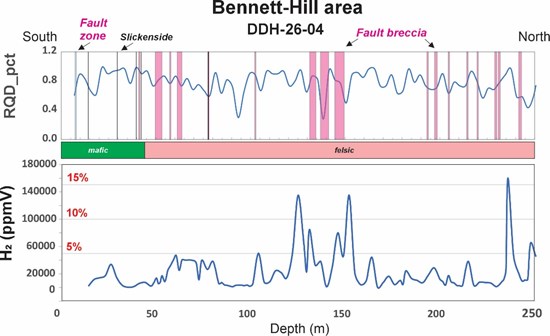
Figure 1. Diagrams showing a summary of the geology observed in hole DDH-26-04 between depths of 0m to 250m (measured along the hole). The H2 concentrations (ppmV) from the analysis of the drilling muds (Isojar technique) underline the importance of the H2 concentrations observed as well as the spatial relationship with tectonic breccia zones and core fracturing (RQD%).
To view an enhanced version of this graphic, please visit:
https://images.newsfilecorp.com/files/7968/303249_12c3bda5b4a48850_001full.jpg
About Québec Innovative Materials Corp. (QIMC)
Québec Innovative Materials Corp. (CSE: QIMC) (OTCQB: QIMCF) (FSE: 7FJ) is a North American exploration and development company advancing a portfolio of natural hydrogen and critical mineral interests. The Company is advancing its exploration model across Québec, Ontario, Nova Scotia, and Minnesota through the application of its proprietary R2G2™ framework.
QIMC is focused on responsible exploration, technical innovation, and the advancement of natural hydrogen opportunities that may contribute to future clean-energy development initiatives. The Company's exploration at the Advocate Area involves no hydraulic fracturing and no reservoir stimulation.
Sampling, Methodology and Data Verification
Mud-gas readings reported in this news release are preliminary and are based on co-collected IsoJar headspace samples taken at approximately 3-metre intervals during the drilling of DDH-26-04. Readings over the 100-metre to 250-metre interval were obtained using a portable EAGLE II gas analyzer fitted with a higher measurement range than the unit used in the upper 100 metres, which had reached its 4.03% H₂ upper measurement limit (saturation point). Methane (CH₄) was recorded at approximately 0% and carbon dioxide (CO₂) at or below 0.2% across the reported interval, at or below the detection limit of the analyzer.
Readings over the 100m-250m interval were obtained within the measurement range of the higher-range EAGLE II analyzer. All readings remain subject to laboratory calibration and independent verification.
All reported values are subject to independent verification against certified gas cylinder samples analyzed by a higher-precision laboratory reference instrument, under the supervision of Prof. Marc Richer-LaFlèche, P.Geo., of INRS.
Cautionary Statement Regarding Mud-Gas Readings
Investors are cautioned that mud-gas and headspace gas readings are preliminary, exploration-stage geochemical indicators only. They are preliminary laboratory measurements obtained from IsoJar headspace samples. They are not mineral resources or mineral reserves, are not indicative of the presence, volume, concentration, flow rate, deliverability or commercial recoverability of any natural hydrogen accumulation, and should not be relied upon as such. There is no guarantee that elevated hydrogen readings will be independently verified, calibrated, or translate into an economically recoverable resource. References to "record," "highest," "strongest" or similar terms reflect the Company's review of its own records and are not statements of independently verified fact.
Neither the Canadian Securities Exchange nor its Regulation Services Provider (as that term is defined in the policies of the Canadian Securities Exchange) accepts responsibility for the adequacy or accuracy of this release.
Forward-Looking Statements
This news release contains "forward-looking information" and "forward-looking statements" within the meaning of applicable Canadian securities laws. Forward-looking statements include, without limitation, statements regarding the interpretation and significance of hydrogen readings at DDH-26-04 and other holes; the existence, extent, continuity or scalability of any hydrogen corridor or system; the relationship between Bennett Hill and the Eatonville drill area; the results expected from continued sampling and from laboratory calibration; planned, ongoing or future exploration, drilling and development activities; and potential strategic opportunities, technical evaluation, development partnerships or other future commercial opportunities. Such statements are based on assumptions and are subject to known and unknown risks and uncertainties - including that readings may not be confirmed by laboratory analysis, that geochemical indicators may not reflect a recoverable resource, and risks relating to financing, permitting, weather, markets and general economic conditions - that may cause actual results to differ materially from those expressed or implied. Readers are cautioned not to place undue reliance on forward-looking statements. Except as required by applicable law, the Company disclaims any obligation to update or revise any forward-looking statements.
Scientific and Technical Information
The scientific and technical information in this news release has been reviewed and approved by Prof. Marc Richer-LaFlèche, P.Geo., of the Institut national de la recherche scientifique (INRS), a technical consultant to the Company.
Natural hydrogen is a gaseous substance and is not a "mineral resource" or "mineral reserve" as those terms are defined under National Instrument 43-101 - Standards of Disclosure for Mineral Projects ("NI 43-101") and the CIM Definition Standards. The hydrogen readings disclosed in this news release are provided as exploration-stage geochemical information and general corporate disclosure. NI 43-101 mineral resource and mineral reserve definitions and classifications do not apply to the hydrogen readings reported herein.

To view the source version of this press release, please visit https://www.newsfilecorp.com/release/303249

© 2026 Canjex Publishing Ltd. All rights reserved.