(via TheNewswire)
Igrejinha: 6.55 m @ 2.28 g/t Au, including 4.80 m @ 3.06 g/t Au, beneath a trench that returned 7.04 m @ 6.19 g/t Au. Queimadas: 45.00 m @ 0.40 g/t Au, including 7.15 m @ 1.21 g/t Au, and 24.00 m @ 0.63 g/t Au in holes 530 m apart; hole 26DDQUE001, the longest hole drilled at the Project to that date, ended in mineralization at 250.60 m
Highlights
Visible gold confirmed by assays in the first diamond drilling at Igrejinha: hole 26DDIGR005, drilled beneath trench PBTR009 (7.04 m @ 6.19 g/t Au, 2021 technical report), returned 6.55 m @ 2.28 g/t Au from 35.00 m, including 4.80 m @ 3.06 g/t Au, which includes 1.00 m @ 12.75 g/t Au , the interval with the visible gold observed at 38.1 m (Figure 1).
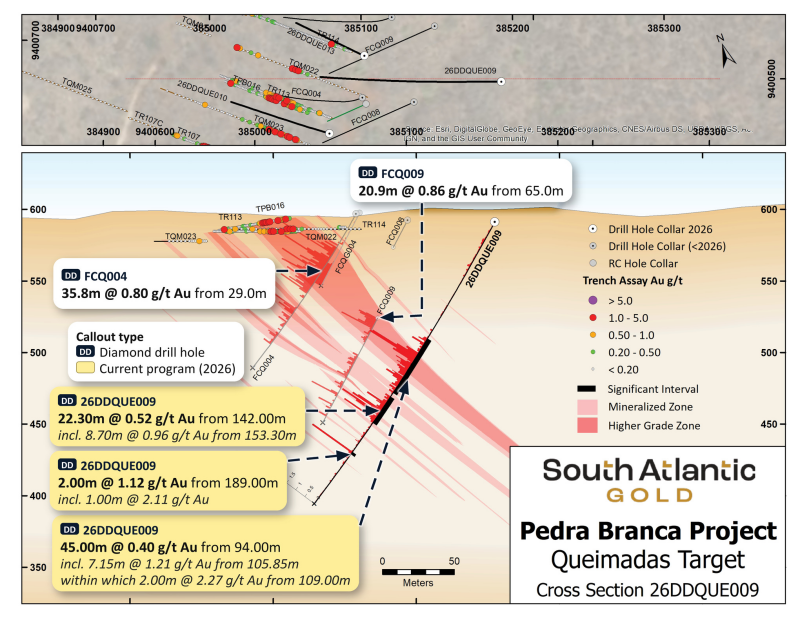
At Queimadas, drill hole 26DDQUE009 returned a broad zone of 45.00 m @ 0.40 g/t Au (0.10 g/t Au threshold) from 94.00 m, including 7.15 m @ 1.21 g/t Au ; 22.30 m @ 0.52 g/t Au from 142.00 m, including 8.70 m @ 0.96 g/t Au ; and 2.00 m @ 1.12 g/t Au from 189.00 m, including 1.00 m @ 2.11 g/t Au (Figure 6).
Drill hole 26DDQUE004, 530 m away, also intersected a broad zone of gold mineralization, returning 24.00 m @ 0.63 g/t Au from 77.00 m, including 5.00 m @ 1.17 g/t Au
Sixteen follow-up drill holes have been completed at Queimadas (26DDQUE010 to 26DDQUE025), including holes around both of these gold zones, and are awaiting assays.
Drill hole 26DDQUE001 ended in mineralization at 250.60 m, returning 3.60 m @ 0.48 g/t Au from 247.00 m; this result demonstrates that the Queimadas gold system extends to depth. At 250.60 m it was the longest hole drilled at the Project to that date.
Two styles of mineralization have been observed: gold in white quartz veins at Igrejinha and Mirador, and gold in sulphide-rich zones at Queimadas.
Assays also pending: results are pending for all seven Mirador holes, and for the unassayed intervals of the 13 Igrejinha holes and of 26DDQUE005 and 26DDQUE007.
Catalysts ahead: assay results for the remaining drill core, more than half of the program, from Queimadas, Mirador and Igrejinha; trench results from Igrejinha and Mirador; and follow-up mapping and trenching at Cachoeirinha and Barra Nova.
Kelowna, British Columbia – TheNewswire - October 15, 2026 – South Atlantic Gold Inc. (TSX-V: SAO) (the “Company” or “South Atlantic Gold”) is pleased to report the first diamond drill results ever obtained from the Igrejinha target, further results from Queimadas, and the completion of its approximately 5,000 m drilling program at the 100%-owned Pedra Branca Gold Project (the “Project”) in Ceará State, northeast Brazil.
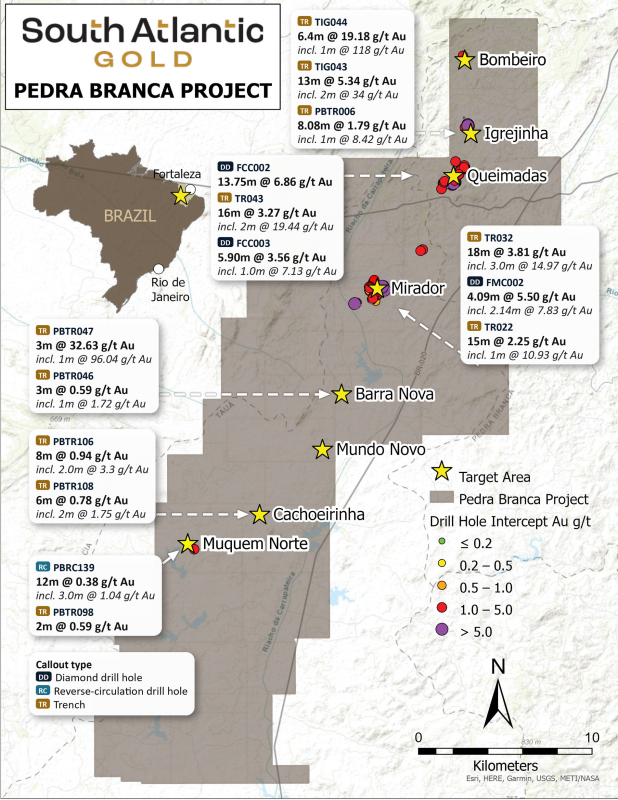
Pedra Branca is a district-scale land position: over 52,000 hectares on the Troia greenstone belt in the Ceará Central Domain, with nine gold targets described in the 2021 technical report. Three of them, Queimadas, Igrejinha and Mirador, host an Inferred Mineral Resource of 4.0 million tonnes grading 1.38 g/t Au for approximately 180,000 ounces of gold, defined by 90 diamond holes averaging 99 m in length, the longest measuring 201.2 m, and 67 reverse-circulation holes averaging 38 m in length (see “Mineral Resource” in Part B and Figure 2). At the time of that report, the other six targets had been tested by trenching, and two of them by reverse-circulation drilling. Trench results outside the current resource include 3.0 m @ 32.63 g/t Au at Barra Nova (news release of May 6, 2022).
The current program was designed to further test Queimadas, extending the known mineralization along strike and at depth and improving the understanding of its characteristics, to put the first diamond holes into Igrejinha, and to drill Mirador. To date, complete assays have been received for seven holes; results for the others are pending in full or in part.
At Igrejinha, hole 26DDIGR005 intersected a gold-bearing quartz vein, with visible gold observed, beneath the assay-confirmed gold-bearing veins in the trench it was drilled to test, and a second hole 28 m away is interpreted to have cut the same vein. At Queimadas, two holes 530 m apart intersected broad zones of gold mineralization, one of them with three zones in the same hole, and the longest hole drilled at the Project to that date ended in mineralization. With results still to come from 38 holes, in whole or in part, including the first Mirador assays, the Company expects the coming months to give a far clearer picture of the extent and geometry of the mineralization at each target.
Pedra Branca at a Glance
Land position | Over 52,000 hectares on the Troia greenstone belt, Ceará State, Brazil; 100% owned |
Targets | Nine described in the 2021 technical report; three host the resource; the other six tested by trenching, two of them also by reverse-circulation drilling, at the time of the report |
Inferred Mineral Resource (2021) | 4.0 Mt @ 1.38 g/t Au for approximately 180,000 oz at a 0.40 g/t Au cut-off: Queimadas ~128,000 oz at 1.24 g/t, Mirador ~40,000 oz at 1.97 g/t, Igrejinha ~12,000 oz at 1.73 g/t |
Resource drilling (2021 report) | 90 diamond holes averaging 99 m (longest 201.2 m) and 67 reverse-circulation holes averaging 38 m, as filed in the 2021 technical report |
2026 program | Approximately 5,000 m of diamond drilling; 45 holes for 5,003.55 m completed October 8, 2026 (25 Queimadas, 13 Igrejinha, 7 Mirador) |
Assays received | Seven holes in full; 38 holes pending in whole or in part |
Previously reported trench result | 3.0 m @ 32.63 g/t Au in trench PBTR047 at Barra Nova (news release of May 6, 2022) |
Other 2026 work | Induced polarization (“IP”) survey completed at Queimadas, Igrejinha and Mirador (June to July); structural interpretation developed in July and August; follow-up mapping and trenching being prepared at Cachoeirinha and Barra Nova |
Qualified Person | Marcelo A. Batelochi, P.Geo., MAusIMM (CP), Senior Vice-President, Exploration |

Click Image To View Full Size
Figure 1 – Drill core from hole 26DDIGR005 at approximately 38.1 m, showing visible gold (circled) in a quartz vein. The photograph shows a single sample interval and is not representative of mineralization in the hole or the Project; the 1.00 m sample (37.90 to 38.90 m) containing the visible gold assayed 12.75 g/t Au and has not yet been check-assayed. Assays are reported in Table 1.
Comment from the President and CEO
Douglas Meirelles, President and CEO, commented: “ This program set out to test mainly our three targets: whether the gold at Igrejinha continues below the trenches, and whether Queimadas and Mirador can be extended at depth and laterally. Whilst we are still waiting for more than 50% of the results, the first ones are already shaping our understanding of how the gold is arranged. At Igrejinha, drilling found the vein beneath trench PBTR009, and our working interpretation is that the gold sits in shoots that plunge down through the vein, which would tell us how to target the next holes: along that plunge.”
Mr. Meirelles added: “At Queimadas, 26DDQUE009 cut three stacked zones of gold mineralization and 26DDQUE004, 530 metres to the southwest, a broad zone of its own; because sulphides accompany the gold there, the IP survey should sharpen our targeting. Beyond the three resource targets, Pedra Branca covers more than 52,000 hectares of the Troia greenstone belt, with six more targets described in our 2021 technical report, and we are preparing mapping and trenching at Barra Nova and Cachoeirinha. Mirador’s assays are pending, and we are working on an update of the Mineral Resource estimate in parallel. Together, the new assays will support our resource work and, more importantly, show us where to drill next.”
Structural Interpretation
The Company’s structural interpretation, developed during July and August 2026 with its technical committee and with Dr. Brett Davis, Principal Structural Geologist of Olinda Gold Pty Ltd, from field mapping, trench and core observations and the historical drill database, is that the gold at Pedra Branca is structurally controlled. Dr. Davis, a consultant to the Company, holds a Ph.D. in structural geology from James Cook University and has held structural geology roles with Placer Dome, RSG Global, Chalice Gold Mines and Dundee Precious Metals, and is a Registered Professional Geoscientist (Structural Geology) with the Australian Institute of Geoscientists. He visited the Project from July 12 to 16, 2026, examining outcrops, trenches and drill core at Igrejinha, Mirador, Cachoeirinha and other prospects, and continues to work for the Company. So far, he has concluded that the mineralization examined is consistent with orogenic-style gold, and that its continuity along-strike and down-dip is restricted at the prospect-scale. Drilling and trenching to date have not resolved the geometry of the mineralized volumes at the three main targets. The interpretation carries the caveats stated below and is subject to the pending assays and to the structural data still being collected from the oriented core.
The quartz veins that host the gold are interpreted to have formed in an early deformation event and to have been strongly deformed in a second, with the gold introduced or remobilized during that second event. The relative timing of veining and gold is a working hypothesis. Under this interpretation the geometry and plunge of mineralized shoots, rather than the strike of the veins, are the targeting criteria.
Veins at Igrejinha and Mirador show dip rolls at a scale of 10 to 20 m, locally flattening to subhorizontal, so adjacent trenches or holes can intersect markedly different vein counts.
At Igrejinha, vein continuity along-strike is restricted and the structural control is strongly linear; the current holes test the veins but not the length of any shoot. Of the prospects visited during the structural review, Mirador showed the most voluminous quartz veining. At Cachoeirinha, veining is restricted and post-mineral dykes may have removed part of the vein system.
To date, structural measurements from the program’s oriented core are limited (foliation and fault readings). Vein and lineation measurements at Igrejinha and Mirador are still to be collected and will be used to orient follow-up drilling along the interpreted plunge of the shoots.
Chargeability from the IP survey is expected to be most useful at Queimadas, where sulphides accompany the mineralization.
Stress heterogeneity around rigid intrusions at the northern end of the belt is a regional targeting concept that remains to be tested.
What Comes Next
The next several weeks carry a sequence of catalysts, each of which should add to the picture of the extent of mineralization at the Project:
Mirador’s first results: assays for all seven holes at the highest-grade resource target.
Queimadas follow-up: holes 26DDQUE010 to 26DDQUE025, including the follow-up holes around 26DDQUE004 and 26DDQUE009 and two holes at the southwest end of the drilled area, plus the unassayed intervals of the partly assayed holes at Igrejinha and Queimadas. Results will be reported as they are received and reviewed by the Qualified Person (“QP”).
Follow-up mapping and trenching at Cachoeirinha, a target outside the nine described in the 2021 technical report, and at Barra Nova, where trench PBTR047 returned 3.0 m @ 32.63 g/t Au, including 1.0 m @ 96.04 g/t Au (news release of May 6, 2022).
Geophysics and assays: strong, coherent IP anomalies occur at Queimadas, and early results suggest gold mineralization may be focused where the IP anomalies (sulphides) coincide with highly magnetic mafic rocks, a chemical and structural trap. If assays from the remaining holes confirm this pattern, the geophysical data will provide a useful tool for finding further gold zones.
About South Atlantic Gold Inc.
South Atlantic Gold is an exploration company advancing the 100%-owned Pedra Branca Gold Project in Ceará State, northeast Brazil. The Project covers over 52,000 hectares and hosts an Inferred Mineral Resource of 4.0 million tonnes grading 1.38 g/t Au for approximately 180,000 ounces of gold at three targets, Queimadas, Igrejinha and Mirador (NI 43-101 technical report effective March 16, 2021; Qualified Person: Rodrigo Mello, FAusIMM). The Company is listed on the TSX Venture Exchange under the symbol “SAO”. Additional information is available on SEDAR+ (www.sedarplus.ca) and on the Company’s website (www.southatlanticgold.com).
For further information, please contact:
SOUTH ATLANTIC GOLD INC.
Douglas Meirelles, President and CEO
E: ir@southatlanticgold.com
T: 250-762-5777
The technical information supporting this release, including the geology, the target-by-target results, Tables 1 and 2, Figures 2 to 6, the sampling and assaying procedures, the Mineral Resource statement, the Qualified Person statement and the cautionary statements, follows in Part B.
PART B: SUPPORTING TECHNICAL INFORMATION |
Geology, target detail, Tables 1 and 2, Figures 2 to 6, sampling and assaying, Mineral Resource, Qualified Person and cautionary statements |
Geology and Mineralization
Pedra Branca lies within the Ceará Central Domain, in the northern part of the Borborema Province of northeast Brazil. The 2021 technical report places it within the Troia greenstone belt terrain of the Cruzeta Complex and interprets the Project’s gold mineralization as a mesothermal, shear-zone-hosted deposit.
The report describes two settings for the gold. At Coelho-Queimadas it is associated with quartz veinlets parallel to the foliation and with thin, foliation-parallel sulphide strings, predominantly pyrrhotite, in amphibole schists with magnetite. At Mirador and Igrejinha it is associated with sub-metre to metre-scale milky quartz veins, and at Mirador pyrite is the predominant sulphide. Hydrothermal alteration occurs locally, in halos a few metres wide in the wall rocks.
The 2021 technical report describes nine targets at the Project. Three host the Inferred Mineral Resource. At the time of the report, the other six had been tested by trenching, and Bombeiro and Mir Coelho also by reverse-circulation drilling.
Igrejinha Target
The first diamond drilling at Igrejinha has intersected the quartz vein beneath trench PBTR009 in hole 26DDIGR005, with visible gold observed, and hole 26DDIGR013, approximately 28 m away, is interpreted to have cut the same vein.
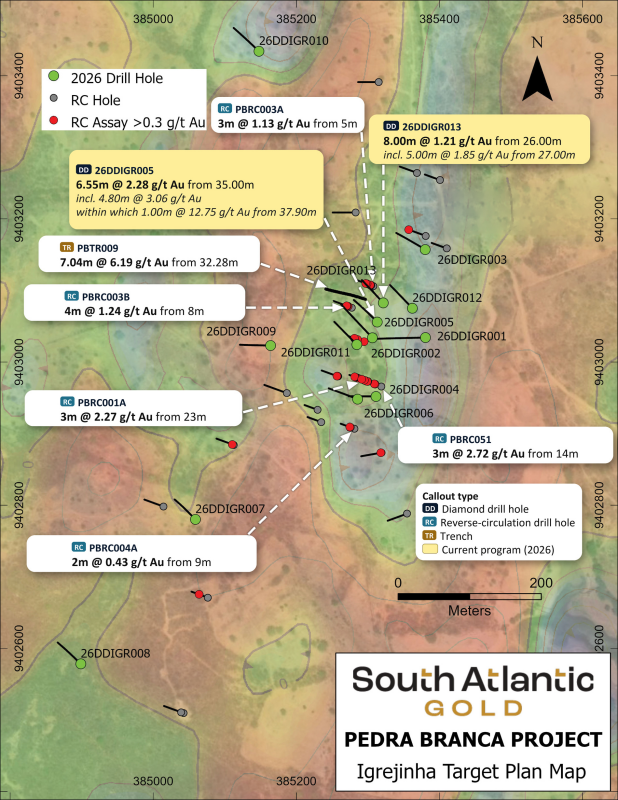
Igrejinha lies approximately 3 km north of the Queimadas drilling and hosts approximately 12,000 ounces of the Inferred Mineral Resource (215,000 tonnes at 1.73 g/t Au; see “Mineral Resource” below). Before this program it had been tested only by trenching and shallow reverse-circulation drilling. The Company has completed 13 holes for 1,103.25 m on the target, the first diamond drilling at Igrejinha (Figure 3). New trenches excavated at Igrejinha in July and August 2026 have been mapped and sampled; the samples are at the laboratory and the results are pending.
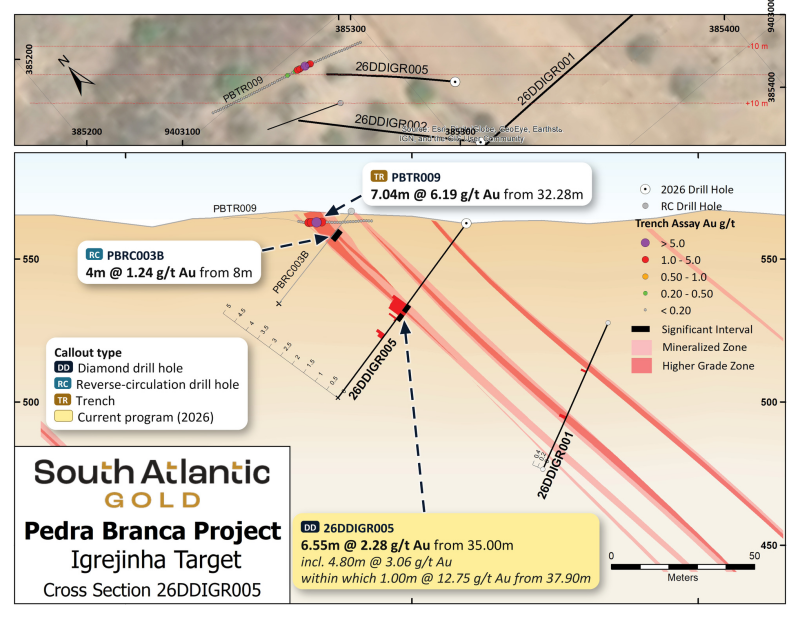
Hole 26DDIGR005 was drilled to test the mineralization in trench PBTR009, which returned 7.04 m @ 6.19 g/t Au (2021 technical report). It intersected 6.55 m @ 2.28 g/t Au from 35.00 m, including 4.80 m @ 3.06 g/t Au, within which a 1.00 m sample returned 12.75 g/t Au (Figure 4). The Company’s geologists observed visible gold in a quartz vein at approximately 38.1 m, within that sample (Figure 1). The 12.75 g/t Au sample is a single determination with no laboratory repeat (see “Sample Collection, Assaying and Data Management” below). The hole also returned 2.00 m @ 0.26 g/t Au from 48.00 m. Only the interval from 31.00 m to 50.00 m of the 75.70 m hole has been assayed to date.
Hole 26DDIGR013, collared approximately 28 m from 26DDIGR005, intersected 8.00 m @ 1.21 g/t Au from 26.00 m, including 5.00 m @ 1.85 g/t Au from 27.00 m, within which a 1.00 m sample from 29.00 m returned 5.89 g/t Au. Every sample in the included interval grades at least 0.40 g/t Au. The interval is logged as schist with abundant quartz veins.
Apart from its uppermost 1.10 m, the 26DDIGR005 interval lies within a quartz-vein unit logged from 36.10 m to 45.10 m, and the field team interprets the two holes as intersecting the same quartz vein. The holes cut across the vein’s interpreted plunge and do not establish the length of any mineralized shoot. Both intercepts lie approximately 20 to 45 m from historical reverse-circulation intercepts and confirm known mineralization at shallow depth.
No Igrejinha hole has yet been fully assayed; unassayed intervals are untested and should not be interpreted as barren.
Queimadas Target
Queimadas has returned broad zones of gold mineralization in two holes approximately 530 m apart, and mineralization at the end of the longest hole drilled at the Project to that date.
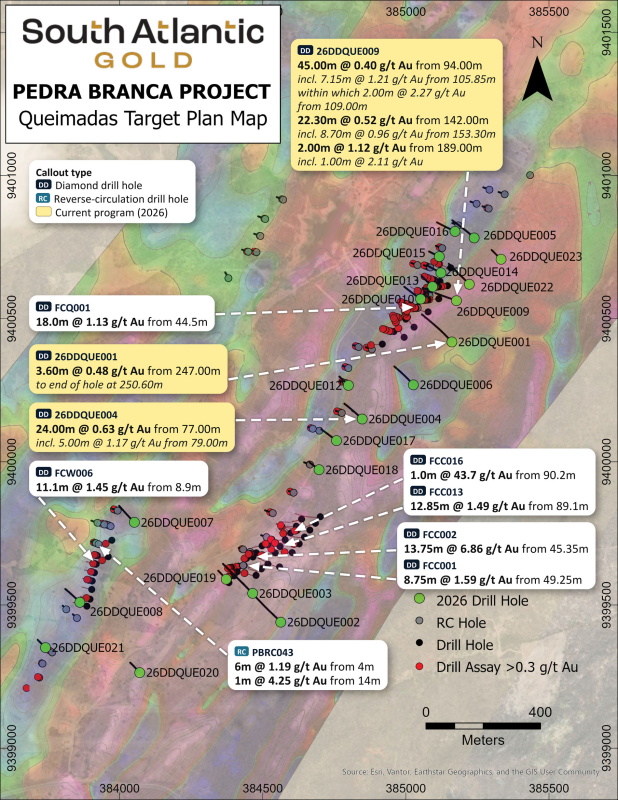
Queimadas (Coelho-Queimadas) hosts approximately 128,000 ounces of the Inferred Mineral Resource (3,189,000 tonnes at 1.24 g/t Au; see “Mineral Resource” below), the largest of the three resource targets. Twenty-five holes for 3,512.20 m were completed there in the current program. The program’s longest holes, 26DDQUE001 to 26DDQUE003 and 26DDQUE009, test the target below the depth of previous drilling; the other holes test the drilled area along strike and at shallower depths. Results have been received for the first nine holes, seven in full and two (26DDQUE005 and 26DDQUE007) in part (Figure 5).
Hole 26DDQUE009 intersected 45.00 m @ 0.40 g/t Au from 94.00 m, including 7.15 m @ 1.21 g/t Au from 105.85 m, within which 2.00 m from 109.00 m returned 2.27 g/t Au (Figure 6). A second zone in the same hole returned 22.30 m @ 0.52 g/t Au from 142.00 m, including 8.70 m @ 0.96 g/t Au from 153.30 m, and a third zone returned 2.00 m @ 1.12 g/t Au from 189.00 m, including 1.00 m @ 2.11 g/t Au. Hole 26DDQUE004, approximately 530 m southwest of 26DDQUE009, intersected 24.00 m @ 0.63 g/t Au from 77.00 m, including 5.00 m @ 1.17 g/t Au from 79.00 m, within which 1.00 m returned 3.32 g/t Au. Hole 26DDQUE006, collared between the two, returned 4.20 m @ 0.13 g/t Au from 79.25 m. Follow-up holes around 26DDQUE004 and 26DDQUE009 have been drilled and are awaiting assay.
Hole 26DDQUE001 intersected 3.60 m @ 0.48 g/t Au from 247.00 m to the end of the hole at 250.60 m, including 3.00 m @ 0.53 g/t Au. At 250.60 m it was the longest hole drilled at the Project to that date. It also returned 2.00 m @ 0.21 g/t Au from 162.95 m, 9.00 m @ 0.20 g/t Au from 215.00 m and 6.00 m @ 0.16 g/t Au from 229.00 m, which includes the 0.50 m @ 0.52 g/t Au reported on June 30, 2026.
Of the program’s two longest holes, 26DDQUE002 (318.95 m) returned 4.00 m @ 0.13 g/t Au from 266.00 m and 26DDQUE003 (274.60 m) returned 4.40 m @ 0.19 g/t Au from 100.00 m. Hole 26DDQUE005, partly assayed, returned 2.00 m @ 0.56 g/t Au from 98.00 m, including 1.00 m @ 0.99 g/t Au. Hole 26DDQUE008 returned 3.90 m @ 0.21 g/t Au from 10.00 m and 2.95 m @ 0.24 g/t Au from 16.00 m. Hole 26DDQUE007, partly assayed, returned no composite of 2 m or more in the intervals assayed.
The intercepts reported to date are widely spaced and do not establish continuity between holes. Results are pending for holes 26DDQUE010 to 26DDQUE025, which include the follow-up holes around 26DDQUE004 and 26DDQUE009 and two holes at the southwest end of the drilled area with potential to extend the strike length.
Mirador Target
Mirador showed the most voluminous quartz veining of the prospects visited during the structural review. Seven diamond holes for 388.10 m have been completed there in the current program, and all are awaiting assay.
Mirador lies approximately 8 km southwest of Queimadas and hosts approximately 40,000 ounces of the Inferred Mineral Resource (638,000 tonnes at 1.97 g/t Au; see “Mineral Resource” below). Alongside the drilling, historical trenches at Mirador have been reopened for topographic resurvey, remapping and re-sampling, to validate their positions and historical assay data.
Table 1: Reported Drill Intervals
All intervals are downhole lengths; true widths are not yet known. Composites are calculated at a threshold of 0.10 g/t Au and included intervals at a threshold of 0.40 g/t Au, as described under “Sample Collection, Assaying and Data Management”, using the first reported value where the laboratory reported repeats. Every hole in the program is listed.
Hole | Target | From (m) | To (m) | Length (m) | Au (g/t) | Note |
26DDQUE001 | Queimadas | 162.95 | 164.95 | 2.00 | 0.21 | |
26DDQUE001 | Queimadas | 215.00 | 224.00 | 9.00 | 0.20 | |
including | | 221.20 | 222.00 | 0.80 | 0.57 | |
26DDQUE001 | Queimadas | 229.00 | 235.00 | 6.00 | 0.16 | |
including | | 231.00 | 231.50 | 0.50 | 0.52 | reported June 30, 2026 |
26DDQUE001 | Queimadas | 247.00 | 250.60 | 3.60 | 0.48 | to end of hole |
including | | 247.00 | 250.00 | 3.00 | 0.53 | |
26DDQUE002 | Queimadas | 266.00 | 270.00 | 4.00 | 0.13 | hole length 318.95 m |
26DDQUE003 | Queimadas | 100.00 | 104.40 | 4.40 | 0.19 | hole length 274.60 m |
26DDQUE004 | Queimadas | 77.00 | 101.00 | 24.00 | 0.63 | |
including | | 79.00 | 84.00 | 5.00 | 1.17 | |
within which | | 79.00 | 80.00 | 1.00 | 3.32 | |
26DDQUE005 | Queimadas | 98.00 | 100.00 | 2.00 | 0.56 | partly assayed |
including | | 99.00 | 100.00 | 1.00 | 0.99 | |
26DDQUE006 | Queimadas | 79.25 | 83.45 | 4.20 | 0.13 | |
26DDQUE007 | Queimadas | | | | | no composite of 2 m or more in the intervals assayed; partly assayed |
26DDQUE008 | Queimadas | 10.00 | 13.90 | 3.90 | 0.21 | |
including | | 13.00 | 13.90 | 0.90 | 0.57 | |
26DDQUE008 | Queimadas | 16.00 | 18.95 | 2.95 | 0.24 | |
including | | 18.10 | 18.95 | 0.85 | 0.46 | |
26DDQUE009 | Queimadas | 94.00 | 139.00 | 45.00 | 0.40 | |
including | | 98.00 | 99.00 | 1.00 | 0.60 | |
including | | 105.85 | 113.00 | 7.15 | 1.21 | |
within which | | 109.00 | 111.00 | 2.00 | 2.27 | |
including | | 115.50 | 121.00 | 5.50 | 0.46 | |
including | | 125.65 | 129.00 | 3.35 | 0.55 | |
26DDQUE009 | Queimadas | 142.00 | 164.30 | 22.30 | 0.52 | |
including | | 148.00 | 150.00 | 2.00 | 0.65 | |
including | | 153.30 | 162.00 | 8.70 | 0.96 | |
26DDQUE009 | Queimadas | 189.00 | 191.00 | 2.00 | 1.12 | |
including | | 189.00 | 190.00 | 1.00 | 2.11 | |
26DDQUE010 to 024 | Queimadas | | | | | assays pending |
26DDQUE025 | Queimadas | | | | | assays pending |
26DDIGR001, 002, 004, 006 | Igrejinha | | | | | no composite; highest single sample 0.45 g/t Au (26DDIGR006, 16.00 to 17.00 m); partly assayed |
26DDIGR003 | Igrejinha | 39.00 | 41.00 | 2.00 | 0.29 | partly assayed |
including | | 39.00 | 40.00 | 1.00 | 0.46 | |
26DDIGR005 | Igrejinha | 35.00 | 41.55 | 6.55 | 2.28 | only 31.00 to 50.00 m of 75.70 m assayed |
including | | 35.00 | 39.80 | 4.80 | 3.06 | |
within which | | 37.90 | 38.90 | 1.00 | 12.75 | visible gold at about 38.1 m; no repeat; not check-assayed |
26DDIGR005 | Igrejinha | 48.00 | 50.00 | 2.00 | 0.26 | |
26DDIGR007 | Igrejinha | 25.00 | 27.00 | 2.00 | 0.19 | partly assayed |
26DDIGR008 | Igrejinha | | | | | lateral test; assayed from 18.20 m to the end of the hole; no sample of 0.10 g/t Au or more (maximum 0.014 g/t Au); partly assayed |
26DDIGR009 | Igrejinha | 40.00 | 42.00 | 2.00 | 0.42 | partly assayed |
including | | 40.00 | 41.00 | 1.00 | 0.55 | |
26DDIGR010 | Igrejinha | 50.00 | 58.00 | 8.00 | 0.27 | partly assayed |
including | | 51.00 | 52.00 | 1.00 | 0.74 | |
26DDIGR011 | Igrejinha | 15.50 | 17.50 | 2.00 | 0.19 | partly assayed |
26DDIGR012 | Igrejinha | 47.00 | 48.00 | 1.00 | 2.73 | single sample of 2 g/t Au or more; partly assayed |
26DDIGR013 | Igrejinha | 26.00 | 34.00 | 8.00 | 1.21 | partly assayed |
including | | 27.00 | 32.00 | 5.00 | 1.85 | every sample at least 0.40 g/t Au |
within which | | 29.00 | 30.00 | 1.00 | 5.89 | |
26DDMIR001 to 007 | Mirador | | | | | assays pending |
Notes:
The assay data were obtained directly from the Excel spreadsheets provided by SGS GEOSOL. The field team cross-checked the assay results against the original laboratory certificates in PDF format, and the Qualified Person (QP) reviewed the mineralized intercepts.
Internal quality assurance and quality control (QA/QC) reviews were conducted on a batch-by-batch basis, including individual checks of blanks, duplicates, and certified reference materials (standards).
Samples were analyzed by SGS GEOSOL in Vespasiano, Minas Gerais, Brazil, using analytical method FAA313, with gold results reported in the laboratory certificates in parts per billion (ppb; Au_ppb). The assay results presented in Table 1 were converted from ppb to grams per tonne (g/t) by dividing the reported values by 1,000 (1,000 ppb = 1 g/t). Minor discrepancies may occur due to rounding to the displayed number of decimal places.
Table 2: Drill-Hole Collars
Coordinates are UTM Zone 24 South, SIRGAS 2000 datum. * Planned azimuth and dip; the downhole survey is not yet in the database. The collars of 26DDQUE024 and 26DDQUE025 are still to be surveyed.
Hole | Target | Easting (UTM) | Northing (UTM) | Elev. (m) | Azimuth | Dip | Length (m) | Status |
26DDQUE001 | Queimadas | 385,160.46 | 9,400,418.84 | 616.25 | 316.30 | -58.75 | 250.60 | reported |
26DDQUE002 | Queimadas | 384,562.86 | 9,399,440.35 | 601.26 | 316.30 | -53.46 | 318.95 | reported |
26DDQUE003 | Queimadas | 384,464.58 | 9,399,540.31 | 596.90 | 316.06 | -59.94 | 274.60 | reported |
26DDQUE004 | Queimadas | 384,847.28 | 9,400,149.73 | 600.28 | 313.91 | -60.28 | 159.70 | reported |
26DDQUE005 | Queimadas | 385,238.87 | 9,400,781.84 | 584.15 | 313.83 | -59.79 | 171.80 | reported in part |
26DDQUE006 | Queimadas | 385,026.04 | 9,400,269.20 | 669.83 | 317.52 | -59.82 | 177.60 | reported |
26DDQUE007 | Queimadas | 384,051.49 | 9,399,788.44 | 595.31 | 316.35 | -59.24 | 149.70 | reported in part |
26DDQUE008 | Queimadas | 383,861.33 | 9,399,509.20 | 590.09 | 315.97 | -60.90 | 138.20 | reported |
26DDQUE009 | Queimadas | 385,177.13 | 9,400,563.07 | 591.16 | 289.57 | -60.99 | 234.05 | reported |
26DDQUE010 | Queimadas | 385,051.82 | 9,400,568.16 | 598.19 | 306.26 | -54.87 | 120.50 | assays pending |
26DDQUE011 | Queimadas | 384,851.33 | 9,400,217.45 | 598.59 | 316.81 | -54.55 | 133.10 | assays pending |
26DDQUE012 | Queimadas | 384,799.14 | 9,400,266.78 | 599.73 | 315.75 | -55.18 | 76.15 | assays pending |
26DDQUE013 | Queimadas | 385,092.60 | 9,400,611.40 | 596.27 | 317.54 | -54.74 | 92.10 | assays pending |
26DDQUE014 | Queimadas | 385,122.19 | 9,400,659.91 | 594.98 | 298.12 | -54.11 | 95.25 | assays pending |
26DDQUE015 | Queimadas | 385,116.86 | 9,400,717.05 | 590.28 | 295.93 | -54.23 | 67.20 | assays pending |
26DDQUE016 | Queimadas | 385,172.05 | 9,400,804.93 | 583.64 | 295.11 | -54.74 | 120.75 | assays pending |
26DDQUE017 | Queimadas | 384,757.51 | 9,400,074.37 | 586.19 | 306.98 | -54.79 | 114.80 | assays pending |
26DDQUE018 | Queimadas | 384,696.56 | 9,399,972.30 | 588.23 | 308.86 | -55.03 | 72.35 | assays pending |
26DDQUE019 | Queimadas | 384,372.84 | 9,399,590.13 | 589.71 | 316.91 | -54.68 | 71.20 | assays pending |
26DDQUE020 | Queimadas | 384,070.44 | 9,399,264.25 | 589.74 | 316.05 | -54.86 | 85.10 | assays pending |
26DDQUE021 | Queimadas | 383,740.58 | 9,399,351.49 | 589.85 | 316.59 | -54.60 | 66.90 | assays pending |
26DDQUE022 | Queimadas | 385,222.04 | 9,400,619.85 | 587.71 | 316.36 | -54.88 | 171.70 | assays pending |
26DDQUE023 | Queimadas | 385,332.35 | 9,400,707.15 | 575.58 | 316.17 | -55.87 | 81.20 | assays pending |
26DDQUE024 | Queimadas | 385,289.40 | 9,400,643.00 | 575.00 | 307.38 | -53.83 | 160.70 | assays pending and preliminary coordinates by handheld GPS |
26DDQUE025 | Queimadas | 385,352.80 | 9,400,875.00 | 575.00 | 305.00 | -55.00 | 108.00 | assays pending and preliminary coordinates by handheld GPS |
26DDIGR001 | Igrejinha | 385,380.35 | 9,403,034.15 | 565.03 | 268.85 | -60.38 | 151.35 | reported in part |
26DDIGR002 | Igrejinha | 385,306.20 | 9,403,033.98 | 563.31 | 316.21 | -54.24 | 111.85 | reported in part |
26DDIGR003 | Igrejinha | 385,380.19 | 9,403,156.99 | 574.44 | 302.38 | -61.31 | 94.60 | reported in part |
26DDIGR004 | Igrejinha | 385,311.35 | 9,402,952.00 | 567.99 | 269.97 | -54.59 | 65.40 | reported in part |
26DDIGR005 | Igrejinha | 385,312.96 | 9,403,055.87 | 562.39 | 315.22 | -53.46 | 75.70 | reported in part |
26DDIGR006 | Igrejinha | 385,285.55 | 9,402,948.21 | 567.09 | 290.95 | -55.52 | 75.00 | reported in part |
26DDIGR007 | Igrejinha | 385,058.96 | 9,402,780.03 | 571.25 | 316.02 | -55.41 | 70.35 | reported in part |
26DDIGR008 | Igrejinha | 384,898.69 | 9,402,578.22 | 601.57 | 314.71 | -54.68 | 76.15 | reported in part |
26DDIGR009 | Igrejinha | 385,164.14 | 9,403,023.01 | 572.09 | 271.71 | -53.25 | 71.55 | reported in part |
26DDIGR010 | Igrejinha | 385,147.86 | 9,403,434.10 | 580.07 | 313.65 | -55.04 | 83.90 | reported in part |
26DDIGR011 | Igrejinha | 385,284.39 | 9,403,024.21 | 563.69 | 316.24 | -54.37 | 77.70 | reported in part |
26DDIGR012 | Igrejinha | 385,362.17 | 9,403,075.08 | 564.82 | 316.40 | -53.56 | 75.10 | reported in part |
26DDIGR013 | Igrejinha | 385,321.35 | 9,403,082.70 | 561.88 | 317.01 | -54.26 | 74.60 | reported in part |
26DDMIR001 | Mirador | 380,329.44 | 9,393,702.90 | 558.60 | 314.77 | -53.03 | 77.60 | assays pending |
26DDMIR002 | Mirador | 380,309.49 | 9,393,655.04 | 559.81 | 315.00* | -55.00* | 79.75 | assays pending |
26DDMIR003 | Mirador | 380,420.26 | 9,393,572.47 | 548.22 | 318.15 | -53.72 | 74.60 | assays pending |
26DDMIR004 | Mirador | 380,254.86 | 9,393,648.15 | 561.16 | 315.21 | -55.90 | 30.95 | assays pending |
26DDMIR005 | Mirador | 380,275.11 | 9,393,627.85 | 560.27 | 315.21 | -55.90 | 35.95 | assays pending |
26DDMIR006 | Mirador | 380,423.45 | 9,393,573.13 | 548.38 | 291.26 | -53.85 | 40.50 | assays pending |
26DDMIR007 | Mirador | 380,305.29 | 9,393,579.69 | 556.60 | 251.09 | -54.34 | 48.75 | assays pending |
Click Image To View Full Size
Figure 2 – Pedra Branca property map showing the three resource targets and other target areas, with selected historical drill and trench results, shown for context. Results are as reported in the 2021 technical report (Appendix B) or the Company’s news releases, except those for TIG043, TR043, TR032, TR022, PBTR046 and PBRC139 and the “incl.” intervals for TIG044, PBTR006 and FMC002, which have not previously been reported. Trench results are from surface channel samples and may not be representative of the mineralization.
Click Image To View Full Size
Figure 3 – Igrejinha plan showing the 13 diamond holes drilled in the current program, the Company’s earlier reverse-circulation holes and trench PBTR009. The PBRC holes shown are reverse-circulation holes drilled for the Company by ServDrill between October 2020 and January 2021; holes prefixed 26DDIGR are diamond holes drilled for the Company by Geosol – Geologia e Sondagens S/A in June and July 2026. Current-program intervals are as reported in this release; earlier intervals are from the 2021 technical report.
Click Image To View Full Size
Figure 4 – Cross-section through hole 26DDIGR005 and trench PBTR009, Igrejinha target. Current-program intervals are as reported in this release; earlier intervals are from the 2021 technical report. The mineralized and higher-grade zones shown are interpreted and do not establish continuity of mineralization.
Click Image To View Full Size
Figure 5 – Queimadas plan showing current and historical drill holes; holes 26DDQUE011, 26DDQUE024 and 26DDQUE025 are not shown. Current-program intervals are as reported in this release; earlier intervals are from the 2021 technical report.
Click Image To View Full Size
Figure 6 – Cross-section through hole 26DDQUE009, Queimadas target. Current-program intervals are as reported in this release; earlier intervals are from the 2021 technical report. The mineralized and higher-grade zones shown are interpreted and do not establish continuity of mineralization.
Sample Collection, Assaying and Data Management
Composites are reported as downhole lengths, and the true width of mineralization is not yet known. Composites are length-weighted and calculated at a 0.10 g/t Au threshold, with a minimum length of 2 m and a maximum of 2 m of consecutive internal dilution. Each composite begins and ends on a sample at or above the threshold and averages at least the threshold grade. Included intervals are calculated at a 0.40 g/t Au threshold, the cut-off grade of the 2021 Inferred Mineral Resource estimate, with no minimum length and a maximum of 2 m of consecutive internal dilution, and are reported where they grade above the enclosing composite. Intervals above 2 g/t Au within included intervals are also reported, as are single samples of 2 g/t Au or more outside composites. Gold grades are uncapped. Where the laboratory reported repeat determinations, the QP has used the first reported value. The 0.10 g/t Au and 0.40 g/t Au thresholds are reporting criteria only and do not imply Mineral Resource classification or economic significance.
Drill core is HQ2 in diameter in oxide and friable to semi-compact materials, reducing to NQ2 in compact materials. Downhole surveys are run by the drilling contractor with a north-seeking gyroscopic tool. Structural measurements from oriented core are so far limited to holes 26DDQUE001 to 26DDQUE003. The core is logged, photographed, cut and sampled by the Company’s field team, in samples nominally 1.0 m long downhole, adjusted to geological contacts and to changes in mineralization or alteration. Core recovery averaged 99.8% across the program and was above 90% throughout the reported intervals except for one drill run in 26DDQUE008 (13.20 to 14.55 m, 85%). Samples are delivered to SGS GEOSOL Laboratórios S.A., a laboratory independent of the Company and certified to ISO 9001:2015 and ISO 14001:2015, in Goiânia, Goiás, for preparation, and the pulps are sent to its laboratory in Vespasiano, Minas Gerais, Brazil, for analysis. Samples are dried, crushed to 75% passing 3 mm, riffle split (250 g) and pulverized to 95% passing 150 mesh. Gold is determined by fire assay on a 30 g charge with an atomic absorption finish (detection limit 0.01 g/t Au).
Quality control. The Company inserts certified reference materials, blanks and field duplicates into the sample stream. For the batches reported, 92 certified reference materials, 94 blanks and 99 field duplicates were inserted, and results have been received for all of them. Four reference-material results differed from their certified values by more than 10%: two ITAK642 results 13.2% and 12.0% above (batches GY2603003 and GY2603006, hole 26DDQUE002) and two SG102 results 14.2% below (batch GY2604478, hole 26DDIGR006) and 10.9% above (batch GY2604197, hole 26DDQUE009); blanks returned a maximum of 0.017 g/t Au; and one duplicate pair returned <0.01 and 0.266 g/t Au (hole 26DDQUE006). The Company has referred these results to the laboratory for investigation and will decide on any re-assaying when the investigation is complete.
Coarse gold and repeat determinations. For samples from several holes, the laboratory reported widely varying repeat fire assay determinations, which it attributes to the possible presence of free gold. These include one sample in the 35.00 m to 41.55 m interval in hole 26DDIGR005 (the 35.00 m to 36.10 m sample), one in each of the reported intervals in holes 26DDIGR009, 26DDIGR013 and 26DDQUE004, and one in the 142.00 m to 164.30 m interval in hole 26DDQUE009. The variability may reflect a coarse-gold (nugget) effect and adds uncertainty to individual determinations. In hole 26DDIGR005, the 1.00 m sample grading 12.75 g/t Au is a single determination with no laboratory repeat; it accounts for approximately 85% of the gram-metres in the 6.55 m interval, and the remaining 5.55 m average approximately 0.39 g/t Au. In hole 26DDIGR013, the 5.89 g/t Au sample accounts for approximately 61% of the gram-metres in the 8.00 m interval. No screen-metallic or gravimetric check assays have yet been performed.
Mineral Resource
The Project hosts an Inferred Mineral Resource of 4.0 million tonnes grading 1.38 g/t Au, containing approximately 180,000 ounces of gold, at a 0.40 g/t Au cut-off grade. The Mineral Resource was estimated in accordance with the CIM Definition Standards and is disclosed under NI 43-101 in the technical report titled “NI 43-101 Technical Report, Mineral Resource Estimation for the Pedra Branca Gold Project, Ceará State, Brazil,” with an effective date of March 16, 2021. The report was prepared by Rodrigo Mello, FAusIMM, of RBM Consultoria Mineral, an independent Qualified Person, and is available under the Company’s profile on SEDAR+ at www.sedarplus.ca. An Inferred Mineral Resource has a lower level of confidence than an Indicated Mineral Resource, must not be converted to a Mineral Reserve, does not have demonstrated economic viability, and there is no certainty that all or any part of it will be upgraded to a higher category. The drill results reported in this news release have not been incorporated into the Mineral Resource estimate. They do not establish continuity or a plunge of mineralization and do not demonstrate an extension of the Mineral Resource or economic viability.
Qualified Person
All scientific and technical information in this news release, other than the 2021 Mineral Resource estimate prepared by RBM Consultoria Mineral, has been reviewed and approved by Marcelo Antonio Batelochi, P.Geo., MAusIMM (CP), Senior Vice-President, Exploration of South Atlantic Gold, and a Qualified Person under National Instrument 43-101 – Standards of Disclosure for Mineral Projects. Mr. Batelochi is not independent of the Company. Mr. Batelochi has verified the data disclosed in this news release, including checking the assay results in Table 1 against the original laboratory certificates and reviewing the quality-control results. The four reference-material results noted under “Sample Collection, Assaying and Data Management” are under investigation with the laboratory, and no check assays have yet been performed on samples with possible free gold. The QP has been working in coordination with the independent Qualified Persons of GE21, who are undertaking a review of the project database, including the QA/QC results, in support of an ongoing Mineral Resource update. The QP will continue to coordinate with GE21 and participate in the verification and assessment of the dataset, as appropriate, to support database integrity and the reliability of the information used for Mineral Resource estimation.
Cautionary Statement on Forward-Looking Information
All statements, other than statements of historical fact, contained in this news release constitute “forward-looking information” within the meaning of applicable Canadian securities laws. Forward-looking information in this news release includes, without limitation, statements regarding the timing and outcome of pending drill-core and trench assays; planned mapping and trenching at Cachoeirinha and Barra Nova, and the reporting of their results; the update of the Mineral Resource estimate; the expectation that pending results will provide a clearer picture of the extent and geometry of mineralization; statements regarding the Project’s exploration potential; statements attributed to the Company’s President and CEO; the Company’s structural interpretation and Dr. Davis’s conclusions; and geological interpretations, including the interpretation that holes 26DDIGR005 and 26DDIGR013 intersect the same vein.
Forward-looking information is based on assumptions that, while considered reasonable by the Company, may prove to be incorrect. These include that the Company has or obtains sufficient funds to pay for the analysis of pending samples, that drilling, sampling and laboratory services remain available on acceptable terms, that required landholder permissions and other access rights will be obtained for planned work, and that assay results are received and validated by the Qualified Person in a timely manner.
Forward-looking information involves known and unknown risks and uncertainties, including equipment downtime, laboratory turnaround and operational delays, surface access and permitting, commodity prices and the availability of financing. It also involves the risks that drill results may not be representative of mineralization generally, that a single hole or a partly assayed hole may not be representative of a target, that pending assays may return lower grades or no mineralized intervals, that samples with possible free gold may return different grades on further testing, and that geological interpretations may be revised as further data are received. Any of these may cause actual results to differ materially. The Mineral Resource for the Project is classified as Inferred, with the limitations set out under “Mineral Resource” above. Readers are cautioned not to place undue reliance on forward-looking information. The Company disclaims any intention or obligation to update or revise forward-looking information, except as required by applicable law.
Neither the TSX Venture Exchange nor its Regulation Services Provider (as that term is defined in the policies of the TSX Venture Exchange) accepts responsibility for the adequacy or accuracy of this news release.

Copyright (c) 2026 TheNewswire - All rights reserved.
© 2026 Canjex Publishing Ltd. All rights reserved.