Highlights
- Hole 26MN-124 returned, at Goldwedge:
- 2.94 g/t gold over 36.42 metres ("m") from 169.62 m including 19.33 g/t gold over 4.27 m from 188.36 m within faulted Zanzibar and Gold Hill Formations.
- Hole 26MN-125 returned, at West Pit:
- 24.85 g/t gold over 1.22 m from 150.88 m within the Gold Hill Formation.
- Hole 26MN-121 returned, at Black Mammoth:
- 1.37 g/t gold over 17.07 m from 275.54 m, within the mudstones of the Zanzibar Formation, including 17.04 g/t gold over 1.07 m 289.74 m at the brecciated contact of the Zanzibar mudstone and Zanzibar limestone units.
- Hole 26MN-122 returned, along the Zanzibar Trend:
- 1.18 g/t gold over 17.10 m from 47.21 m, including 5.58 g/t over 2.59 m from 60.66 m within brecciated metasediments of the Gold Hill Formation.
- 1.48 g/t gold over 9.48 m from 67.79 m within metasediments of the Gold Hill Formation crosscut by quartz and sulfide breccias, as well as epithermal textured quartz-carbonate veins.
Vancouver, British Columbia--(Newsfile Corp. - October 14, 2026) - Scorpio Gold Corp. (NASDAQ: SGLD) (TSXV: SGLD) (OTCQB: SRCRF) (FSE: RY9) ("Scorpio Gold", or the "Company") is pleased to announce results from eight drill holes of the Phase Two drill program at the Manhattan District Project ("Manhattan"), Nevada, USA: 26MN-117, and 26MN-119 through 26MN-125, see Figure 1. The results are tabulated in Table 1 and discussed below. Scorpio Gold has drilled 122 drill holes to date from its Phase Two diamond drilling program, 25MN-011 through 25MN-045, 26MN-046 through 26MN-132, for a grand total of 35,844 m. With the results herein, Scorpio Gold has reported assays on 115 of these (25MN-011 through 25MN-045, 26MN-046 through 26MN-125, totalling 33,379 m), and assays are pending from seven holes (26MN-126 through 26MN-132), totalling 2,465 m. The pending results will be reported as they become available.
"Hole 26MN-124 returned 2.94 grams across 36.42 metres, containing 19.33 grams over 4.27 metres and is consistent with high grade feeder zones feeding a wider mineralised envelope. Additionally, generally lower grade intercepts in eight holes, drilled in four areas across the system returned intervals outside the existing resource. Our understanding now puts all of these areas in context and will allow the company to keep expanding the current compliant resource, update and expand the historic resources and explore the abundant historic small mines dating from the initial gold rush in this area. Scorpio continues to add value with systematic drilling guided by modern drilling to expand toward its true district scale potential. Moreover, Scorpio continues to investigate innovative ways to crystallise the value of this unique asset as early as possible. Hole 26MN-124 provides further impetus to investigate a potential underground restart at Goldwedge as a nearer-term path to production, ahead of the surrounding district. Also, a sonic drill program to provide an initial test of grade and tonnage of the historic heap leach, tailings pond and low-grade stockpile is scheduled to start before the end of the month. Few juniors can offer this diversity of existing value, near-term potential and district-scale upside," said Zayn Kalyan, CEO and Director of Scorpio Gold.
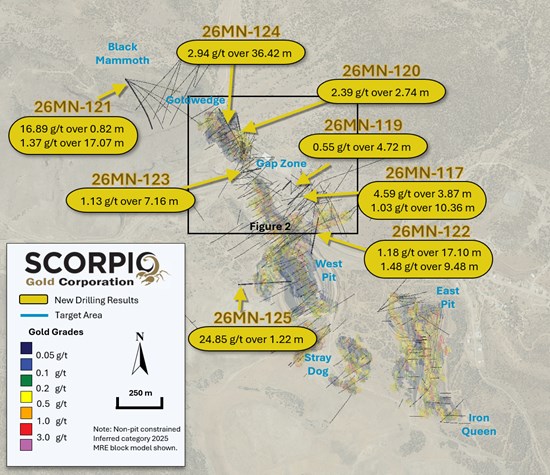
Figure 1: Surface Plan Map of drill holes.
To view an enhanced version of this graphic, please visit:
https://images.newsfilecorp.com/files/9779/318846_d89e9563d47f18f6_002full.jpg
| Drill Hole ID | Target
Azimuth / Dip | From (m) | To (m) | Intercept¹ (m) | Gold (g/t) |
| 26MN-117 | Zanzibar Trend | 40.23 | 50.14 | 9.91 | 0.52 |
| 241 m | 050° / -45° | 74.37 | 78.24 | 3.87 | 4.59 |
| including | 75.07 | 77.11 | 2.04 | 8.40 |
|
| 126.74 | 130.09 | 3.35 | 0.42 |
|
| 152.24 | 161.54 | 9.30 | 0.59 |
|
| 177.24 | 185.93 | 8.69 | 0.28 |
|
| 194.47 | 204.83 | 10.36 | 1.03 |
| 26MN-119 | Zanzibar Trend | 110.80 | 115.52 | 4.72 | 0.55 |
| 261 m | 038° / -75° |
| 26MN-120 | Goldwedge | 111.25 | 121.46 | 10.21 | 0.26 |
| 309 m | 351° / -47° | 151.18 | 153.92 | 2.74 | 2.39 |
| 26MN-121 | Black Mammoth | 157.40 | 164.62 | 7.22 | 0.32 |
| 446 m | 145° / -45° | 180.29 | 184.10 | 3.81 | 0.45 |
|
| 212.75 | 213.57 | 0.82 | 16.89 |
|
| 275.54 | 292.61 | 17.07 | 1.37 |
| including | 289.74 | 290.81 | 1.07 | 17.04 |
|
| 416.35 | 419.25 | 2.90 | 0.28 |
| 26MN-122 | Zanzibar Trend | 47.21 | 64.31 | 17.10 | 1.18 |
| 288 m | 192° / -45° |
| including | 60.66 | 63.25 | 2.59 | 5.58 |
|
| 67.79 | 77.27 | 9.48 | 1.48 |
|
| 87.78 | 94.18 | 6.40 | 0.29 |
|
| 229.27 | 229.88 | 0.61 | 2.03 |
|
| 246.49 | 246.98 | 0.49 | 1.28 |
| 26MN-123 | Goldwedge | 26.22 | 37.19 | 10.97 | 0.19 |
| 154 m | 80° / -45° | 41.76 | 44.81 | 3.05 | 0.71 |
|
| 57.91 | 65.07 | 7.16 | 1.13 |
| 26MN-124 | Goldwedge | 26.98 | 44.14 | 17.16 | 0.37 |
| 415 m | 332° / -50° | 61.87 | 90.83 | 28.96 | 0.37 |
|
| 94.49 | 110.95 | 16.46 | 0.36 |
|
| 115.97 | 134.26 | 18.29 | 0.51 |
|
| 140.21 | 145.60 | 5.39 | 0.26 |
|
| 169.62 | 206.04 | 36.42 | 2.94 |
| including | 188.36 | 192.63 | 4.27 | 19.33 |
|
| 225.95 | 237.62 | 11.67 | 0.39 |
|
| 244.30 | 254.97 | 10.67 | 0.19 |
| 26MN-125 | ICP / Brougher | 103.45 | 113.17 | 9.72 | 0.48 |
| 379 m | 90° / -45° | 126.07 | 142.07 | 16.00 | 0.30 |
|
| 150.88 | 152.10 | 1.22 | 24.85 |
|
| 155.30 | 165.66 | 10.36 | 0.31 |
|
| 169.38 | 186.54 | 17.16 | 0.25 |
|
| 276.30 | 286.36 | 10.06 | 0.21 |
| ¹ Intervals contain no more than 3 continuous metres grading less than 0.1 g/t gold. |
Table 1: Tabulated assay results showing significant intervals of gold mineralization. Note: There is insufficient geological information to estimate a true width for the drill intercepts reported.
Goldwedge Results:
26MN-124: This drill hole contains several significant intercepts (Figure 3) at or above the cutoff grade of the 2025 MRE (0.3 g/t gold), hosted in a structurally complex zone (Figure 2) containing apparently repeated stratigraphic sections through both the Ordovician Zanzibar Formation and Cambrian Gold Hill Formation. Faulted and apparently discontinuous intervals of the Oligocene Volcanics of the Manhattan Caldera are also present within the mineralized zones. The upper intervals of notable gold mineralization are hosted in faulted Zanzibar mudstones and limestones, with gouge-filled structures being common in intervals with stronger gold concentrations. These intervals include:
- 0.37 g/t gold over 17.16 m from 26.98 m
- 0.37 g/t gold over 28.96 m from 61.87 m
- 0.36 g/t gold over 16.46 m from 94.49 m
- 0.51 g/t gold over 18.29 m from 115.97 m
Below these intervals the drill hole encounters heavily altered and brecciated metasediments of the Gold Hill Formation. The highest-grade portion of the drill hole is found within these rocks, representing one of several individual fault planes that make up the larger negative flower structure that has been interpreted at the Goldwedge zone. This interval returned:
- 2.94 g/t gold over 36.42 m from 169.62 m
- including 19.33 g/t gold over 4.27 m from 188.36 m
The highly faulted and brecciated rocks within the flower structure allow for significant fluid flow in this area, creating the high-grade deposit at Goldwedge. Below the highest-grade portion of the drill hole, more Zanzibar Formation limestones are encountered, reinforcing the interpretation of the negative flower structure which allows for younger rocks to be present deeper than the older Gold Hill rocks. Continued faulting and brecciation of the sediments is seen here, and an additional significant interval was encountered which returned:
- 0.39 g/t gold over 11.67 m from 225.95 m
26MN-120: This drill hole encountered less of the structural preparation that was observed in the nearby 26MN-124, and no repeated stratigraphy was encountered. Instead, this drill hole encountered the expected Ordovician Zanzibar mudstones and limestones, then proceeds directly into the volcanic rocks of the Manhattan Caldera without ever encountering the metasediments of the Cambrian Gold Hill Formation. This implies that this drillhole encountered a relatively intact block of country rock that was entrained within and not cut by the structures that comprise the negative flower structure at Goldwedge. Due to this relative lack of crosscutting structure, less gold-bearing fluid has permeated the rock encountered by this drillhole relative to drill hole 26MN-124, and the sole significant intercept returned was:
- 2.39 g/t gold over 2.74 m from 151.18 m
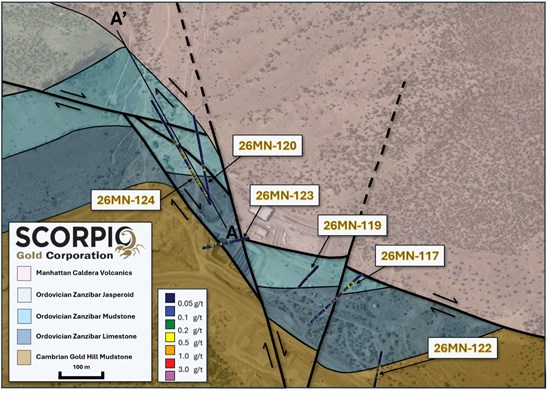
Figure 2: Plan view of complex structural zone around Goldwedge and highlighted drill results. Note that for clarity, only drill holes discussed in text are displayed.
To view an enhanced version of this graphic, please visit:
https://images.newsfilecorp.com/files/9779/318846_d89e9563d47f18f6_003full.jpg
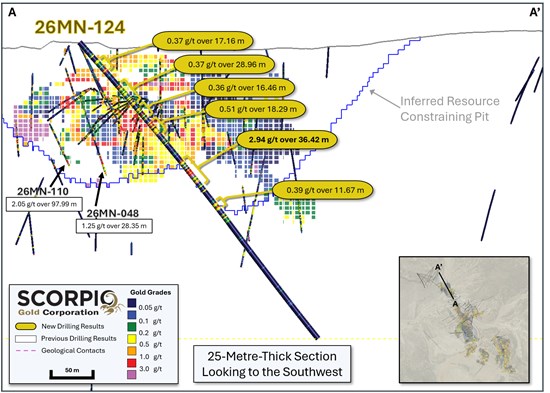
Figure 3: Cross Section along drill hole 26MN-124 with highlighted gold intervals, 2025 Block Model and IRCP outline
To view an enhanced version of this graphic, please visit:
https://images.newsfilecorp.com/files/9779/318846_d89e9563d47f18f6_004full.jpg
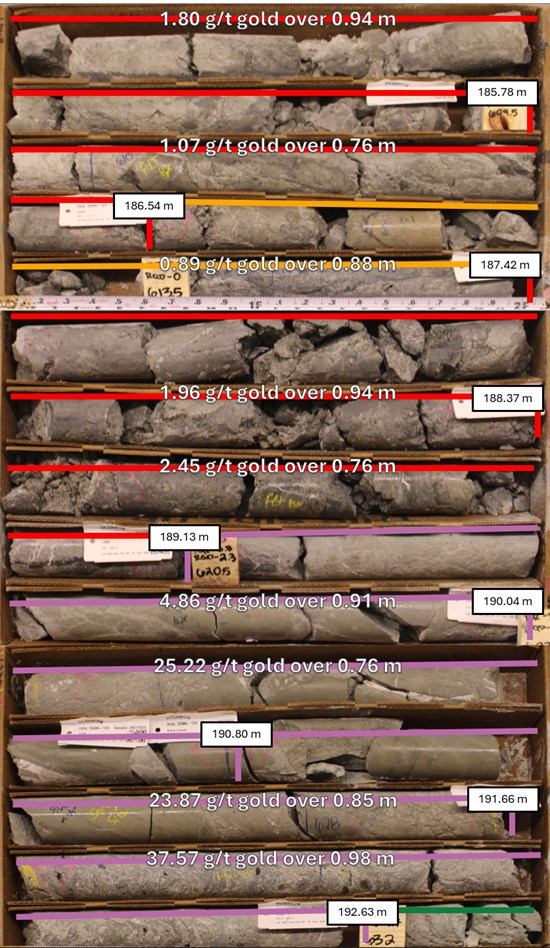
Figure 4: Drill hole 26MN-124, interval 184.83 m to 192.63 showing brecciated Gold Hill Formation and gold grades
To view an enhanced version of this graphic, please visit:
https://images.newsfilecorp.com/files/9779/318846_d89e9563d47f18f6_005full.jpg
Context: Drill holes 26MN-120 and 26MN-124 were both designed as approximate 50 m step-outs along the projected Reliance Fault from high grade gold intercepted in drill hole 26MN-091, within the Manhattan Caldera Volcanics. Recent drilling at Goldwedge, including the results herein, has demonstrated consistent gold grades, especially in the Paleozoic sediments of the Ordovician Zanzibar Formation and in the underlying Cambrian Gold Hill Formation, located in the structurally well-prepared hanging wall of the Reliance Fault. The Reliance Fault is considered one of the main fluid pathways capable of delivering gold-rich fluids to the prospective host rocks in the Goldwedge area. Additionally, recent results have proven that the Manhattan Caldera Volcanics can likewise host lower grade envelopes around high grade feeder structures. Consistent gold mineralization at Goldwedge is demonstrated by the following previously reported intercepts:
The Gap Zone Results
26MN-123: Drill hole 26MN-123 was designed as an up-dip step-out approximately 50 m from drill hole 25MN-041 along the Reliance Fault which in this area separates the Paleozoic sedimentary package from the Manhattan Caldera Volcanics. This drillhole encountered anomalous gold mineralization throughout the upper portion of Gold Hill Formation meta-mudstones, especially near the brecciated marble units. The most significant mineralization encountered in this hole is found in a heavily faulted zone of Zanzibar limestones and mudstones, with lenses of competent rock surrounded by gouge and zones of low recovery, representing lithons entrained within the larger structural zone.
- 1.13 g/t gold over 7.16 m from 57.91 m
Context: The Gap Zone is the previously undrilled area that connects Goldwedge to the Reliance Trend and ultimately, the historic West Pit. Mineralization is hosted entirely within the meta-sediments of the Gold Hill Formation or in brecciated limestone of the Zanzibar Formation and is dominantly controlled by veins and structures related to the steeply dipping Reliance Fault. The Gap Zone lies near the complex structural zone that defines the southern end of the negative flower structure that has been interpreted at the Goldwedge area. First tested in early 2025, significant mineralization at the Gap Zone includes:
Zanzibar Trend Results:
26MN-117: Drill hole 26MN-117 was designed as an approximate 50 m step out from both 26MN-080 and 26MN-097, testing the multiple mineralization controls previously identified at the Zanzibar Trend like bedding parallel dissolution vugs and sub-vertical veins and faults running generally parallel to the major fault zone separating the Paleozoic sediments from the Oligocene aged volcanics of the Manhattan Caldera. This drillhole also crosses the sub-vertical Brougher Fault which has apparent controls on mineralization where it intersects the primary controls. Mineralized intervals within this drill hole are found straddling the Ordovician Zanzibar and Cambrian Gold Hill Formation contact, as well as throughout the Gold Hill Formation in veins and sub-vertical structures healed by quartz and sulfide. Notable intervals of gold mineralization include:
- 0.52 g/t gold over 9.91 m from 40.23 m
- 4.59 g/t gold over 3.87 m from 74.37 m
- 0.59 g/t gold over 9.30 m from 152.24 m
The deepest encountered significant gold mineralization in this drill hole is found along the major structure (the Pemba Fault) separating the sedimentary rocks from the volcanic rocks of the Manhattan Caldera. The Pemba Fault is continuously mineralized along strike for at least 400 metres at the Zanzibar Trend, and locally along dip from surface to a depth of at least 250 metres. Drill hole 26MN-117 steps out approximately 40 meters vertically down-dip along the Pemba Fault from drill hole 26MN-080 (See Press Release Here), where it encountered:
- 1.03 g/t gold over 10.36 m from 194.47 m
26MN-119: Testing the western extension of the Zanzibar Trend, drill hole 26MN-119 was designed targeting a gap along the Pemba Fault between drill holes 26MN-093 (approximately 50 m up-dip) and 26MN-085 (approximately 65 m down-dip). Detectable gold mineralization was encountered along the Pemba Fault, however it is not considered significant at this time. Significant mineralization was encountered further up-hole within the Zanzibar limestone unit where it was weakly brecciated, with some zones of fault gouge present. Drill hole 26MN-119 returned:
- 0.55 g/t gold over 4.72 m from 110.80 m
26MN-122: This drill hole is collared at the Zanzibar Trend area but is targeting high-grade mineralization from historic drilling at Mustang Hill, and continues towards the West Pit. Familiar stratigraphy of the Ordovician Zanzibar limestone transitioning to the Gold Hill meta-mudstones and meta-siltstones is encountered at the top of the hole. The White Caps marble unit is encountered high in the Gold Hill portion of the sediments, and near the bottom of this unit the first significant gold mineralization is reported. The technical team at Scorpio believes that the strong rheological contrast between the marble and the surrounding meta-mudstones allows for a preferred stratigraphic horizon to host gold mineralization, and drill hole 26MN-122 is another example of this observation; straddling the marble to meta-mudstone contact is the following interval:
- 1.18 g/t gold over 17.10 m from 47.21 m
- Including 5.58 g/t gold over 2.59 m from 60.66 m
Following this interval is a zone of moderately clay altered meta-sediments, and then another zone of weak silicification and epithermal stringer veins with drusy quartz returning:
- 1.48 g/t gold over 9.48 m from 67.79 m
The balance of the hole is comprised of weakly altered meta-sediments of the Gold Hill Formation, though several small zones of quartz and sulfide healed breccias are moderately mineralized with gold:
- 2.03 g/t gold over 0.61 m from 229.27 m
- 1.28 g/t gold over 0.49 m from 246.49 m
Context: The Zanzibar Trend is the previously underexplored area between Mustang Hill and Goldwedge along the faulted contact of the Paleozoic meta-sediments and the Oligocene aged volcanics of the Manhattan Caldera. High grade gold mineralization is encountered along two main controlling features: sub-vertical structures parallel to the main contact fault, and along gently to moderately dipping bedding planes primarily in the Cambrian Gold Hill Formation. All drillholes reported herein attempt to extend known mineralization by stepping out approximately 50 m from previous drilling along interpreted ore controlling features such as preferred bedding planes or sub-vertical structures. The results reported herein add to the significant mineralization encountered along the Zanzibar Trend, including:
Black Mammoth Results:
26MN-121: Stepping out approximately 50 metres to the west of drill hole 26MN-092, drill hole 26MN-121 was designed to test the extent of gold mineralization along the Black Mammoth Fault and along stratigraphic horizons near the upper and lower contacts of the limestone member of the Ordovician Zanzibar Formation. The limestone is overlain by variably siliceous mudstone of the Zanzibar Formation and underlain by phyllitic meta-mudstone of the Cambrian Gold Hill Formation. The strong rheological contrast across these contacts partitioned strain during pre-mineral contractional deformation, producing brecciation and fracture permeability within the chemically reactive limestone. The much younger gold-bearing fluids, potentially fed by the Black Mammoth Fault, exploited these zones, while the bounding low-permeability mudstones helped confine fluid flow along the contacts. While anomalous gold was detected around the Black Mammoth Fault, the significantly mineralized intervals were found along the brecciated and hydrothermally cemented upper and lower contacts of the limestone member of the Zanzibar Formation and locally within variably oxidized quartz and sulfide cemented breccias that crosscut the stratigraphy:
- 0.32 g/t gold over 7.22 m from 157.4 m
- 0.45 g/t gold over 3.81 m from 180.29 m
- 16.89 g/t gold over 0.82 m from 212.75 m
- 1.37 g/t gold over 17.07 m from 275.54 m
- Including 17.04 g/t gold over 1.07 m from 289.74 m
Context: Black Mammoth is a ~200+ m step-out from Goldwedge. Significant gold mineralization can be found within the Ordovician Zanzibar sediments along structures related to the Black Mammoth Fault, and on both sides of the major fault defining the contact between the Paleozoic sediments and the Oligocene aged volcanics of the Manhattan Caldera. Drill hole 26MN-121 is an approximate 50 m step-out along strike from significant mineralization encountered within drill hole 26MN-092 within the Zanzibar Formation. Significant mineralization encountered at Black Mammoth includes:
West Pit Results:
26MN-125: On the Northwestern corner of the West Pit two major faults converge to create a damage zone with increased porosity relative to the country rock, making a preferential pathway for ascending gold-bearing fluids. The confluence of the Brougher Fault and the Nellie Gray Fault has a small set of drill holes around it that contain high-grade gold intervals, and drill hole 26MN-125 was designed to step out approximately 50 metres below the existing drill holes to test for gold mineralization in a potential "feeder" zone following one or both of these structures. The drill hole was successful in encountering significant gold mineralization between the two modeled structures, where the Cambrian Gold Hill meta-sediments have been variably brecciated and crosscut by quartz/carbonate veins:
- 0.48 g/t gold over 9.72 m from 103.45 m
- 0.30 g/t gold over 16.00 m from 126.07 m
- 24.85 g/t gold over 1.22 m from 150.88 m
- 0.31 g/t gold over 10.36 m from 155.30 m
Context: The West Pit was mined by various operators throughout the 1980s but significant gold mineralization remains near and around the pit. The prominent Brougher Fault cuts through the northwestern corner of the pit and the Nellie Gray Fault strikes generally North/South just to the west side of the pit. The confluence of these structural zones focused the gold-bearing fluids to create an apparent high-grade ore shoot at the western edge of the West Pit. Drill hole 26MN-125 was designed to test the down-plunge extension of this ore shoot, as well as deeper mineralization that is continuous with the bedding-parallel mineralization found throughout the West Pit on the hanging wall of the Little Gray Fault.
All 2026 drill holes tested within and beyond the Inferred Resource Constraining Pit ("IRCP"), targeting new mineralization outside of the 2025 MRE block model, see Figure 3. For further details see "Mineral Resource Estimate and NI 43-101 Technical Report, Manhattan Property, Nye County, Nevada" dated October 23, 2025, with an effective date of June 4, 2025, on Scorpio Gold's website at Technical Report.
QA/QC
HQ sized diamond drill core samples were cut in halves, then bagged and secured with security tags to ensure integrity during transportation to the Elko, NV, MSALABS facility for preparation. For quality assurance ("QA"), unmarked coarse blanks, unmarked certified reference materials, and requested laboratory duplicates were inserted into the sampling sequence. QA samples were systematically inserted into each batch of samples, amounting to approximately 10% of the run of samples. Samples were analyzed for gold using a two-cycle PhotonAssay™ analysis method (~500 g) of crushed material (70% passing 2 mm). All MSALABS facilities comply with ISO 17025:2017.
About the Manhattan District
Manhattan, located in the Walker Lane Trend of Nevada, USA, is road accessible and lies approximately 20 kilometers south of the operating Round Mountain Gold Mine (https://www.kinross.com/operations/default.aspx#americas-roundmountain), which has produced more than 15 million ounces of gold (past-production is cited solely for geological context, see third note, below). For the first time, the Company has consolidated Manhattan's past-producing mines under a single entity that holds valuable permitting and water rights. Historically, Manhattan has produced approximately 700,000 ounces of gold from high-grade placer and lode operations dating from the late 1890s through to the mid-2000s.¹ The maiden mineral resource estimate (the "Maiden MRE") covering the Goldwedge and Manhattan Pit areas of Manhattan is comprised of 18,343,000 tonnes grading 1.26 g/t gold for a total of 740,000 oz contained gold in the inferred category.² Inferred resources have a significant amount of uncertainty as to their existence and as to their economic feasibility. It cannot be assumed that all or any part will be upgraded to a higher category. They are not mineral reserves and have not demonstrated economic viability.
Notes
- Adjacent Properties: The Company has no interest in, or rights to, any of the adjacent properties mentioned, including the Round Mountain Gold Mine, and exploration results on adjacent properties are not necessarily indicative of mineralization on the Company's properties. Any references to exploration results on adjacent properties are provided for information only and do not imply any certainty of achieving similar results on the Company's properties.
- Historical Data: This news release includes historical information that has been reviewed by the Company's qualified person. The Company's review of the historical records and information reasonably substantiate the validity of the information presented in this presentation. The Company encourages readers to exercise appropriate caution when evaluating these data and/or results.
- Third-Party Mineral Projects: These deposits are cited solely for geological context. The Company cautions that these properties are not necessarily adjacent to, nor does the Company or have any interest in or control over them. Although certain geological features may be similar, there is no assurance that mineralization comparable to these deposits will be discovered on any of the Company's properties. Information regarding the aforementioned deposits is taken from publicly available sources and technical reports believed to be reliable but has not been independently verified by the Company. The Company encourages readers to exercise appropriate caution when evaluating these data and/or results.
- Mineral Resource Estimate (MRE): All scientific and technical information relating to Manhattan pertaining to Maiden MRE contained in this news release is derived from the Technical Report dated June 4, 2025 (with an effective date of June 4, 2025) titled "Mineral Resource Estimate and NI 43-101 Technical Report" (the "Technical Report") prepared by Matthew R. Dumala, P.Eng (BC) of Archer Cathro Geological (US) Ltd., Patrick Loury, M.Sc., CPG (AIPG) of Daniel Kunz & Associates, Annaliese Miller, LG (WA) of Geosyntec Consultants, Inc. and Art Ibrado, PhD, PE (AZ) of Fort Lowell Consulting PPLC. The information contained herein in respect of the Maiden MRE is subject to all of the assumptions, qualifications and procedures set out in the Technical Report and reference should be made to the full text of the Technical Report, a copy of which has been filed with the applicable securities regulators and is available under the Company's profile on www.sedarplus.ca.
- References: (1) Strachan, D. G., and Master, T. D., 2005: Update and Revision of the Gold Wedge Project Development, Nye County. Report prepared for Nevada; Royal Standard Minerals, Inc. and dated March 31, 2005; (2) Dumala, M. R., and Loury, P., 2025: Mineral Resource Estimate and NI 43-101 Technical Report, Manhattan Property, Nye County, Nevada. Report prepared for Scorpio Gold Corporation and dated October 23, 2025 (with an effective date of June 4, 2025).
Qualified Person
The scientific and technical information in this news release has been reviewed, verified and approved by Leo Hathaway, P. Geo., Executive Technical Director of Scorpio Gold, a "Qualified Person", as defined under National Instrument 43-101 Standards of Disclosure for Mineral Projects. Verification included review of laboratory certificates, review of field logs and chain-of-custody records, inspection of blank/standard/duplicate performance, and sample nature and location. No limitations or failures to verify were identified.
About Scorpio Gold Corp.
Scorpio Gold holds a 100% interest in the Manhattan District located in the Walker Lane Trend of Nevada, USA. Scorpio Gold's Manhattan District is ~4,780-hectares and comprises the advanced exploration-stage Goldwedge Mine, and four past-producing pits that were acquired from Kinross in 2021 (see news release dated March 25, 2021 https://scorpiogold.com/news/scorpio-gold-closes-purchase-of-kinross-manhattan-property-nye-county-nevada/). The consolidated Manhattan District presents an exciting late-stage exploration opportunity, with over 140,000 metres of historical drilling, significant resource potential, and valuable permitting and water rights.
Neither the TSX Venture Exchange nor its Regulation Services Provider (as that term is defined in the policies of the Exchange) accepts responsibility for the adequacy or accuracy of this release.
Forward-Looking Statements
This news release contains statements that constitute "forward-looking statements" or "forward-looking information" within the meaning of applicable securities laws (collectively, "forward-looking statements"). Such forward-looking statements involve known and unknown risks, uncertainties and other factors that may cause the Company's actual results, performance or achievements, or developments to differ materially from the anticipated results, performance or achievements expressed or implied by such forward-looking statements. Forward-looking statements are statements that are not historical facts and are generally, but not always, identified by the words "expects," "plans," "anticipates," "believes," "intends," "estimates," "projects," "potential" and similar expressions, or that events or conditions "will," "would," "may," "could" or "should" occur. Forward-looking statements are based on the beliefs, estimates and opinions of the Company's management as of the date of this news release.
Forward-looking statements in this news release include, among others, statements relating to: the mobilization of a diamond core drill to the April Fool Target this week and the commencement and completion of the first-ever drill test of the April Fool Target; the expected timing of assay results from the April Fool drill program, including the Company's expectation that results from the first drill hole will be received by the end of October 2026 and that assay results will be received within approximately four weeks of drill hole completion; the design and objectives of the April Fool drill holes, including their ability to test the vertical extent and continuity of mineralization and the bedding-parallel and fault-controlled controls on mineralization interpreted at surface; the Company's interpretation of the geological setting of the April Fool Target and its similarity to the Zanzibar Trend, and the potential for that geological setting to host gold mineralization of comparable continuity, grade or extent beneath the historic workings; the Company's belief that gold mineralization not targeted by historical miners may remain at the April Fool Target; the potential for the April Fool Target to represent a new growth front or a near-term catalyst for the Company; the Company's interpretation of the structural controls on mineralization within the Manhattan District and the application of that interpretation to other target areas; the Company's ongoing exploration plans, priorities and objectives at the Manhattan Project, including resource expansion; the anticipated timing of future disclosures and announcements; and other statements that are not historical facts. In making the forward-looking statements in this news release, the Company has applied several material assumptions, including: that the drill contractor, equipment and qualified personnel will be available and able to mobilize to and operate at the April Fool Target on the anticipated schedule; that weather, ground conditions and access will permit drilling to proceed as planned; that the analytical laboratory will process and report assays within its expected turnaround times; that the Company will be able to obtain sufficient financing to complete planned exploration activities; that the Company will be able to obtain and maintain necessary permits and regulatory approvals in a timely manner; that exploration results will be consistent with management's expectations; that general business and economic conditions will not change in a materially adverse manner; and that the Company's interpretations of geological data, including the analogy drawn between the April Fool Target and the Zanzibar Trend, are accurate. By their nature, forward-looking statements involve known and unknown risks, uncertainties and other factors which may cause our actual results, performance or achievements, or other future events, to be materially different from any future results, performance or achievements expressed or implied by such forward-looking statements. Such factors and risks include, among others: delays in drill mobilization or drilling due to contractor, equipment, personnel, weather, access or ground condition issues; delays in laboratory processing or reporting of assay results; the risk that drill results at April Fool do not confirm the mineralization, continuity or geological interpretation indicated by surface mapping and selective rock chip and grab sampling, which are by their nature not representative of the grade, width or continuity of mineralization; the limited quality control applied to the surface samples reported in this news release; the Company may require additional financing from time to time in order to continue its operations, which may not be available when needed or on acceptable terms and conditions; the inherent risks involved in the exploration and development of mineral properties, including uncertainties related to the interpretation of drill results and other geological data; fluctuations in commodity prices; compliance with extensive government regulation and changes in domestic and foreign laws and regulations that could adversely affect the Company's business and results of operations; uncertainties related to obtaining necessary permits and regulatory approvals; risks related to the Company's ability to retain key personnel; environmental risks and hazards; title matters and surface rights issues; competition in the mining industry; the stock markets have experienced volatility that often has been unrelated to the performance of companies and these fluctuations may adversely affect the price of the Company's securities, regardless of its operating performance; and other risks and uncertainties disclosed in the Company's public filings.
The forward-looking information contained in this news release represents the expectations of the Company as of the date of this news release and, accordingly, is subject to change after such date. Readers should not place undue importance on forward-looking information and should not rely upon this information as of any other date. The Company undertakes no obligation to update these forward-looking statements in the event that management's beliefs, estimates or opinions, or other factors, should change.

To view the source version of this press release, please visit https://www.newsfilecorp.com/release/318846

© 2026 Canjex Publishing Ltd. All rights reserved.