VANCOUVER, BC, Aug. 26, 2026 /CNW/ -- Vizsla Copper Corp. (TSXV: VCU) (OTCQB: VCUFF) (FRANKFURT: 97E0) ("Vizsla Copper" or the "Company") is pleased to announce initial drill results from its recently completed summer 2026 drill program at the Woodjam Project located in central British Columbia.
Copper mineralization intersected in drill hole DH26-136 at the Deerhorn deposit represents, to the Company's knowledge based on its review of historical and current drilling records, the longest high-grade copper intersection drilled to date at the Woodjam project.
HIGHLIGHTS
Drill hole DH26-136 evaluated the eastern portion of the Deerhorn deposit and intersected two main intervals of strong porphyry-related mineralization:
- A lower interval of significant high-grade copper mineralization:
- 266.0 meters of 0.97% Cu, 0.06 g/t Au, and 4.29 g/t Ag from 306.0 meters down hole, including
- 107.7 meters of 2.01% Cu, 0.13 g/t Au, and 8.61 g/t Ag from 320.5 meters down hole, including
- 48.5 meters of 3.32% Cu, 0.23 g/t Au, and 16.59 g/t Ag from 320.5 meters down hole.
- A near-surface, broad interval of copper-gold mineralization:
- 129.9 meters of 0.30% Cu, 0.21 g/t Au, and 0.94 g/t Ag from 70.1 meters down hole, including
- 50.0 meters of 0.46% Cu, 0.40 g/t Au, and 1.43 g/t Ag from 150.0 meters down hole.
- Follow-up drill planning underway: A program of core-relogging and subsequent 3D modeling of all historical drill core from the eastern Deerhorn area will commence once all pending assays are returned. This focused geological and structural model will inform follow-up drilling aimed at evaluating the potential extent and continuity of this emerging zone of high-grade copper mineralization.
- Drilling at the Poplar and Palmer projects is ongoing: Two drill rigs are currently operating at each project and evaluating priority copper targets. Assay results remain pending from Palmer due to extended laboratory turnaround times; however, results are expected in the coming weeks.
"In addition to high-grade massive sulphide copper hits at the Palmer project in Alaska and long intervals of near-surface porphyry-related copper mineralization at our Thira discovery at the Poplar project in BC, we've also now drilled a strong copper-gold intersection at the Deerhorn deposit at our Woodjam project" commented Craig Parry, Executive Chair and CEO. "These results highlight the depth of our copper project portfolio, and we look forward to reporting additional results as we advance our drill programs in Alaska and at the Thira discovery."
"Drilling at the Deerhorn deposit continues to improve our understanding of the porphyry-related copper-gold system, with these results representing the strongest mineralization we have encountered at the project to date" commented Steve Blower, VP Exploration. "These results suggest that the high-grade component of the system may be more extensive than previously recognized and provide further insight into the geometry and distribution of mineralization. Follow-up drilling will focus on this very high-grade zone and its potential extensions."
Emerging High-Grade Copper Zone at Deerhorn
The recently completed, 6,055 meter, 11-hole drill program at the Woodjam project in central BC (Figure 1) included three drill holes at the Deerhorn deposit (DH26-134, DH26-136 and DH26-137). The drill holes evaluated the extent and grade continuity of mineralization hosted within a historical inferred mineral estimate of 32.8 million tonnes of 0.22% copper and 0.49 g/t gold1. The Deerhorn estimate is a historical estimate within the meaning of National Instrument 43-101 – Standards of Disclosure for Mineral Projects. A Qualified Person has not done sufficient work to classify the Deerhorn historical estimate as a current mineral resource or mineral reserve, and Vizsla Copper is not treating the Deerhorn historical estimate as a current mineral resource or mineral reserve. Mineral resources are not mineral reserves and do not have demonstrated economic viability.
Drill hole DH26-134 targeted the southwest extent of gold-rich mineralization on the western side of the deposit (results are pending), whereas drill holes DH26-136 and DH26-137 targeted high-grade copper mineralization on the eastern side of the deposit (results are pending for DH26-137, Figures 2 and 3). Results from eight additional holes drilled at the Three Firs and Great Plains targets also remain pending.
Drill hole DH26-136 evaluated the lateral and vertical extents and structural/lithological controls on high-grade porphyry-related copper mineralization intersected in two 2012 drill holes. The hole was drilled steeply to the southwest and returned two long intervals of porphyry-related copper-gold mineralization (Figure 3). The upper interval yielded 129.9 meters of 0.30% Cu, 0.21 g/t Au and 0.94 g/t Ag (Table 1) from 70.1 meters down hole, including 50.0 meters of 0.46% Cu, 0.40 g/t Au and 1.43 g/t Ag (Table 1) from 150.0 meters down hole. Mineralization in this upper interval consists of quartz-chalcopyrite stockwork cutting potassically altered monzonite (Figure 4a). The base of the interval appears to be fault controlled. The lower, high-grade copper zone returned 266.0 meters of 0.97% Cu, 0.06 g/t Au, and 4.29 g/t Ag (Table 1) from 306.0 meters down hole, including 107.7 meters of 2.01% Cu, 0.13 g/t Au, and 8.61 g/t Ag, (Table 1) from 320.5 meters down hole. This subinterval contains 48.5 meters of 3.32% Cu, 0.23 g/t Au and 16.59 g/t Ag (Table 1) from 320.5 meters down hole. Mineralization in the high-grade zone consists of quartz-chalcopyrite veins and stock-work zones grading into semi-massive chalcopyrite and quartz-chalcopyrite breccias (Figure 4b and 4c). The zone is faulted and locally sheared near a lower contact with fine-grained volcanics. Here, copper mineralization consists of strongly disseminated chalcopyrite and local clotted chalcopyrite associated with quartz veins and lesser stockwork.
Drill hole DH26-136 intersected copper mineralization approximately 100 meters below the modelled area of the Deerhorn historical mineral resource estimate1, further defined a broad zone of near-surface copper-gold mineralization in an area with limited historical drilling and identified an area of high-grade copper mineralization which remains open in multiple directions. This emerging target area warrants follow-up drilling.
Next Steps
Once results from drill hole DH26-137 are returned, a program of core relogging focused on all historical drill holes from the eastern portion of the Deerhorn deposit will commence. The goal of the relogging program will be to develop a new geological and structural model for the emerging high-grade zone. This model will inform follow-up drilling.
Table 1. Assay Results for Drill hole DH26-136
Hole ID | From (m) | To (m) | Interval (m) | Cu (%) | Au (g/t) | Ag (g/t) | CuEq* (%) |
DH26-136 | 70.10 | 200.00 | 129.90 | 0.30 | 0.21 | 0.94 | 0.48 |
including | 150.00 | 200.00 | 50.00 | 0.46 | 0.40 | 1.43 | 0.79 |
and | 306.00 | 572.00 | 266.00 | 0.97 | 0.06 | 4.29 | 1.05 |
including | 320.50 | 428.20 | 107.70 | 2.01 | 0.13 | 8.61 | 2.19 |
including | 320.50 | 369.00 | 48.50 | 3.32 | 0.23 | 16.59 | 3.66 |
including | 320.50 | 342.00 | 21.50 | 5.63 | 0.40 | 22.56 | 6.16 |
*Copper equivalent (CuEq) values are provided for illustrative purposes only to express the combined value of copper, gold and silver relative to copper. CuEq values were calculated using metal prices of US$4.00/lb Cu, US$2,500/oz Au and US$25/oz Ag, and metallurgical recovery assumptions of 64% Cu, 56% Au and 65% Ag. Limited metallurgical test work has been completed on Deerhorn drill core. Copper and gold recovery assumptions are based on 2011 and 2012 studies from drill core from three drill holes, and the silver recovery assumption is conceptual. CuEq values are not intended to represent actual recoveries or payable metal. The formula used was: CuEq (%) = Cu (%) + [(Au g/t × Au recovery × Au price US$/oz ÷ 31.1035) ÷ (Cu recovery × Cu price US$/lb × 22.0462)] + [(Ag g/t × Ag recovery × Ag price US$/oz ÷ 31.1035) ÷ (Cu recovery × Cu price US$/lb × 22.0462)]. Composite intervals are calculated using length-weighted averages above cut-off grades of 0.1%, 0.2%, 0.4%, 1.0% Cu, and 2% with up to 10 metres of internal dilution. Reported intervals are downhole core lengths. True thickness of the bulk-tonnage style, stockwork-hosted mineralization is unknown. |
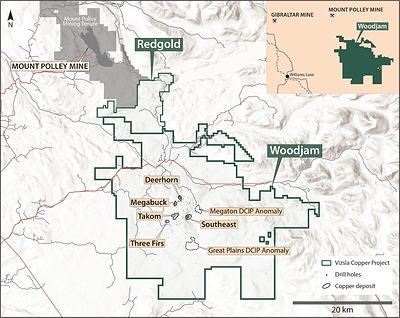
Figure 1. Map showing the location of Vizsla Copper's Woodjam and Redgold projects in relation to Imperial Metals' Mount Polley mine. Priority exploration targets at Woodjam, including the Deerhorn deposit, are also shown. Mineralization at Mount Polley or other nearby or regional mineral projects is not necessarily indicative of mineralization at the Woodjam Project or the Redgold Project.
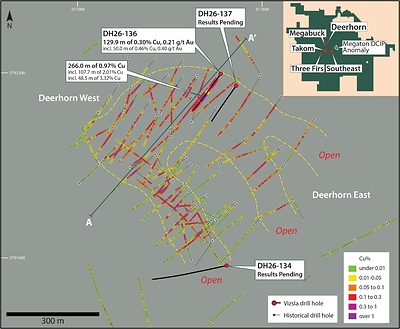
Figure 2. Map of the Deerhorn deposit showing the location of all previous drill holes and drill hole DH26-136. Assay results for drill holes DH26-134 and DH26-137 are pending. Section line for Figure 3 is shown. See references1,2 below for sources of historical drill data. Historical drill data shown in this figure were completed by prior operators and have not been independently verified by Vizsla Copper except as expressly stated. Vizsla Copper considers this historical information relevant for geological context and exploration planning purposes, but readers should not place undue reliance on historical information.
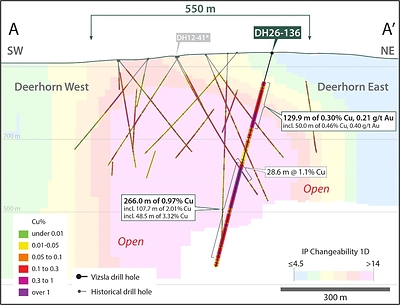
Figure 3. Northeast-southwest (A-A') section (100m wide) through the Deerhorn deposit showing copper assays down hole for drill hole DH26-136 and all historic drill holes. The 3D IP chargeability voxel model is shown. See references1,2 below for sources of historical drill data. Historical drill data shown in this figure were completed by prior operators and have not been independently verified by Vizsla Copper except as expressly stated. Vizsla Copper considers this historical information relevant for geological context and exploration planning purposes, but readers should not place undue reliance on historical information.
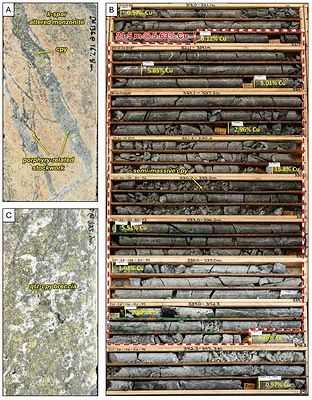
Figure 4. Core photos of DH26-136. A. Example of quartz-chalcopyrite stockwork cutting k-feldspar altered monzonite from the upper copper-gold zone (Table 1) at 167.8 meters downhole, B. Box photos showing drill core from 318.0 meters to 345.3 meters down hole which includes a high-grade interval of 21.5 meters of 5.63% Cu (Table 1). Individual down hole copper assay results are annotated at the sample depths to illustrate the distribution of copper grades within the interval. The interval consists of chalcopyrite-quartz stockwork and breccias and semi-massive chalcopyrite, C. Quartz-chalcopyrite breccia at 325.7 meters downhole. Abbreviations: Cu = copper, qtz = quartz, cpy = chalcopyrite, k-spar = potassium feldspar. Photographs of drill core are provided for illustrative purposes only. Visual estimates of mineralization are inherently imprecise and may not accurately reflect true grade. Readers are cautioned that photographic representations of mineralization should not be relied upon as a substitute for analytical assay results and do not represent the average grade of any sample interval.
Table 2. Collar information for drill hole DH26-136
Hole ID | Easting^ | Northing^ | Elevation (m) | Azimuth | Dip | Depth (m) |
DH26-136 | 611471 | 5792214 | 937 | 215 | -75 | 597 |
Sampling, Chain of Custody, Quality Assurance and Quality Control
All drill core analytical results have been monitored through the Company's quality assurance and quality control program (QA/QC). Drill core was sawn in half at Vizsla Copper's dedicated and secure core logging and processing facility near Horsefly, BC.
Half of the drill core was sampled and shipped by a bonded courier in sealed and secured woven polyester bags to the ALS Global preparation facilities in Kamloops, BC. Core samples were prepared using ALS standard preparation procedure PREP-31A which involves crushing the sample to 70% less than 2mm, followed by a riffle split of 250g, and then a pulverised split to better than 85% passing 75 microns.
Following sample preparation, the pulps were sent to the ALS Global analytical laboratory in North Vancouver, BC for analysis. ALS Global is registered to ISO/IEC 17025:2017 accreditations for laboratory procedures.
Drill core samples were analyzed for 48 elements, including Cu and Ag by ICP-MS on a 0.25-gram aliquot using a four-acid digestion (method ME-MS61). Overlimit samples (>10,000 ppm Cu) were re-analyzed using an ore-grade, four-acid digestion and ICP-AES finish (method ME-OG62). Gold was analyzed by fire assay on a 30-gram aliquot with an AES finish (inductively coupled plasma atomic emission spectroscopy - method Au-ICP21).
In addition to ALS Global laboratory QA/QC protocols, Vizsla Copper implements a rigorous internal QA/QC program that includes the insertion of field and lab duplicates, certified reference materials (standards prepared by an independent lab) and blanks into the sample stream. Data verification of the analytical results includes a statistical analysis of the QA/QC data. Results are considered acceptable.
About Vizsla Copper
Vizsla Copper is a critical-minerals focused exploration and development company headquartered in Vancouver, Canada. The Company is primarily focused on its Palmer VMS project in Southeast Alaska, and its Poplar and Woodjam porphyry-related projects in British Columbia.
All of the Company's projects are well situated amongst significant infrastructure. The Company's growth strategy is focused on the exploration and development of the properties within its portfolio in addition to value-accretive acquisitions. Vizsla Copper's vision is to be a responsible copper explorer and developer in stable mining jurisdictions, and it is committed to socially responsible exploration and development, working safely, ethically, and with integrity.
Vizsla Copper is backed by Inventa Capital Corp., a premier investment group founded in 2017 with the goal of discovering and funding opportunities in the resource sector.
Additional information about the Company is available on SEDAR+ (www.sedarplus.ca) and the Company's website (www.vizslacopper.com).
Qualified Person and National Instrument 43-101 Disclosure
The scientific and technical information in this press release has been reviewed and approved by Christopher Leslie, Ph.D., P.Geo., Technical Advisor for Vizsla Copper, who is a Qualified Person as defined under the terms of National Instrument 43-101 - Standards of Disclosure for Mineral Projects.
Certain scientific and technical information in this news release, including historical exploration results, historical drilling information and historical estimates, is historical in nature and has been compiled from prior reports and public disclosure prepared by previous property owners and operators. Except as expressly stated, such information has not been independently verified by Vizsla Copper. Vizsla Copper considers this information relevant for geological context and exploration planning purposes, but readers should not place undue reliance on historical information.
References
- Lomas, S. (2022), NI43-101 Technical Report for the Woodjam Property Horsefly, British Columbia, Canada, https://sedarplus.ca
- NI 43-101 Technical Report for 2012 Activities on the Woodjam North Property, Cariboo Mining Division, British Columbia", prepared by Ross Sherlock, PhD., P.Geo., Gold Fields Canada Exploration BV, Jacqueline Blackwell, Ph. D., P. Geo., Gold Fields Canada Exploration BV and Twila Skinner, P.Geo., Gold Fields Canada Exploration BV, prepared for the Former JV Partner and WCC with an effective date of May 15, 2013. The Historical Estimate on the Deerhorn deposit (the "Deerhorn Historical Estimate") was completed by Brian Wolfe (MAIG), Principal Resource Geologist, Gold Fields Australasia Pty. Ltd. with an effective date of May 15, 2013. The Deerhorn Historical Estimate was prepared with localized multivariate uniform conditioning, with a cutoff grade of US$8.60/t. The NSR calculation uses US$1,650/oz Au, US$3.90/lb Cu and recoveries of 56% Au and 64% Cu. The Deerhorn Historical Estimate was reported within a modelled open pit shell based on a price assumption of US$1,650/oz Au and US$3.90/lb Cu.
The Historical Estimates are considered historical in nature and are based on prior data and reports prepared by previous property owners. Readers are cautioned not to treat them, or any part of them, as current mineral resources or mineral reserves. Vizsla Copper considers the Historical Estimates relevant because they provide information regarding mineralization identified at the Woodjam Project and assist in guiding exploration planning. Vizsla Copper considers the Historical Estimates reliable for these limited purposes because they were prepared by qualified professionals using drilling and sampling information collected using methods available at the time. However, Vizsla Copper has not independently verified the Historical Estimates and readers should not rely on them as current mineral resources or mineral reserves. Additional work required to verify or upgrade the Historical Estimates as current mineral resources may include, as applicable, data compilation, confirmation drilling, resampling, data verification, verification of historical drill hole locations and survey data, review and validation of historical QA/QC data, density verification, updated geological modelling, a site visit by a Qualified Person and preparation of a current mineral resource estimate and technical report in accordance with NI 43-101. A Qualified Person has not done sufficient work to classify the Historical Estimates as current mineral resources or mineral reserves, and Vizsla Copper is not treating the Historical Estimates as current mineral resources or mineral reserves.
There can be no assurance that any of the historical mineral resources, in whole or in part, will ever become economically viable. In addition, mineral resources are not mineral reserves and do not have demonstrated economic viability.Even if classified as a current resource, there is no certainty as to whether further exploration will result in any inferred mineral resources being upgraded to an indicated or measured mineral resource category. The Historical Estimates relating to inferred mineral resources were calculated using prior mining industry standard definitions and practices for estimating mineral resources and mineral reserves. Such prior definitions and practices were utilized prior to the implementation of the current standards of the Canadian Institute of Mining for mineral resource estimation, and have a lower level of confidence.
Neither the TSX Venture Exchange nor its Regulation Services Provider (as that term is defined in the policies of the TSX Venture Exchange) accepts responsibility for the adequacy or accuracy of this release.
FORWARD LOOKING STATEMENTS
The information contained herein contains "forward-looking statements" within the meaning of the United States Private Securities Litigation Reform Act of 1995 and "forward-looking information" within the meaning of applicable Canadian securities legislation (collectively, "forward-looking statements"). "Forward-looking statements" includes, but is not limited to, statements with respect to the activities, events or developments that the Company expects or anticipates will or may occur in the future, including, without limitation, planned exploration activities. Generally, but not always, forward-looking statements can be identified by the use of words such as "plans", "expects", "is expected", "budget", "scheduled", "estimates", "forecasts", "intends", "anticipates", or "believes" or the negative connotation thereof or variations of such words and phrases or state that certain actions, events or results "may", "could", "would", "might" or "will be taken", "occur" or "be achieved" or the negative connotation thereof. Forward-looking statements in this news release include, among others, statements relating to: the Company's exploration plans; the timing, scope and results of ongoing and planned drilling at Woodjam, Poplar and Palmer; the timing and receipt of pending assay results; follow-up drilling at Deerhorn; core relogging and geological and structural modelling; the interpretation of drill results, historical drill data and geological information; the potential extent, continuity and distribution of mineralization; the potential for additional discoveries or resource growth; the advancement of the Company's mineral properties; and future plans, projections, objectives, estimates and forecasts.
Such forward-looking statements are based on numerous assumptions, including among others, that the results of planned exploration activities are as anticipated, the anticipated cost of planned exploration activities, that general business and economic conditions will not change in a material adverse manner, that financing will be available if and when needed and on reasonable terms, that third party contractors, equipment and supplies and governmental and other approvals required to conduct the Company's planned exploration activities will be available on reasonable terms and in a timely manner. Although the assumptions made by the Company in providing forward-looking statements are considered reasonable by management at the time, there can be no assurance that such assumptions will prove to be accurate.
Forward-looking statements also involve known and unknown risks and uncertainties and other factors, which may cause actual events or results in future periods to differ materially from any projections of future events or results expressed or implied by such forward-looking statements, including, among others: negative operating cash flow and dependence on third party financing, uncertainty of additional financing, the absence of mineral reserves and the uncertainty of mineral resource estimates and historical estimates, the limited operating history of the Company, the influence of a large shareholder, aboriginal title and consultation issues, reliance on key management and other personnel, actual results of exploration activities being different than anticipated, changes in exploration programs based upon results, availability of third party contractors, availability of equipment and supplies, failure of equipment to operate as anticipated; accidents, effects of weather and other natural phenomena and other risks associated with the mineral exploration industry, environmental risks, changes in laws and regulations, community relations and delays in obtaining governmental or other approvals.
Although the Company has attempted to identify important factors that could cause actual results to differ materially from those contained in the forward-looking statements or implied by forward-looking statements, there may be other factors that cause results not to be as anticipated, estimated or intended. There can be no assurance that forward-looking statements will prove to be accurate, as actual results and future events could differ materially from those anticipated, estimated or intended. Accordingly, readers should not place undue reliance on forward-looking statements. The Company undertakes no obligation to update or reissue forward-looking statements as a result of new information or events except as required by applicable securities laws.
SOURCE Vizsla Copper Corp.

 View original content to download multimedia: http://www.newswire.ca/en/releases/archive/August2026/26/c3465.html
Contact Information: For more information, please contact: Craig Parry, Executive Chair, Chief Executive Officer, Tel: (604) 364-2215 | Email: info@vizslacopper.com