Vancouver, British Columbia--(Newsfile Corp. - September 28, 2026) - Zodiac Gold Inc. (TSXV: ZAU) (OTCQB: ZAUIF) (FSE: K19) ("Zodiac Gold" or the "Company"), a West African gold exploration company, is pleased to report that it has completed a soil geochemical survey (the "Soil Sampling Program") across an area of 530 km2 that has identified gold, nickel, cobalt, chromium and copper anomalies within the Company's licenses covering 2,316 km². These results are consistent with a national stream sediment survey conducted by Liberia's Ministry of Mines and Energy through the Chinese Geological Survey and may indicate potential for a polymetallic mineral system as well as pointing to underlying mafic lithologies which are highly prospective for gold throughout the region.
Program Highlights
Analysis of national maps showing interpolated anomalous zones based on stream sediment sample point data, shows that stream sediment samples in Zodiac Gold's license package are in the top 0.5% of the most anomalous areas of the national dataset for sixteen elements.
These elements are chromium, cobalt, lanthanum, lead, lithium, manganese, nickel, niobium, samarium, silver, tantalum, tin, uranium, vanadium, zinc and zirconium.
Every one of these elements is designated a critical mineral on the U.S. Geological Survey's 2025 List of Critical Minerals.
Chromium in particular is a strategic input for stainless steel and defense superalloys, while nickel and cobalt are core battery-supply-chain metals - end-uses at the centre of United States and allied efforts to secure non-Chinese sources of these materials.
10,661-sample survey covering 530 km² of the Bomi South and Bong West licenses, with a line spacing of 500 m and sample stations every 100 m along each line. Laboratory gold assays have been received for 9,160 samples and 2,270 samples have been scanned to date using a portable X-ray fluorescence ("pXRF") unit to provide multielement data. Additional results will be announced as more data becomes available.
Results show coincident gold and arsenic anomalism in discrete east-west trending zones across the sampled area, with individual anomalies up to 2.5 km in length (Figure 1). Another zone shows gold anomalism (results up to 1.16 g/t Au) in close proximity to a northwest trending Todi Shear Zone structure. Previously unknown artisanal workings have been identified and lithologies interpreted from airborne magnetic data along this trend, to be followed up on the ground, include possible itabirite +/- mafic / ultramafic greenstone units, granitized greenstone and mafic amphibolite.
Multielement pXRF data across 45 elements is being evaluated for gold pathfinders and critical minerals, and has been benchmarked against the 616-sample national stream sediment survey (Figures 2 and 3):
Nickel: Peak stream sediment result in the top 0.5% of the national survey. Peak pXRF soil value of 686 ppm, with nickel rising in step with chromium.
Cobalt: Peak stream sediment result in the top 0.5% of the national survey. Peak pXRF soil value of 894 ppm.
Chromium: Peak stream sediment result in the top 0.5% of the national survey. Peak pXRF soil value of 3,368 ppm, with 14 samples above 1,000 ppm concentrated in two clusters.
Copper: Parts of the license lie within the highest class of the national survey. Peak pXRF soil value of 512 ppm.
Rare earth elements: detectable rare earth elements including cerium (to 253 ppm), lanthanum (to 176 ppm) and yttrium (to 63 ppm), as well as more isolated neodymium and praseodymium anomalism (to +200 ppm). Note that the peak rare earth stream sediment areas have not yet been sampled.
Additional critical minerals: vanadium to 709 ppm, niobium to 61 ppm, barium to 3,002 ppm, zinc to 200 ppm, lead to 167 ppm, manganese to 2,291 ppm.
"The Soil Sampling Program is additional support for our belief in the high prospectivity of our district-scale land package, not only for gold but also potentially for critical minerals and iron ore. The Ministry's national survey data first pointed us to the critical minerals potential across this license package. What our own soil sampling and pXRF program has now confirmed is that those indications are real, they are coherent over multiple kilometres and in several elements," said David Kol, CEO of Zodiac Gold. "Combined with the gold pathfinder trend we're seeing in arsenic, this tells us we could be sitting on more than one mineralizing system within a single license block."
Mr Kol continued: "Gold remains the Company's top priority, however, the critical minerals signature within the license package may be a significant additional opportunity. This aligns directly with the priority now shared across the United States and its G7 allies of securing diversified, reliable supplies of critical minerals from trusted partner jurisdictions and reducing dependence on a single dominant supplier. Liberia - a longstanding United States partner with a U.S.-dollar-based economy, an English-speaking, common-law business environment and deep historical ties to the United States - is well positioned to contribute to these allied supply chains. Nickel, cobalt, chromium and copper, the elements most strongly expressed in the Company's soil data, are all U.S.-designated critical minerals. Realizing this potential will be subject to successful follow-up exploration and studies of priority targets."
Technical Significance
Arsenic is a well-established pathfinder for orogenic gold and the Company considers this trend a high-priority target for follow-up. The coincident nickel-cobalt-chromium enrichment pattern is typically associated with mafic-to-ultramafic rocks. These lithologies are highly prospective for gold throughout the region and may also be prospective for laterite-hosted nickel-cobalt mineralization, magmatic nickel-copper-cobalt sulfide mineralization or chromite, all important sources of the battery and critical minerals feedstocks currently sought by North American and allied supply chains.
Interpretation of regional geophysical data shows potential intrusions and granitized greenstone belt which could have exploration potential for critical minerals and rare earths. These initial interpretations will be refined as additional results become available and field mapping is completed.
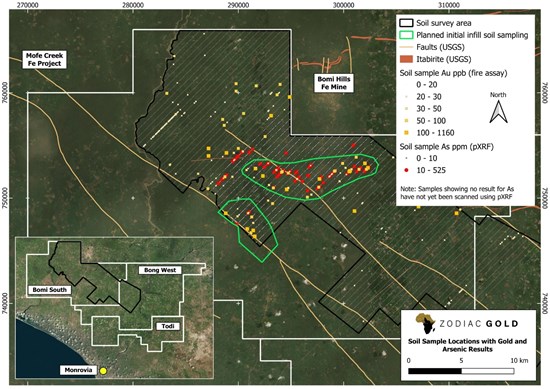
Figure 1: Gold and arsenic anomalism and location map
To view an enhanced version of this graphic, please visit:
https://images.newsfilecorp.com/files/7932/316213_13641461e439e9a0_002full.jpg
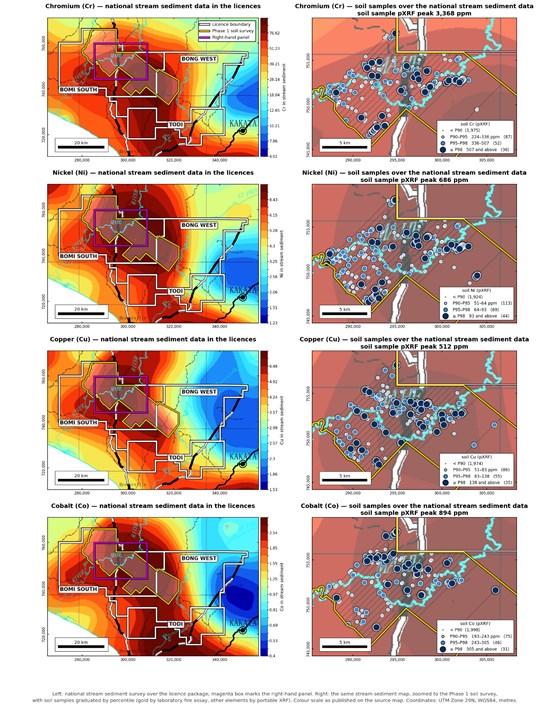
Figure 2: Chromium, nickel, copper, cobalt. Left - licenses and soil sample area on stream sediment anomaly maps. Right - soil sample pXRF data on stream sediment anomaly maps
To view an enhanced version of this graphic, please visit:
https://images.newsfilecorp.com/files/7932/316213_13641461e439e9a0_003full.jpg
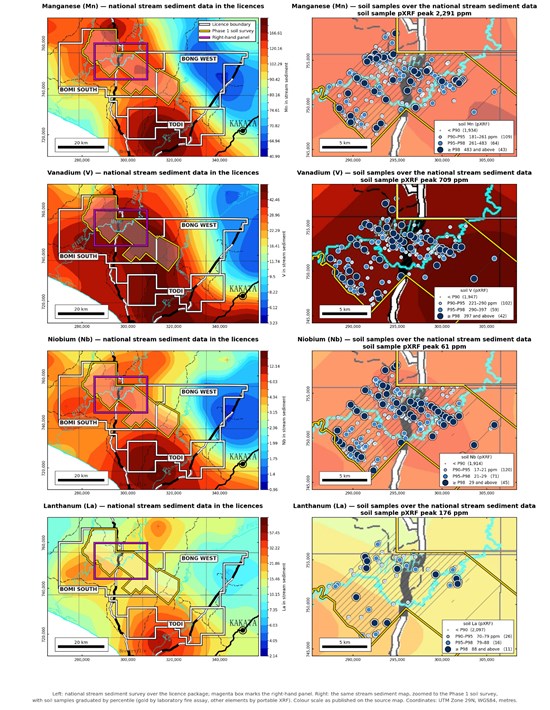
Figure 3: Manganese, vanadium, niobium, lanthanum. Left - licenses and soil sample area on stream sediment anomaly maps. Right - soil sample pXRF data on stream sediment anomaly maps
To view an enhanced version of this graphic, please visit:
https://images.newsfilecorp.com/files/7932/316213_13641461e439e9a0_004full.jpg
Next Steps
The Company plans to integrate these results with ongoing work at its Todi Gold Project - including the active 14,000-meter diamond drill program at the Arthington and Lewis sites along the Monterra Trend - and to prioritize the nickel-cobalt-chromium-copper and gold-arsenic trends identified here for follow-up infill soil sampling and geological mapping, with subsequent trenching and target definition depending on results.
Sampling and QA/QC
Planned soil sample locations were navigated to using a handheld GPS. On arrival, each site was assessed for potential sources of contamination and moved if necessary, and the actual location coordinates were recorded. Details such as land use, slope angle and direction, soil type, soil color, moisture content and depth of sample were recorded. A 50-60 cm hole was dug and approximately 2-3 kg of material from the bottom of the hole was placed in a plastic bag labeled with the sample number. Where it was not possible to dig to a depth of 50-60 cm, the sample was taken from as deep as possible and the actual depth was recorded. Equipment was cleaned between samples to avoid contamination.
Samples were submitted to Liberia Geochemical Services Inc. in Monrovia where they were dried and sieved using an 80 mesh (177 micron) sieve. Where necessary, clumps of material were broken down carefully using a pestle before sieving. Approximately 150 g (ranging from 120-170 g) of the sieved sample was bagged and labeled, with the remainder being returned to Zodiac Gold for pXRF scanning. Analysis was performed by 50g fire assay with an atomic absorption finish (method Au-AA24) at the ALS Geochemistry laboratory in Kumasi, Ghana. ALS Geochemistry is independent of Zodiac Gold and is accredited for method Au-AA24.
PXRF scanning was completed by Zodiac Gold's field team using an Evident Vanta Max XRF Analyzer. Each sieved sample is placed into a plastic sample cup and scanned with three beams for one minute each, with the analyzer secured in a field stand. Results of calibration samples are routinely checked during pXRF scanning. Note that a limitation of pXRF is the small sample size scanned, which can lead to biases in results where mineralization is not homogenous. The potential impact of this has been reduced by scanning sieved samples only.
Management cautions that soil geochemical and pXRF results are an early-stage exploration tool. Anomalous concentrations in near-surface soil are not necessarily indicative or proportional to the presence, grade, tonnage or depth extent of any underlying mineralization. The pXRF has not been calibrated against laboratory soil sample data and results are considered semi-quantitative, with the purpose of assisting with exploration targeting only. The Company intends to submit a proportion of the samples for multielement analysis for calibration purposes and will also follow up on these anomalies with infill soil sampling, geological mapping, trenching and/or additional systematic sampling, with drill targeting to follow where warranted. Information on the national stream sediment survey can be obtained through Liberia's Ministry of Mines and Energy.
Qualified Person
Tom Dowrick, Director of Exploration at Zodiac Gold, is a Chartered Geologist of the Geological Society of London and a Qualified Person as defined by NI 43-101. He has reviewed and approved the technical and scientific information contained in this release.
About Zodiac Gold
Zodiac Gold Inc. (TSXV: ZAU) (OTCQB: ZAUIF) (FSE: K19) is a West African gold exploration company focused on its flagship Todi Gold Project in Liberia - an underexplored, politically stable, mining-friendly jurisdiction hosting several large-scale gold and iron ore deposits. Strategically positioned along the fertile Todi Shear Zone, Zodiac Gold is developing a district-scale gold opportunity with additional iron ore potential, covering a vast 2,316 km² land package. The Todi Gold Project has undergone de-risking, showcasing proven gold occurrences at both surface and depth, with five drill-ready targets, four of which have been drilled, delivering high-grade gold intercepts.
Forward-Looking Information
This news release includes certain "forward-looking statements" within the meaning of Canadian securities legislation.
Forward-looking statements include predictions, projections, and forecasts and are often, but not always, identified by the use of words such as "seek", "anticipate", "believe", "plan", "estimate", "forecast", "expect", "potential", "project", "target", "schedule", "budget" and "intend" and statements that an event or result "may", "will", "should", "could" or "might" occur or be achieved and other similar expressions and includes the negatives thereof. All statements other than statements of historical fact included in this release, including, without limitation, statements regarding the Company's planned exploration programs and drill programs and the potential significance of results, are forward-looking statements that involve various risks and uncertainties. There can be no assurance that such statements will prove to be accurate, and actual results and future events could differ materially from those anticipated in such statements. Forward-looking statements are based on a number of material factors and assumptions. Important factors that could cause actual results to differ materially from the Company's expectations include actual exploration results, changes in project parameters as plans continue to be refined, results of future resource estimates, future metal prices, availability of capital and financing on acceptable terms, general economic, market or business conditions, uninsured risks, regulatory changes, defects in title, availability of personnel, materials and equipment on a timely basis, accidents or equipment breakdowns, delays in receiving government approvals, unanticipated environmental impacts on operations and costs to remedy same, and other exploration or other risks detailed herein and from time to time in the filings made by the Company with securities regulators. Although the Company has attempted to identify important factors that could cause actual actions, events, or results to differ from those described in forward-looking statements, there may be other factors that cause such actions, events, or results to differ materially from those anticipated. There can be no assurance that forward-looking statements will prove to be accurate, and accordingly readers are cautioned not to place undue reliance on forward-looking statements.
Neither TSX Venture Exchange nor its Regulation Services Provider (as that term is defined in the policies of the TSX Venture Exchange) accepts responsibility for the adequacy or accuracy of this release.
To view the source version of this press release, please visit https://www.newsfilecorp.com/release/316213

© 2026 Canjex Publishing Ltd. All rights reserved.